
Subscribe now and watch my free trend following VIDEO.

A Debate on Trend Following

A recent email exchange:

Name: Reading “The Talent Code” by Daniel Coyle. A superb book, I wonder if you know it. On the subject of TF may I also suggest you to consider a podcast with Gary Anderson (The Janus Factor). His work is superb because he has developed a way on knowing when to use tf tools or when to be a mean reverting contrarian. We know that TF does not always work: to know WHEN it offer a different edge. I really believe you should talk with him.

Covel: So all those drawdowns taken by some very smart and successful TFs over the decades were all in vane? They could have avoided them all by switching out at the exact right time to another strategy?

Name: Not 100% but to a certain extent it would seem so. Before you dismiss the idea, have a look at his papers / work. You can measure momentum for leaders and laggards separately; then you calculate the spread in relative performance, some sort of relative strength between 2 equity lines: one for a portfolio with only leaders and one with only laggards. Say from the universe of all commodities you look at the top 20% and bottom 20%. TF has its own cycles, they are not of fixed length clearly but its feature, positive feedback, can be measured. This is another level of analysis not seen in the Turtle work: having a plan, having a broad universe of asset classes, normalizing risk, adjusting risk is all a way to mitigate the inherent volatility of trend following. Anderson’s work has, so far, since 2003, limited to stock but there is no reason not to apply to commodities. Consider this: TF works like a peach until it breaks, then it starts to work again. Maybe the WHY cannot be explained but the WHEN, in reasonable terms, can be calculated, plotted and, possibly, integrated in a TF portfolio. Can you remember how from March 2009 the market has gone up overall but it was led by the laggards? Applying TF to stocks would not have generated good profits or even losses (what I call a “dirty” trend, where reversals are deep and costly for TF). Nowhere in the TF work I have done I have seen this interesting concept. Food for thought.

Covel: At first blush if tomorrow can’t be predicted the idea of a money making system that shifts gears such as you propose … would be novel. I would wonder why all the big names over the years have not been available to invent such a fool proof system? And beyond academic efforts, does a track record exist to show this bi-polar trading system in action?

Name: I am working to see if there is a way to use this “technology”. Tomorrow cannot predicted but you can reasonably sure that it is not going to go very far from where you are. There is a gradual transition from TF to MR and that can be measured – the HOW one implements the idea is another matter. Anderson has been working on stocks. No there is no track record.Consider this: work on relative strength goes back to the 60s with Levi’s paper. Only now there is widespread acceptance of momentum. It took ages to dismantle the idea of EMH. Anderson is trying to show / describe why and when TF (momentum) is “shape shifting”. It is a fascinating subject. And Levi’s work was snubbed from academia if you remember. Original ideas take time to establish, to be accepted. In any environment. You are showing yourself that TF works with numbers and yet very few out there are adopting it. It is what someone called one of those “mysteries of life”.

Covel: Good luck here. I would read Taleb’s work, consult with TFs who have come before us, objectively analyze why TF works, and maybe not try to reinvent the wheel.

Name: First I did not say that one could exactly know when to switch from TF to MR. There is of course some lag but what is interesting, is the persistence of a particular “state” until it changes again. I cannot say that TF drawdowns were in “vane” because either they recognized the problem and accepted to go with it anyway by sticking with their strategy no matter what (a-la Dunn) or they have tried to reduce the impact of the rotation between positive and negative feedback by adjusting risk and market exposure by calculating correlation coefficients to change the mix. Also adding more and more markets, reducing exposure when all the markets are working too much too nicely (a sign that risk has gone up too much), or simply by decreasing risk during drawdowns. ALL these methods address the problem from a different point of view without necessarily asking the question: is TF working NOW, is there a way to see if the lack of performance in leaders and laggards from a TF can be distilled in an indicator to warn… I have added some of his work available on internet for you to see and ponder. It’s your call.

Covel: What is the problem? The idea of a drawdown is the problem? Losing any money is the problem? What do you mean by “impact of rotation between positive and negative feedback”? A loss? BTW Connie Brown dodged my podcast. MTA really needs to clean up the hocus pocus on the train!

Name: I agree with that 150% – you know I dislike “normal” TA. But it is YOUR fault! You are going to someone that a.) is not systematic, b.) she uses EWaves, c.) she makes “calls”. Basically your are asking the right questions to the wrong person. Unless you are deliberately an agent provocateur with technicians. My humble suggestion is to interview those technicians that are systematic like Kirkpatrick. Connie Brown is the exact opposite. But you already knew that.

Covel: Yeah, but if the people in MTA let that nonsense in, on their boards, etc. — what value is CMT/MTA?

Addendum for everyone: Yes, that last sentence may be controversial, but tell me how my thought goes in the wrong direction?

Related Content

Next Level thinking by Faulkner

Fascinating Work

Mark Kritzman Interview

A Fresh Start

Morgan Stanley Hit and Run


How can you move forward immediately to Trend Following profits? My books and my Flagship Course and Systems are trusted options by clients in 70+ countries.

Also jump in:

Trend Following Podcast Guests
Frequently Asked Questions
Performance
Research
Markets to Trade
Crisis Times
Trading Technology
About Us

Trend Following is for beginners, students and pros in all countries. This is not day trading 5-minute bars, prediction or analyzing fundamentals–it’s Trend Following.

Not My Trend Following Role

Feedback in:

Hi, my name is [name] I have just discovered your books on trend following and I am a trend follower myself. I am currently trying to look for registered investment advisers who use your trend following approach and I was wondering if you had any names of people. It seems like the ones that you have in your books are people who invest more in commodities and futures. I am looking for someone who is more into equities, bonds, that sort of thing. If you could give me a call back I would greatly appreciate it. Thanks.

No leads. Not my role. Bottom line, trend following is a strategy. In that strategic spectrum there are traders employing trend following across stocks, futures, commodities, etc.


How can you move forward immediately to Trend Following profits? My books and my Flagship Course and Systems are trusted options by clients in 70+ countries.

Also jump in:

Trend Following Podcast Guests
Frequently Asked Questions
Performance
Research
Markets to Trade
Crisis Times
Trading Technology
About Us

Trend Following is for beginners, students and pros in all countries. This is not day trading 5-minute bars, prediction or analyzing fundamentals–it’s Trend Following.

Ep. 152: Dan Andrews Interview with Michael Covel on Trend Following Radio

Dan Andrews
Dan Andrews

My guest today is Dan Andrews, the founder of The Lifestyle Business podcast. He is the host of the Tropical MBA.

The topic is entrepreneurship, travel and lifestyle.

In this episode of Trend Following Radio we discuss:

  • Location independence
  • Optimizing for time and mobility
  • Andrews’ beginnings as a teenager to where he is today
  • Artists and entrepreneurs
  • Andrews’ beginnings
  • How being in an entirely different atmosphere can bring out your creativity
  • How Paris in the 1920’s relates to the creative explosion in Asia
  • The importance of having a blog and telling your story
  • Why people need stories and ideas to follow
  • Telling a story with your business
  • The importance of “starting” and the iterative process
  • Your brand, and the nature of how you interact with people
  • Thinking you know how to “do it” before you know how the “soup” is made
  • How hard work means so much more than talent
  • Self-control, self-discipline
  • “Failing forward” and getting used to taking emotional risks
  • Hyper-globalization of small businesses
  • The revolution of podcasting
  • Distractions, laziness, and doing an inventory on your time

Listen to this episode:

Jump in!

Breaking Trend Following Into China

Feedback:

Hi Mike, I was speaking to [name] the other day who is the C.O.O. for [billion plus fund] in Hong Kong. He expressed interest in finding more info about marketing CTAs [trend following] in mainland China and thought that after all your travels you may have some good insight to give him. Would it be OK if I passed him your contact details to send you over some questions? No problem at all if you would rather not.

[name]

Sure.


How can you move forward immediately to Trend Following profits? My books and my Flagship Course and Systems are trusted options by clients in 70+ countries.

Also jump in:

Trend Following Podcast Guests
Frequently Asked Questions
Performance
Research
Markets to Trade
Crisis Times
Trading Technology
About Us

Trend Following is for beginners, students and pros in all countries. This is not day trading 5-minute bars, prediction or analyzing fundamentals–it’s Trend Following.

Backslapping at CNBC: The True Path to Wealth! Not.

Feedback in:

Hi Michael. Keep up the great work and the podcasts. Love ’em. I haven’t emailed you (as former customer) for years BUT I thought of you when I read this (ignore the website, it’s only ever bearish, but the CNBC clip attached is hilarious!). Why is it so funny? Because after Fed minutes the market tanked, then CNBC talking heads apparently said to buy it, then it rallied, then they came on TV and all gave themselves high fives for “nailing” such a great call as it went unchanged. But in the last half hour it tanked and I don’t think they told the viewers they’re retracting their high fives! One of the good things about trading in Australia is that you can sleep thru the BS because the NYSE closes at 6am, so we wake up to the only thing that really matters; the closing price!

May the trend be your friend,
Rob Lederer

Thanks Rob!

More.


How can you move forward immediately to Trend Following profits? My books and my Flagship Course and Systems are trusted options by clients in 70+ countries.

Also jump in:

Trend Following Podcast Guests
Frequently Asked Questions
Performance
Research
Markets to Trade
Crisis Times
Trading Technology
About Us

Trend Following is for beginners, students and pros in all countries. This is not day trading 5-minute bars, prediction or analyzing fundamentals–it’s Trend Following.

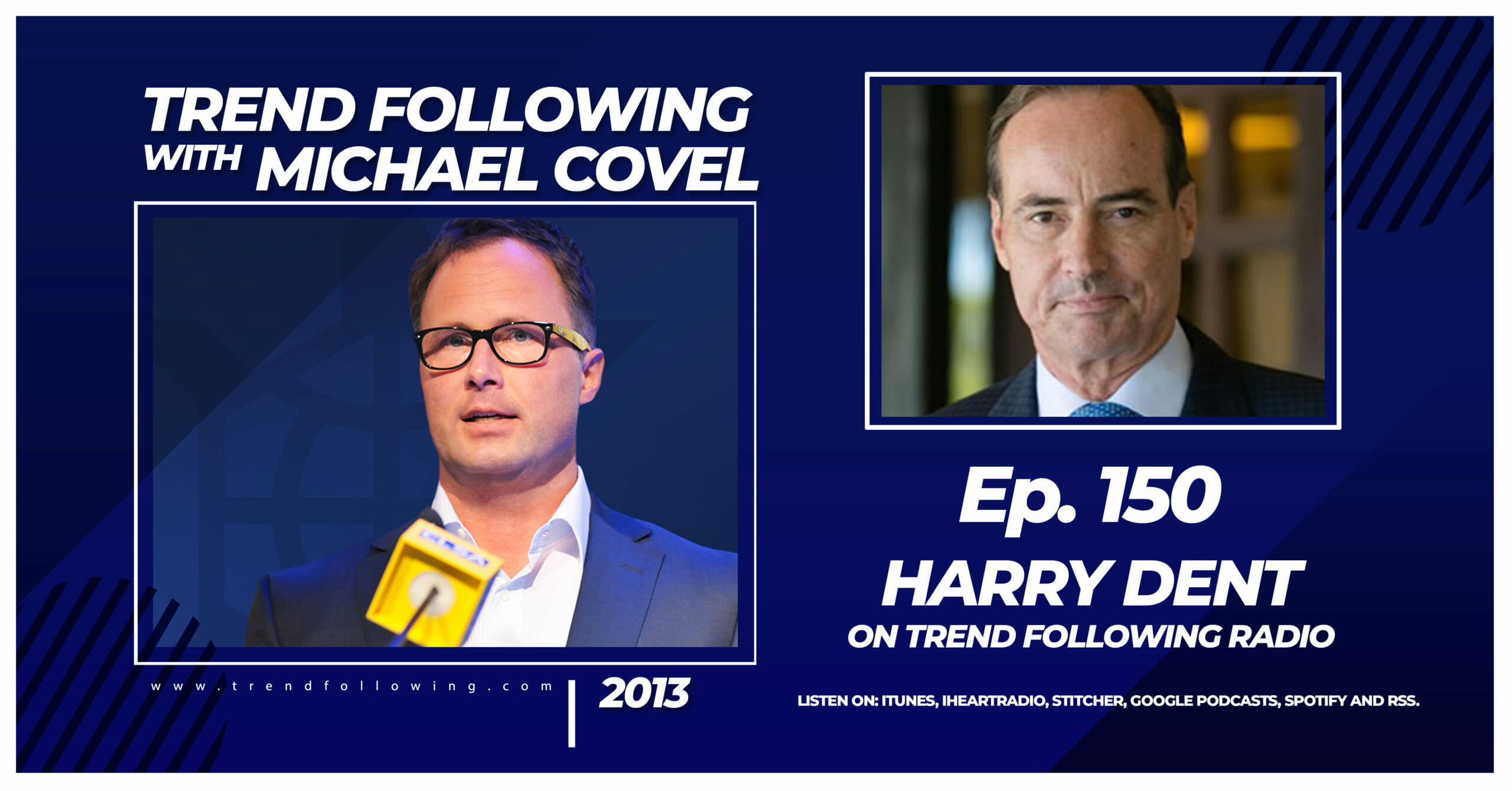
Ep. 150: Harry Dent Interview with Michael Covel on Trend Following Radio

Harry Dent
Harry Dent

My guest today is Harry Dent, a best-selling author and one of the most outspoken financial editors in America.  Using proprietary research, Harry developed a unique method for studying economies around the world, and uses his analysis to provide insights on what to expect in the future.

The topic is his book Demographic Trends in Real Estate.

In this episode of Trend Following Radio we discuss:

  • How demographics and consumer spending help to determine what might happen tomorrow
  • “The demographic clip”
  • “Die-ers vs. buyers”
  • What happens when a smaller generation follows a larger one
  • Zero interest rate policy and asset prices
  • Inflation
  • How the government keeps the bubble inflated
  • Comparisons to Japan
  • The forced spending of principal
  • Whether we’ve lost the ability to have a conversation about the morals of our current policies
  • Real estate speculation
  • How we’ve lost direction on the idea of “resets”
  • The boom-bust cycle
  • The importance of failure
  • “Coma” economies
  • Early retirement, and why you can’t retire at 65
  • Public employee pensions
  • Why we ultimately need a crisis to secure our future

Listen to this episode:

Jump in!

Two Simple Guildelines to Follow When Trading For Others

Feedback:

Hey Michael, I’ve finally gotten to the point of developing programming models that show high rates of return over time using EMA crossover systems, I’m curious what advice you have going forward in terms of potentially getting into the industry professionally.

Make money.

And find clients who like what you do. Anything more than that is inefficient.


How can you move forward immediately to Trend Following profits? My books and my Flagship Course and Systems are trusted options by clients in 70+ countries.

Also jump in:

Trend Following Podcast Guests
Frequently Asked Questions
Performance
Research
Markets to Trade
Crisis Times
Trading Technology
About Us

Trend Following is for beginners, students and pros in all countries. This is not day trading 5-minute bars, prediction or analyzing fundamentals–it’s Trend Following.