Subscribe now and watch my free trend following VIDEO.

Ep. 118: Trend Following in China with Michael Covel on Trend Following Radio

Trend Following in China with Michael Covel on Trend Following Radio

Please enjoy my monologue The Trends of China with Michael Covel on Trend Following Radio. This episode may also include great outside guests from my archive.

Listen to this episode:

Want to learn more Trend Following? Watch my video here.

Listen to my interview with Jed Rothstein creator of the China Hustle Film here.

The Fundamentalist Trucker

Feedback in:

Hey there Mike. Today’s market moves (The collapse of Gold in particular) reminded me of a disagreement I recently had with a truck driver I happened to cross paths with. We ended up discussing the markets and he mentioned that he happened to recently come into a ton of money. He starts telling me all the reasons why the metals is the place to go. I never revealed to him that I have experience as a trader and I happen to watch many many markets on a daily basis. I knew that what he was saying was nonsense because I knew by heart the approximate price of Gold and that it was in a steady downtrend. When I explained this to him, he rudely corrected me and told me that actually Silver is the place to put your money. I then informed him that Silver and Gold are highly correlated markets and that the two move almost in tandem. When Gold goes down, Silver usually goes with it. He then rudely corrected me again, adding in that “he has actually had schooling on these matters” thinking that that would shut me up because he “knows what he’s talking about”. I then told him that if he has had financially schooling then he should well know that the two markets are highly correlated and that any school that teaches fundamental investing will teach you that the long term [buy and hold] track record for the metals is horrific. I then told him that if I were to pull up a chart of Silver and another of Gold and put them side by side covering the names and prices, I bet he couldn’t even tell me which was which because they look nearly identical. Anyway Mike I just wanted to share that story with you to illustrate the difference between the fundamentalist mentality and mentality of traders and even aspiring traders. The fundamentalist trucker is still thinking about the meteoric rise in the metals in the past and is now riding it into the dirt. Traders on the other hand already made our money on the rise, and now we are all short and trying to determine whether we should cover on today’s break or move our stop down and lock in some profits or add to our current positions. When will the fundamentalists learn Mike?

Thanks! They won’t learn. Guaranteed.


How can you move forward immediately to Trend Following profits? My books and my Flagship Course and Systems are trusted options by clients in 70+ countries.

Also jump in:

Trend Following Podcast Guests
Frequently Asked Questions
Performance
Research
Markets to Trade
Crisis Times
Trading Technology
About Us

Trend Following is for beginners, students and pros in all countries. This is not day trading 5-minute bars, prediction or analyzing fundamentals–it’s Trend Following.

The Journey of Turtle Trader Liz Cheval Took to Make Her Fortune

From Attain Capital Management:

In many ways, it can all come down to one decision- one choice in one moment that crystallizes a path in front of you. That path is rarely straight and often difficult to navigate, but once that moment has come and gone, the rest- as they say- is history. For Liz Cheval, chairwoman of the close to $150 million managed futures program EMC, that decision was the choice to respond to Richard Dennis’ famed turtle trader ad.

The story of the turtle traders [see my book The Complete TurtleTrader for more] is pretty fantastic in and of itself. Two renowned traders disagree. One says that what they do is unique, while another says that he could train anyone to trade. They make a wager on the issue, an ad is placed in the paper, and the lives of 20 students would never be the same. As the only female selected for the program, Cheval’s life was turned upside down.

After receiving a degree in mathematics from Lawrence University in Appleton, Wisconsin, Ms. Cheval was working as a trade clerk at the Chicago Board of Trade when Mr. Dennis placed his ad in the paper. At the time, women were few and far between in the famed Chicago trading pits. To hear her explain it, it was largely a function of physique.

“When I started on the floor of the CBOT in the early 1980’s… It was difficult for women to compete, given the physical demands of pit trading and the advantages of a larger, heavier frame,” she recalls.

It was on the floor that Cheval found herself drawn to Dennis’ offer. The excitement in the pits over the opportunity was palpable, as resumes were quickly refreshed and rushed to the mail. Cheval found herself being pushed to apply as well, even by those competing against her for a slot (including her employer). When called into an interview, she began to think that maybe she was missing something.

“As I approached the interview, I thought the opportunity with C&D was literally too good to be true,” she explains. “I simply couldn’t believe that a world renowned trader would teach us his methods and give us his private capital to trade. I assumed that there would be a catch, another story revealed at the interview.”

It turned out that the interview was simply the opportunity of the lifetime.

“It was not until the end of the interview, as Mr. Dennis’ top executive explained the nature and the details of the program that I began to believe it was the real deal,” Cheval recounts. “At that point, I became overwhelmed. My throat went dry. My legs were shaking. I could barely walk out of the room. If I understood the true nature of the program at the beginning, I would not have been as collected during the interview and would not have been selected. ”

Being selected may have been the easy part. After the interview began a rigorous amount of training, and the competition was fierce.

“The group was extremely competitive. The dynamic was open, above-board and collegial, but no doubt, everybody wanted to win,” Cheval states.

Even as the only woman in the group, Cheval found herself seamlessly blending into the adrenaline fueled atmosphere. The experience, by and large, was a positive one. She was able to earn the respect of her peers, and believes that working in a group of professional, competitive men helped prime her for professional challenges in the future.

When the training was done, it was time to hit the pavement running. The turtles were hungry to spread their wings and test their mettle. Cheval remembers making phone calls upon completion of the program, trying to gauge the level of interest for outside investors. That former employer who had encouraged her to apply? He became EMC’s first client, investing $1 million.

While it certainly has not been a bed of roses, Cheval has done very well for herself. EMC , which she runs with former turtle Brian Proctor, now has $148.75 million in assets under management, and is as well respected in the industry as you can get, in our opinion. She credits the nuanced strategies involved in managed futures with keeping her in the game. Even with this success, Cheval knows that you need to keep pushing to make it in this industry.

“The ability to adapt to change is the key to long term success in trading. It’s relatively easy to develop a profitable trading strategy over a short time frame. It’s far more challenging to develop a reliable method to continually adapt the strategy to future market conditions,” Cheval states.

Adaptation is especially important in an environment like what is seen today. Managed futures seems to be perpetually under attack by mainstream media pundits and financial advisors, with the bulk of comment being directed toward “greedy speculators.” This misconception, paired with investor frustration over a divergent return stream and increasing government intervention in the markets, can complicate the managed futures conversation, but Cheval is up to the task. In her mind, the theory of the game makes the challenge all the more worthwhile.

Her experience in the industry has granted her a great deal of perspective, and she’s more than willing to share it. The secret to becoming a successful CTA? She’s not keeping mum.

“You need both a successful trading strategy and, more importantly, a reliable method to adapt the strategy to future market conditions. A successful trading strategy requires robust systems and sound risk management principles. The trading strategy is only as good as your research process. You have to identify robust estimators and develop a process to continually adapt the systems based on these reliable estimators,” Cheval says. “You have to be disciplined in executing both trading and research strategies, in good periods and bad. A CTA has to be committed to their strategy whether it is in or out of favor.”

And for all you women out there thinking about entering the field?

“Over the years I encouraged women to manage money because I believed it to be a gender neutral occupation. No one can dispute your contribution based on gender in investment management. Your performance is there in black and white in the P&L report,” states Cheval.

“Go for it. Today the physical advantage of men [in the trading pits] is inconsequential because trading is virtually 100% electronic. I give the same advice to both men and women seeking entry level jobs in managed futures. Technical skills are mandatory. Great thinkers and idea creators need technical applications to test and execute trading strategies. Having those skills is a great way to gain entry or to build your own business.”

However, in our conversations with Cheval, it was her comments on the future of the industry that resonated with us most.

“Money centers will shift, performance will change, but overall, global markets are large and expansive,” she quipped. “Markets and managers will adapt.”

We couldn’t agree more.

Unfortunately, Liz Cheval recently passed away, but her success lives on.

Related Podcasts and Articles:

Trend Following Forward by Charles Faulkner

Lobster Logic

Interview with Brennan Dunn

Learning Trading Mechanics

Trend Follower Cliff Asness


How can you move forward immediately to Trend Following profits? My books and my Flagship Course and Systems are trusted options by clients in 70+ countries.

Also jump in:

Trend Following Podcast Guests
Frequently Asked Questions
Performance
Research
Markets to Trade
Crisis Times
Trading Technology
About Us

Trend Following is for beginners, students and pros in all countries. This is not day trading 5-minute bars, prediction or analyzing fundamentals–it’s Trend Following.

Practice, Patience and Perseverance

Trend Following is a lifestyle. It is a way of thinking, acting and doing. It does take determination, however. It isn’t easy to make money from the markets, just as it isn’t easy to become an Olympic athlete. Think of all the factors about yourself that would need to be altered if you were to train for the Olympics. Your diet, fitness routine, coaches, psychology and so much more would have to be worked on tirelessly to make it to the top. Your whole lifestyle and way of being would need shift. You would have to put the time in.

Now lets put that into trend following terms. You cant expect to read only a book (even though mine are a great first step), with no work on your end, and magically make millions in the markets. If it were that easy everyone would be making the big money. It takes practice, patience and perseverance. You can memorize algorithms or imagine the “perfect” system all you want, but until you master your psyche you will never reach your full potential. This is why Charles Faulkner (listen) has been on my podcast three times and is easily one of the most popular guests.


How can you move forward immediately to Trend Following profits? My books and my Flagship Course and Systems are trusted options by clients in 70+ countries.

Also jump in:

Trend Following Podcast Guests
Frequently Asked Questions
Performance
Research
Markets to Trade
Crisis Times
Trading Technology
About Us

Trend Following is for beginners, students and pros in all countries. This is not day trading 5-minute bars, prediction or analyzing fundamentals–it’s Trend Following.

A Look at Momentum Investing: Does it Work?

From Alex Brown at Morningstar:

You should be skeptical of anyone who claims to be able to predict the future from the past. If it were so easy to beat the market using past returns, everyone would exploit that relationship until it is arbitraged away. The momentum effect violates that principle. Momentum is based on the premise that securities that have recently outperformed will continue to do so in the short run, and those that have underperformed will continue to lag. While practitioners have been exploiting this relationship for decades, the idea has gained broad acceptance in the academic community only within the past 20 years. Momentum runs counter to the predictions of the efficient market hypothesis, but the evidence is too overwhelming to ignore.

Jegadeesh and Titman published one of the first influential studies on momentum in 1993, “Returns to Buying Winners and Selling Losers: Implications for Stock Market Efficiency.” They found that U.S. stocks with the best performance over the past three-12 months continued to outperform the worst-performing stocks over the next year, using data from 1965 to 1989. Subsequent research found that the momentum effect was also present in the U.S. before and after this original sample, which suggests that the effect was not simply the product of data mining. Generally any momentum signal between six and 12 months worked, though there tends to be a short-term reversal at one month. It has become convention among many researchers to study the momentum effect using stock returns over a trailing 12-month period, excluding the most recent month. However, the results are robust and do not depend on this particular definition.

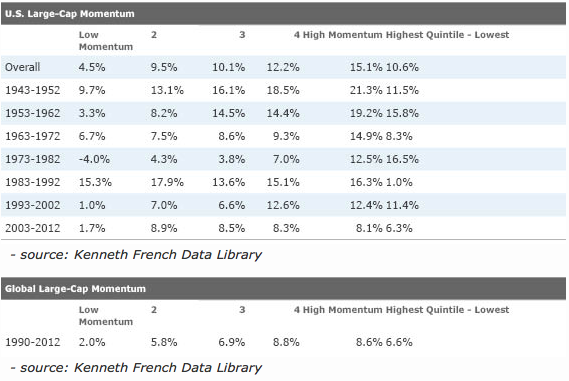
Momentum is pervasive. Many studies have extended this evidence to foreign stocks, commodities, currencies, and bonds. Momentum even works across individual asset classes and country stock indexes. Even efficient market advocates Eugene Fama and Kenneth French found the momentum effect in every stock market they studied, except Japan (see “Size, Value, and Momentum in International Stock Returns”). The tables below illustrate the momentum effect among large-cap U.S. and global stocks. Each column represents a fifth of the total number of stocks in the sample, which are ranked by their momentum. While there is not a linear relationship between the momentum quintiles, stocks with the highest momentum consistently outperform those in the lowest momentum quintile. Small-cap stocks tend to exhibit a stronger momentum effect. However, they can be more expensive to trade.

This evidence creates a puzzle. If the market were efficient, a simple trading rule should not produce superior returns. Arbitrage is a powerful force that should eliminate any excess profits, and yet, momentum has persisted 20 years after it was first widely published. Perhaps more troubling to disciples of Ben Graham and Warren Buffett, momentum appears to be at odds with decades of research, which suggest that stocks trading at low valuations tend to outperform.

Explanations
Behavioral finance offers the best explanation for the momentum effect. Those in this camp assert that investors tend to anchor their beliefs and are slow to update their views in response to new information. For instance, event studies have demonstrated that stocks that beat earnings expectations tend to offer excess returns for many weeks after the announcement. Similarly, stocks that miss expectations tend to continue to underperform. Behavioral finance research also suggests that many investors engage in irrational mental accounting, which may further contribute to this market underreaction. According to this view, investors are reluctant to sell losers in the hope of breaking even and quick to sell winners in order to lock in gains. This irrational behavior may prevent stocks from quickly adjusting to new information. Once a trend is established, investors may pile onto a trade and over extrapolate recent results, pushing prices away from their fair values, which may explain the long-term reversals underlying the value effect (the tendency for stocks trading at low valuations to outperform).

Momentum is consistent with the value premium and may even contribute to it. While momentum tends to persist in the short term (performance over the past six-12 months continues over the next few months), stocks that have been beaten down over the past three to five years tend to do better than their counterparts that outperformed over that horizon. Where this value effect allows investors to profit from the market’s pessimism, momentum allows investors to profit from its optimism. In their paper, “Value and Momentum Everywhere,” Asness, Moskowitz, and Pedersen found that momentum worked well when value didn’t, and vice versa. Because they are two sides of the same coin, each with excess returns, combining value and momentum in a portfolio can offer powerful diversification benefits.

Risks
Although momentum looks good on paper, these strategies require high turnover, often in excess of 100%, in order to work. That can create high transaction costs that may erode profits. Additionally, momentum does not work well when volatility spikes. Consequently, the strategy can underperform when it is most painful. For instance, momentum significantly underperformed during the 2008 global financial crisis. Unlike value strategies where lower valuations predict better long-run returns, it is difficult to gauge when momentum is likely to outperform. This risk may limit arbitrage and allow momentum to persist. In fact, there are only a handful of pure momentum funds available to most investors.

Recommendations
While a diversified and systematic momentum strategy can offer a powerful way to enhance returns, selecting a few stocks on the 52-week high list is a very bad idea. It is difficult to anticipate when a run will end and there may be no greater fool to bail you out. Although momentum is a short-term phenomenon, it is best suited for long-term investors. It won’t always work, but there’s a good chance that a disciplined momentum strategy will continue to outperform over the long term. After all, investor behavior won’t change overnight.

AQR Momentum (AMOMX), AQR Small Cap Momentum (ASMOX), and AQR International Momentum (AIMOX) offer investors an effective way to harness momentum. Each of these funds invests in stocks representing the third of their respective market segments with the highest momentum. AQR balances transaction costs against momentum when deciding whether to trade, which helps rein in expenses. However, because these funds have high turnover, they are most suitable for tax sheltered (retirement) accounts. While the $5 million minimum investment may seem a little steep, there is no minimum for investors who gain access to these funds through a financial advisor.

PowerShares DWA Technical Leaders (PDP) may be a suitable alternative for investors who do not have a financial advisor. This fund targets 100 stocks with the best performance from a broad universe of U.S. large- and mid-cap stocks, and weights them according to their relative strength (a form of momentum). In order to reduce turnover, PDP rebalances only quarterly, which can hurt its performance when the market is choppy.

Combining Value and Momentum
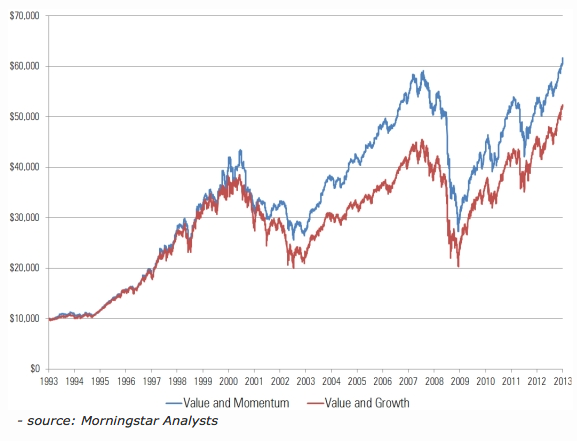
It’s not necessary, or advisable, to abandon value investing to benefit from momentum. Instead, momentum may be a good substitute for investors’ growth allocations. Momentum offers higher expected returns than growth and tends to be less correlated with value. The chart below compares the performance of a portfolio consisting equal weights in the Russell 1000 Value and Growth indexes, with a portfolio that replaces the growth allocation with the AQR Momentum Index. The two portfolios have similar volatility, but the value and momentum portfolio offers slightly better absolute and risk-adjusted returns.

Read original article here.

Recommended Trend Following Podcast Episodes and Articles: Babe Ruth Effect, History of Trend Following Stocks, Making Money Every Month Trading, Momentum Chasing, and Barbara Fredrickson Interview.


How can you move forward immediately to Trend Following profits? My books and my Flagship Course and Systems are trusted options by clients in 70+ countries.

Also jump in:

Trend Following Podcast Guests
Frequently Asked Questions
Performance
Research
Markets to Trade
Crisis Times
Trading Technology
About Us

Trend Following is for beginners, students and pros in all countries. This is not day trading 5-minute bars, prediction or analyzing fundamentals–it’s Trend Following.

Ep. 116: Jerry Parker Interview with Michael Covel on Trend Following Radio

Jerry Parker
Jerry Parker

My guest today is Jerry Parker. In 1983, Parker was accepted into the Turtle Program, a select investment training program developed by successful Chicago portfolio manager Richard Dennis. He appears in Covel’s “The Complete TurtleTrader” and has been the most successful TurtleTrader. Parker founded Chesapeake Capital Corporation, a global investment manager headquartered in Richmond, Virginia, in 1988.

The topic is Trend Following. 

In this episode of Trend Following Radio we discuss:

  • Mistake of combining different strategies with trend following, and the importance of having a concentrated strategy that you can rely on
  • How discretionary moves can get in the way of your system, and “systematized discretion”
  • The psychological effect of following a trend following strategy for decades
  • The idea of going for positive expected value over what’s least risky
  • Why Parker doesn’t like to use the term “managed futures”, and why it doesn’t really tell the story of trend followers
  • Trend followers performing well at different points in time compared to long-only
  • Using trend following as another strategy for investors who only invest through a long-only value-based system
  • The importance of not letting your views on politics and society influence your trading, and maintaining a systematic and disciplined approach
  • The growth of news media since 1984, information overflow, limiting your variables, and using price as your primary indicator
  • How Parker has learned over the years to deal with drawdowns, loving your losses, and the importance the Turtle program played in his education on drawdowns
  • Why governments are the ultimate counter-trend traders
  • Why buy and hold is not a good place to be even if people are saying it’s turned around
  • Parker’s stock-only trend following program, and why the diversified program will do better than the stock-only system
  • Leverage as a tool

Listen to this episode:

Jump in!

Don’t Offend Day Trading!

Feedback in:

Hi Mike, Just listened to your last podcast. Thanks for doing the podcasts while you are on the road! Trading is a solitary activity, I have not found any other trend following traders locally. I find people just want to discuss fundamentals and sentiment and predictions. No good for the business of non-discretionary trading. So I find listening to your interviews balances that, almost like having access to mentors. I’m always looking forward to the next interview. The monologue episodes are sometimes puzzling however, particularly your negative comments aimed at various groups. This time it was daytraders. I am not a daytrader and don’t want to be, its not my style, but I do know people who earn good profits daytrading. But why should you or I care if they have their eyes glued to the screen, its their own choice and it doesn’t effect us. I’m assuming your long term aim is marketing your stuff (an honorable objective, all credit to you for that), but is talking down to potential customers really effective? Also something confused me with your logic today, you make the assumption that any historic data correlated with trend following, must therefore also be derived from trend following. But could daytrading profits also be correlated? eg. Oct 2008 trend following was profitable, but surely daytraders would also be short as markets were consistently directional downwards, so they would also be profitable from the high volatility. My logic might be wrong, let me know. By the way I’m a big fan of your books, and recommend them at every opportunity. Most of my foundation concepts came from reading “Trend Following” about 3 years ago, but I also liked “Trend Commandments” for clarifying the whole TF mentality.

Regards,
Mike B.

In my books are performance track records of trend following traders. Audits. Where are the day trading records like that? My passion is to take what I know and pass it along. Clearly, I am not the only one who shares that day trading view. You are aware of Ed Seykota? Why would potential customers be offended by my comments? Confused. Also, clarify your point about correlations? Not following that logic.

Hi Mike, Thanks for your reply. Why could they be offended? “They have personal issues they try to resolve by daytrading…” Did you mean that in a complimentary way? But I don’t disagree with your Ed Seykota quote about daytraders. My point about marketing is that getting a negative gut reaction from potential customers doesn’t usually result in them reaching for their wallets. Its not offensive to me, I’m not in that group. Personally I prefer to only make decisions once a day, and play more golf! This is how I see the relationship between trend following and daytrading. I view all market activity (all time frames) as driven by two character types, either momentum/TF or reversion-to-mean (RTM). The RTM guys include value investors, most analysts, and most media commentators. Any healthy market needs both TFs and RTMs, but each individual person can’t be both. In sideways markets you can’t tell the difference, but when prices are moving into new territory thats when the two types polarize. When price is making new highs/lows TFs want to be in the trend direction, and RTMs want to be opposite, and the trend stops only when RTMs overwhelm the TFs. But those same two drivers come into play when medium-term traders look at a daily chart, or when daytraders look at a 5-min chart. A daytrader can have a TF style (buying new highs, etc). The difference is the speed, the intensity, and higher probability of being knocked out by market noise. Anyway, you’ve been doing this much longer than me, I could be wrong. So thanks for letting me voice an opinion. Enjoy the rest of the weekend!

Cheers,
Mike
Calgary, Alberta

Thanks Mike for the thoughtful note, but let me be even more stark:

1. Day trading track records don’t appear to exist.
2. If a strategy is faulty, or doesn’t work, or there is no proof, why would you keep hoping for it to work or imagining it to work? Yes, that would lead to Ed Seykota’s conclusion about “issues” that they need to work on.


How can you move forward immediately to Trend Following profits? My books and my Flagship Course and Systems are trusted options by clients in 70+ countries.

Also jump in:

Trend Following Podcast Guests
Frequently Asked Questions
Performance
Research
Markets to Trade
Crisis Times
Trading Technology
About Us

Trend Following is for beginners, students and pros in all countries. This is not day trading 5-minute bars, prediction or analyzing fundamentals–it’s Trend Following.