NOTE: Go to http://www.managedfunds.org/forum2011 and register as a guest. Use the the code TRENDS250 and you can register for Hite/Seykota/Covel panel only — for $250.
Hi Michael, this is [name] from Kuala Lumpur, Malaysia. What is your take on Gold and soft commodities for the present year and where do you think the Dolllar is heading to? Warm Regards, [name]
Hi, are you familiar with my trend following research?
Yes i have read your books namely Trend Following and TurtleTrader. For a fact you go with the trend, but just wanted to know as to how you see these trends goin…
But I am a trend follower, not trend predictor! Trend followers don’t make predictions. Both my books emphatically say that. It’s not a joke!
I spent some time with Francisco Vaca a few years back in Florida. He offered a nice view on my book ‘The Complete TurtleTrader’:
“Regarding your new book [“The Complete TurtleTrader“], I can say that after hearing the turtle story many times from many of the people that are part of the story and after reading many articles about such story, this is by far the most entertaining, inspiring, extensive, and honest story of the turtles I have ever read.”
Vaca’s background? He currently is an associate with original Turtle Paul Rabar. How did he get started?
“…a friend…told me there was a job for a programmer at a commodity trading firm. He had thrown away the job ad, so I picked it out from the garbage! It turned out to be at C&D Commodities, which was co-founded by Richard Dennis of ‘turtle’ fame.”
That ‘find the ad in the garbage can’ was long after the original Turtle experiment. Read a recent article on Vaca (PDF).
BUY-AND-HOLD INVESTING is a loser, says Michael Covel, founder of Trend Following, one of several Websites devoted to the trading strategy of the same name.
“How many more decades can you go with negative returns?” he asks, referring to the disappointing aughts (www.trendfollowing.com). The unofficial chronicler of the 25-year-old active investing strategy, Covel claims that leading practitioners of trend following, like Boston Red Sox owner John William Henry, have collectively logged a 17.56% average annual return since 1984 compared with 7.37% for the Standard & Poor’s 500.
Trend following is grounded in the notion that a stock or sector in motion tends to stay in motion—until it stops. “Markets that break out are more likely to continue than to reverse direction,” maintains Covel. It’s equally applicable to short and long trades and to any class of asset—stocks, futures, currencies—with typical holding periods of a few weeks.
Trend following is similar to momentum investing, except that devotees studiously avoid using company fundamentals like revenue growth or positive earnings surprises as trade signals. The focus is entirely on price movement—although trend followers aren’t that enamored of charting or technical analysis, either. When a trend starts, most technical indicators turn in the same direction, says Covel.
THE KEY DIFFERENCE between trend following and most investment strategies is the lack of crystal-ball gazing. Trend followers make no attempt to forecast a trend’s duration, magnitude or key inflection points. Entry and exit triggers are decided at entry, and trend followers often arrive late to the party.
Its “buy high, sell higher” orientation smacks of the bigger-foolism that has tripped up so many investors, large and small. But trend followers don’t blindly chase bubbles. Their systems try to take the emotion out of investing through rules-based decisions, back-testing of trade theses and strict risk management.
A portfolio is usually spread across a dozen or more (hopefully) noncorrelated assets with tight trailing stops, which can be 2% or less below entry price. That means a high percentage of holdings can get stopped out in the search for a few home runs. Investors need a pre-defined fund allocation strategy that can withstand a losing streak.
“As many as 60% of initial bets will be wrong,” says Covel, “The biggest impediment to success is fear of failure.”
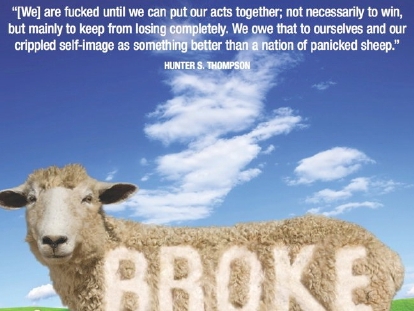
Glenn Beck (and his co-author Kevin Balfe) released a new book today (Oct 2010) titled Broke.
I happen to have a documentary film titled Broke released last year.
Once my film was completed it made the rounds to many potential distribution outlets. One outlet among many was Glenn Beck’s office (my film ended up premiering on The Documentary Channel). Beck’s co-author Kevin Balfe emailed me October 1, 2009 to say:
“I think you’ve produced an excellent documentary but it’s not a great fit for us at this time.”
Did not think too much of that as rejection is part of the business in a creative world. Easy come, easy go. However, a year later it was an interesting surprise to see Beck’s book ‘Broke’ announced in Aug 2010. My gut immediately said, “I know where they got that title from.”
Beck confirmed when his title changed (audio) in Sep 2010:
“This one started out last October [2009] as ‘The Plan’, but we decided to make it ‘Broke.'”
‘Broke’ was a great title for a film and it is interesting to see Beck change his book title due to my random 2008 moment of inspiration.
“Hi Michael, I’m sitting in a class on cognitive psychology and there is a term the professor has introduced called transductive reasoning. Here’s an example: A child hears a dog bark and then sees a train arrive. He concludes that the train comes because the dog barks. The professor told us that transductive reasoning is characteristic of children between 2 and 7 years of age. I think she could add economic and financial media blitz to her list.”
No matter what ‘price’ is the variable that the great traders have lived and died by for decades. Making trading decisions more complicated than the simple heuristic of ‘price’ has always been problematic. Eckhardt knew it was hard to do much better: “Pure price systems are close enough to the North Pole that any departure tends to bring you farther south.”