Subscribe now and watch my free trend following VIDEO.

Expectation Understanding

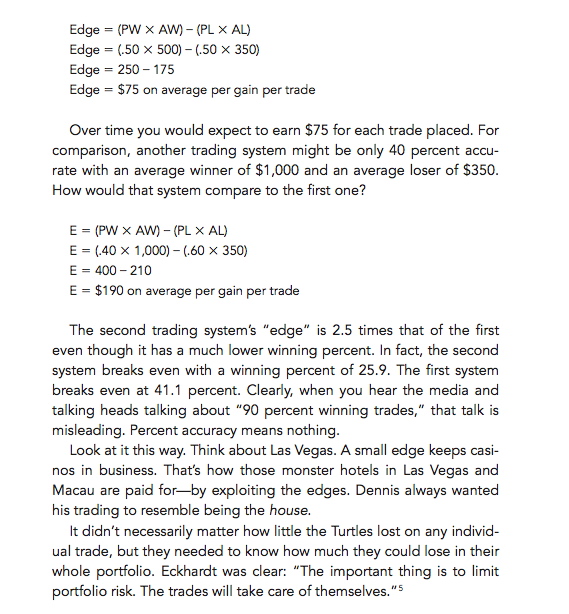
An example from my book:


expectation


Think like that?


How can you move forward immediately to Trend Following profits? My books and my Flagship Course and Systems are trusted options by clients in 70+ countries.

Also jump in:

Trend Following Podcast Guests
Frequently Asked Questions
Performance
Research
Markets to Trade
Crisis Times
Trading Technology
About Us

Trend Following is for beginners, students and pros in all countries. This is not day trading 5-minute bars, prediction or analyzing fundamentals–it’s Trend Following.

Price Action is the Only Action… Don’t Get Distracted

Feedback in:

Hi Michael. Dan in Boston here, hope you are well. I’ve been devouring your podcast after I heard you on the Stansberry podcast. Thanks so much for sharing all the info / state of mind, it’s F%$ing awesome!

Question for you regarding dividends. Will you ever hold a stock that’s trending downward because it’s throwing off solid dividends? I know you can’t talk individual stocks (assuming you can’t) so I’ll just say I bought a BDC that’s throwing off a monthly dividend, annual rate is over approx 12%. I’ve got a few other BDCs all throwing off similar dividends which are generally trading sideways but I’m up on a couple of them. Seems like they are a hidden jewel that nobody cares about. I bought them after the were dis-included from the Russell 2000 ETFs so I got ‘em at rock bottom prices.

I bought the one I’m referring to before I discovered and began to knuckle down into trend following. It’s trending downward but very slowly. My technical indicators are obviously negative but they aren’t screaming toward the bottom, just very slowly shaving off a few cents per day. I may of course hit my stop, however it’s only about 15 cents shy of my buy price, and the dividend is keeping me slightly ahead and reinvesting it I’m still in the green. I’m adjusting my stops to reflect that as well, so either way if I stop out I’m not gonna get hurt too badly, if at all.

Question is do you ever factor dividends into your trend following? I probably answered my own question as I’m still making money on the stock, but would love to have your feedback.

Keep up the great work man, I just finished chapter one of the Little Book of Trend Following and I’m sure within the next few months I will read all your books. I too believe people are sheep and freeloading off the system, I’m an entrepreneur anyway, so trend following is a natural extension of my life.

Cheers
Dan

Thanks Dan for the nice words! Let me keep it simple–judge the trade by price action always (not dividends). Holding onto a losing stock because it is spinning off a dividend is not trend following. Perhaps, the math works and it is ok for your situation, but it’s just not trend following.


How can you move forward immediately to Trend Following profits? My books and my Flagship Course and Systems are trusted options by clients in 70+ countries.

Also jump in:

Trend Following Podcast Guests
Frequently Asked Questions
Performance
Research
Markets to Trade
Crisis Times
Trading Technology
About Us

Trend Following is for beginners, students and pros in all countries. This is not day trading 5-minute bars, prediction or analyzing fundamentals–it’s Trend Following.
Risk, Reward and Uncertainty

Trend followers understand that life is a balance of risk and reward. If you want the big rewards, take the big risks. If you want average rewards and an average life, take average risks. Charles Sanford gave a commencement address that is timeless. It said in part:

“From an early age, we are all conditioned by our families, our schools, and virtually every other shaping force in our society to avoid risk. To take risks is inadvisable; to play it safe is the counsel we are accustomed both to receiving and to passing on. In the conventional wisdom, risk is asymmetrical: it has only one side, the bad side. In my experience—and all I presume to offer you today is observations drawn on my own experience, which is hardly the wisdom of the ages—in my experience, this conventional view of risk is shortsighted and often simply mistaken. My first observation is that successful people understand that risk, properly conceived, is often highly productive rather than something to avoid. They appreciate that risk is an advantage to be used rather than a pitfall to be skirted. Such people understand that taking calculated risks is quite different from being rash. This view of risk is not only unorthodox, it is paradoxical—the first of several paradoxes which I’m going to present to you today. This one might be encapsulated as follows: Playing it safe is dangerous. Far more often than you would realize, the real risk in life turns out to be the refusal to take a risk.”

Life is fraught with risk. There is no getting away from it. However we try to control the direction of our lives, there are times when we fail. Therefore, we might as well accept that life is a game of chance. If life is a game of chance, to one degree or another, we must be comfortable with assessing odds in the face of risk.


How can you move forward immediately to Trend Following profits? My books and my Flagship Course and Systems are trusted options by clients in 70+ countries.

Also jump in:

Trend Following Podcast Guests
Frequently Asked Questions
Performance
Research
Markets to Trade
Crisis Times
Trading Technology
About Us

Trend Following is for beginners, students and pros in all countries. This is not day trading 5-minute bars, prediction or analyzing fundamentals–it’s Trend Following.
Drawdown Wisdom

In the early 1990s, Commodities Corporation (a famed trading incubator that taught and bankrolled new traders) invited a group of Japanese traders to its company for in-house training. One up-and-coming trader at Commodities Corporation took his new friends to lunch. He told his guests how important risk management was, and to risk only 1 percent per trade. He was clear that experiencing small losses were part of his process to ultimately finding big winners. The Japanese traders, with puzzled looks on their faces, asked, “You have losses?” Ouch! Time for everyone regardless of country to learn about small losses, and to love them, even if that means your account will occasionally have drawdowns. What are drawdowns? Drawdowns are those non-fun time periods where your small losses add up to reduce your account size. They happen. The key is to quickly and successfully recover from them by sticking with your trend trading system and waiting patiently for big trends to reappear, which let you get back to making new money again (and paying for all of those small losses). How much can you lose? That’s an important question to answer, and it comes down to the risk you take (which will vary by your personal choice). However, trend following is much easier to believe in when you consider the length of professional trend trading track records, especially the really long track records that offer proof of viability. That said, some will spend a lifetime trying to avoid any loss (even though that is impossible).


How can you move forward immediately to Trend Following profits? My books and my Flagship Course and Systems are trusted options by clients in 70+ countries.

Also jump in:

Trend Following Podcast Guests
Frequently Asked Questions
Performance
Research
Markets to Trade
Crisis Times
Trading Technology
About Us

Trend Following is for beginners, students and pros in all countries. This is not day trading 5-minute bars, prediction or analyzing fundamentals–it’s Trend Following.
Ep. 258: Megan McArdle Interview with Michael Covel on Trend Following Radio

Megan McArdle
Megan McArdle

My guest today is Megan McArdle, a Bloomberg View columnist who writes on economics, business and public policy. She founded the blog “Asymmetrical Information”.

The topic is her book The Up Side of Down: Why Failing Well Is the Key to Success.

In this episode of Trend Following Radio we discuss:

  • “Trophy kids” and taking the monkey bars away
  • The idea of a regulator out there trying to guarantee our safety
  • Why the companies that make it aren’t the ones with the best strategic plan–it’s the ones that execute (and fail well)
  • The power of experimentation
  • Nobel winner Vernon Smith and experimentation
  • The idea of learning in crisis
  • How sunk costs are difficult for a large part of the population to grasp
  • Van Halen, errors, and M&M’s
  • Normative error
  • Small, manageable risks
  • Forager morality vs. farmer morality
  • A story about Kentucky Fried Chicken (KFC)

Listen to this episode:

Jump in!

The Trend Following Questions to Answer

Now, let’s get practical. Answer the following five questions, and you have a trend following trading system:

1. What market do you buy or sell at any time?
2. How much of a market do you buy or sell at any time?
3. When do you buy or sell a market?
4. When do you get out of a losing position?
5. When do you get out of a winning position?

Said another way (Bill Eckhardt inspired):

1. What is the state of the market?
2. What is the volatility of the market?
3. What is the equity being traded?
4. What is the system or the trading orientation?
5. What is the risk aversion of the trader or client?

You want to be black or white with this. You do not want gray. If you can accept that mentality, you have got it.


How can you move forward immediately to Trend Following profits? My books and my Flagship Course and Systems are trusted options by clients in 70+ countries.

Also jump in:

Trend Following Podcast Guests
Frequently Asked Questions
Performance
Research
Markets to Trade
Crisis Times
Trading Technology
About Us

Trend Following is for beginners, students and pros in all countries. This is not day trading 5-minute bars, prediction or analyzing fundamentals–it’s Trend Following.
Ep. 256: Mike Harris Interview with Michael Covel on Trend Following Radio

Mike Harris
Mike Harris

Today on the podcast, Michael Covel speaks with Mike Harris. Harris is President of Campbell & Company (3B+ AUM), the systematic trading firm started by Keith Campbell (Campbell was featured in Covel’s first book Trend Following). Covel and Harris discuss systematic trading in the early 70’s; education about managed futures; correlation with other markets and managers; trading diverse markets; focusing on data rather than the fundamentals; why “commodities” and “CTA” are misnomers; why Harris wouldn’t fly down to Brazil to investigate fundamental information on the coffee market; risk management, drawdowns, and taking small losses; dealing with uncertainty and helping clients to understand the uncertain nature of trading; how human emotion often gets in the way of profitable trading; the efficient market hypothesis and behavioral finance; continuity and how that has been thought through at Campbell & Company; the Sharpe ratio and why it isn’t the best way to look at systematic traders; and why being defensive is central to being a great absolute return trader. For more information on Campbell & Company, visit www.campbell.com.

Listen to this episode:

campbell and co.