
Subscribe now and watch my free trend following VIDEO.

The Narrative as Valuation

Aswath Damodaran writes:

If one extreme of the numbers/narrative spectrum is inhabited by those who are slaves to the numbers, at the other extreme are those who not only don’t trust numbers but don’t use them. Instead, they rely entirely on narrative to justify investments and valuations. Their motivations for doing so are simple.

1. Story telling is a powerful attention getter/keeper: Research in both psychology and business point to an undeniable fact. Human beings respond better to stories than to abstractions or numbers, and remember them for longer. After all, the Harvard Business School has taken story telling almost to an art form with its cases, tightly wound narratives that are supposed to convey larger lessons.

2. Unrestrained creativity: “Creative” people through the ages have always fought back against any restraints on their creativity, especially those imposed by those that they view as less imaginative than they are.

3. The Creative Superiority Complex: Just as numbers people intimidate with mounds of numbers, good narrators can browbeat “bean counters” with superior story telling, especially if they can back their stories up with personal experience.

Don’t trade off storytelling. Just don’t do it.


How can you move forward immediately to Trend Following profits? My books and my Flagship Course and Systems are trusted options by clients in 70+ countries.

Also jump in:

Trend Following Podcast Guests
Frequently Asked Questions
Performance
Research
Markets to Trade
Crisis Times
Trading Technology
About Us

Trend Following is for beginners, students and pros in all countries. This is not day trading 5-minute bars, prediction or analyzing fundamentals–it’s Trend Following.

Ep. 265: Leo Melamed Interview with Michael Covel on Trend Following Radio

Leo Melamed
Leo Melamed

My guest today is Leo Melamed, a pioneer of financial futures, currencies, and stock indexes. Melamed became Chairman of the Chicago Mercantile Exchange in 1969. In 1972, under his leadership, the CME created the International Monetary Market (IMM), the world’s first financial futures exchange, and launched currency futures. He is currently Chairman Emeritus of CME Group (formerly the Chicago Mercantile Exchange).

The topic is his book Leo Melamed: Escape to the Futures.

In this episode of Trend Following Radio we discuss:

  • Overcoming odds
  • China’s futures markets
  • The middle class in China
  • Melamed’s experience meeting Milton Friedman and some of the lessons learned
  • Melamed’s early experiences escaping Nazi-controlled Poland, and eventually going to work for Merrill Lynch
  • Stock futures
  • The importance of speculation

Listen to this episode:

Jump in!

Paul Tudor Jones Interviewed October 19, 1987


How can you move forward immediately to Trend Following profits? My books and my Flagship Course and Systems are trusted options by clients in 70+ countries.

Also jump in:

Trend Following Podcast Guests
Frequently Asked Questions
Performance
Research
Markets to Trade
Crisis Times
Trading Technology
About Us

Trend Following is for beginners, students and pros in all countries. This is not day trading 5-minute bars, prediction or analyzing fundamentals–it’s Trend Following.
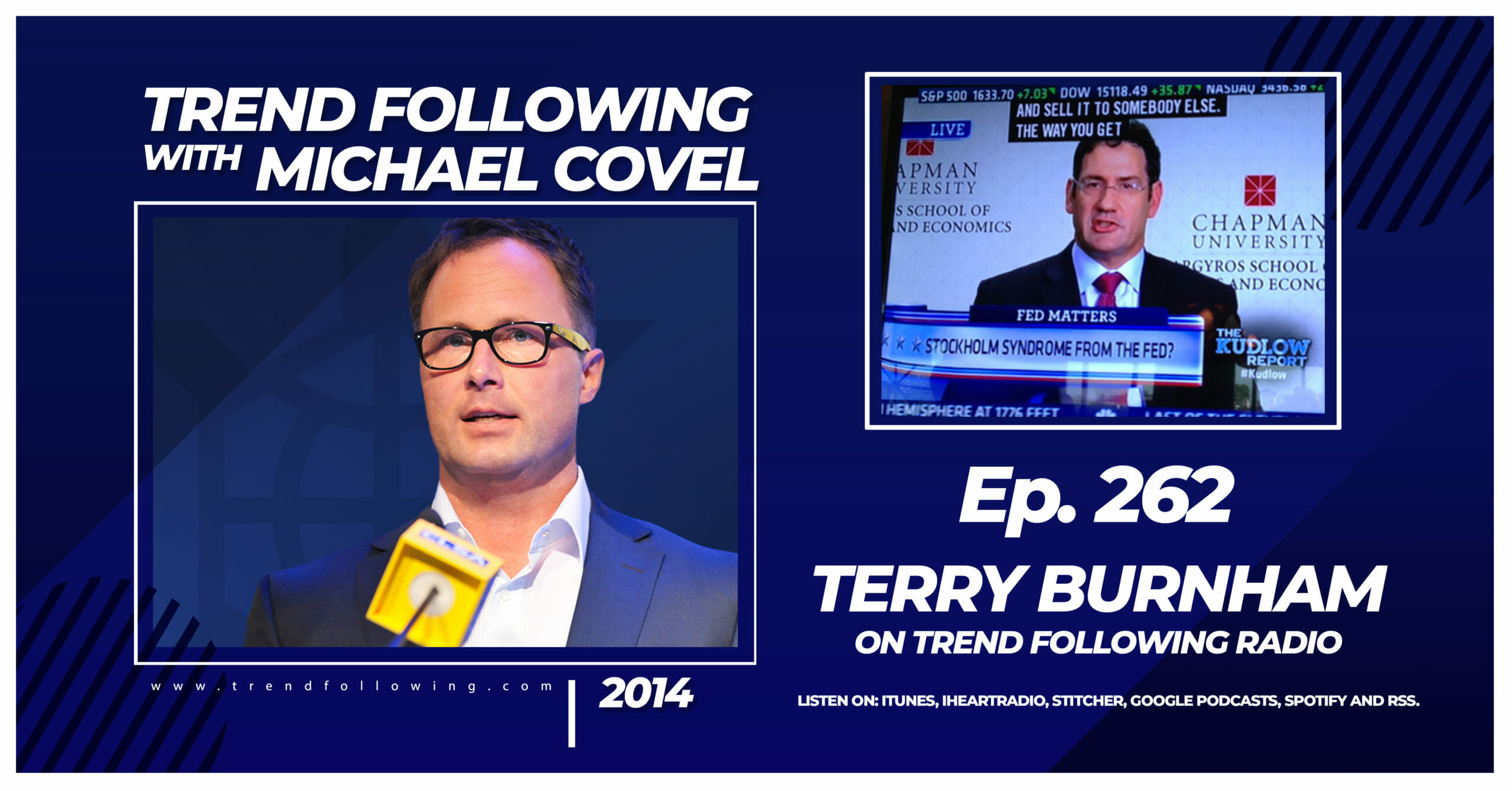
Ep. 262: Terry Burnham Interview with Michael Covel on Trend Following Radio

Terry Burnham
Terry Burnham

My guest today is Terry Burnham, an economist who studies the biological and evolutionary basis of human behavior. He has a Ph.D. in Business Economics from Harvard University, a Masters from the MIT Sloan School with a concentration in finance. Terry was a professor at the Harvard Kennedy School, the University of Michigan, and the Harvard Business School. His non-academic experiences include working briefly for Goldman, Sachs & Co., being the chief financial officer for Progenics Pharmaceuticals , a start-up biotechnology company, and being the director of portfolio management for Acadian Asset Management, a quantitative equity manager.

The topic is his book Mean Markets and Lizard Brains: How to Profit from the New Science of Irrationality.

In this episode of Trend Following Radio we discuss:

  • Burnham removed $1 million from his Bank of America account and said “I don’t trust the banks”
  • The two ways to think about risk
  • Separating the ideas of luck and skill
  • The lizard brain and how it relates back to our choices
  • A story about interacting with Paul Tudor Jones
  • Why markets have momentum
  • The great driver of conformity
  • Rationality and irrationality
  • Captive chimps vs. chimps in the wild and the differences in behavior
  • Predicting when the Fed will step in
  • Thinking of the worst case scenario for equities and looking to Japan for an example
  • Negative interest rates

Listen to this episode:

Jump in!

Starting Out: One Man’s Story

An excerpt from my book:

Even though he loved his job in the markets, David Druz soon entered medical school to hedge his bets. Medicine was interesting to him, but he was 100 percent fascinated with the markets. Did he have lots of money? No. The only money he had was $5,000 in stock that his father had given him. Druz cashed that out and put it into his account. At that same time the brokerage firm offered him a job, a full-time job to quit medical school and go work for them. They offered Druz $50,000 to start. That was really good money in the 1970s. A slightly drunk friend told him, “Dave, don’t take that job. You can be a really good trader, but if you take that job, you’ll never be a great trader. You’ve got to get a nest egg for security. You don’t want to trade with scared money. Finish medical school, be a doctor, and then you’ll be a great trader.” Does that make sense to you? Maybe not at first blush, but it was the wisest piece of information anyone ever told Druz. He has since seen many people over the years trading with scared money—meaning they would make decisions on the value of the money to them (read: emotional decisions about a new car, suit, or wife), and not follow the exact rules of their trading plan. “Don’t quit your day job” is another critical success lesson—write it down and tape it over your desk. Druz took his $5,000 and started to trade. He wasn’t very good at first, and his account dropped down to around $1,500. At that point he had hit rock bottom and trading success was beginning to move out of sight. He then received a message from his brokerage firm, “You got a fill on your trade.” Druz said, “I don’t have any orders in. I’m out of business.” The brokerage replied, “No, you had a ‘Good Til Cancelled’ order (GTC) in and it is ‘limit up’.” Druz was back in business! The universe apparently would not allow him to quit—he truly believed that. You too might think sometimes, “If I only had one more chance,” but when the next opportunity or chance does come around again you have to be willing to get in the game and play again—without thinking about your negative first experience. Second chances are telling you something. Heed their advice.


How can you move forward immediately to Trend Following profits? My books and my Flagship Course and Systems are trusted options by clients in 70+ countries.

Also jump in:

Trend Following Podcast Guests
Frequently Asked Questions
Performance
Research
Markets to Trade
Crisis Times
Trading Technology
About Us

Trend Following is for beginners, students and pros in all countries. This is not day trading 5-minute bars, prediction or analyzing fundamentals–it’s Trend Following.
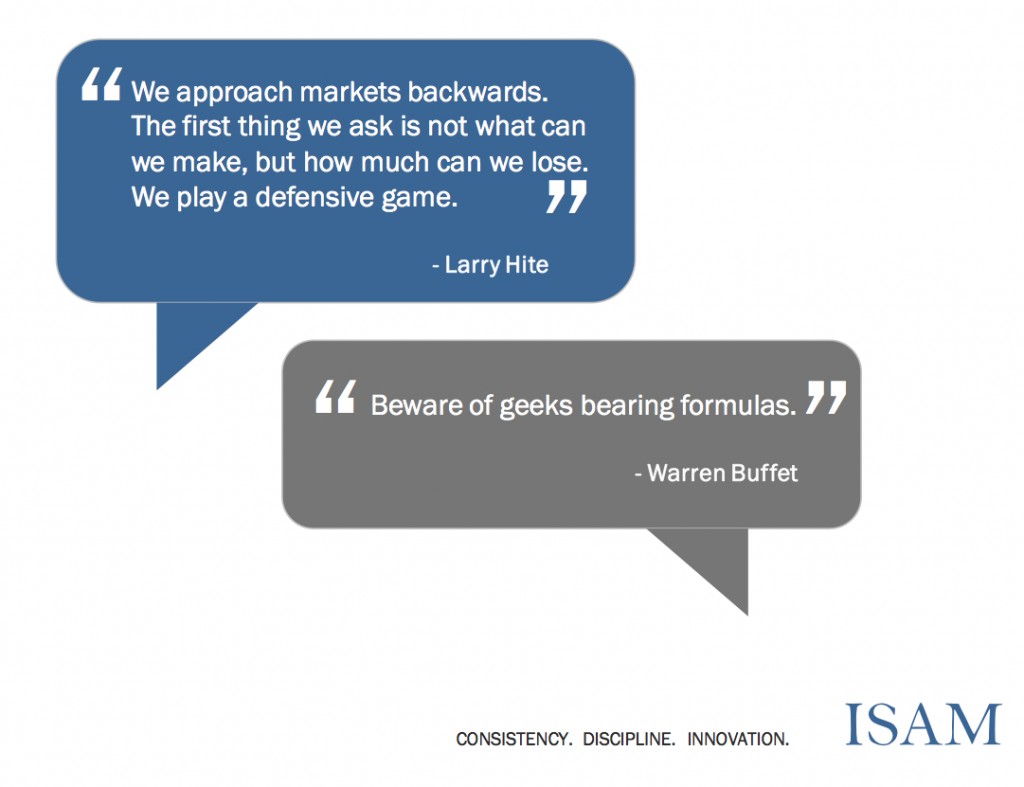
Larry Hite and Warren Buffett

ISAM Systematic Presentation 2011-12


How can you move forward immediately to Trend Following profits? My books and my Flagship Course and Systems are trusted options by clients in 70+ countries.

Also jump in:

Trend Following Podcast Guests
Frequently Asked Questions
Performance
Research
Markets to Trade
Crisis Times
Trading Technology
About Us

Trend Following is for beginners, students and pros in all countries. This is not day trading 5-minute bars, prediction or analyzing fundamentals–it’s Trend Following.

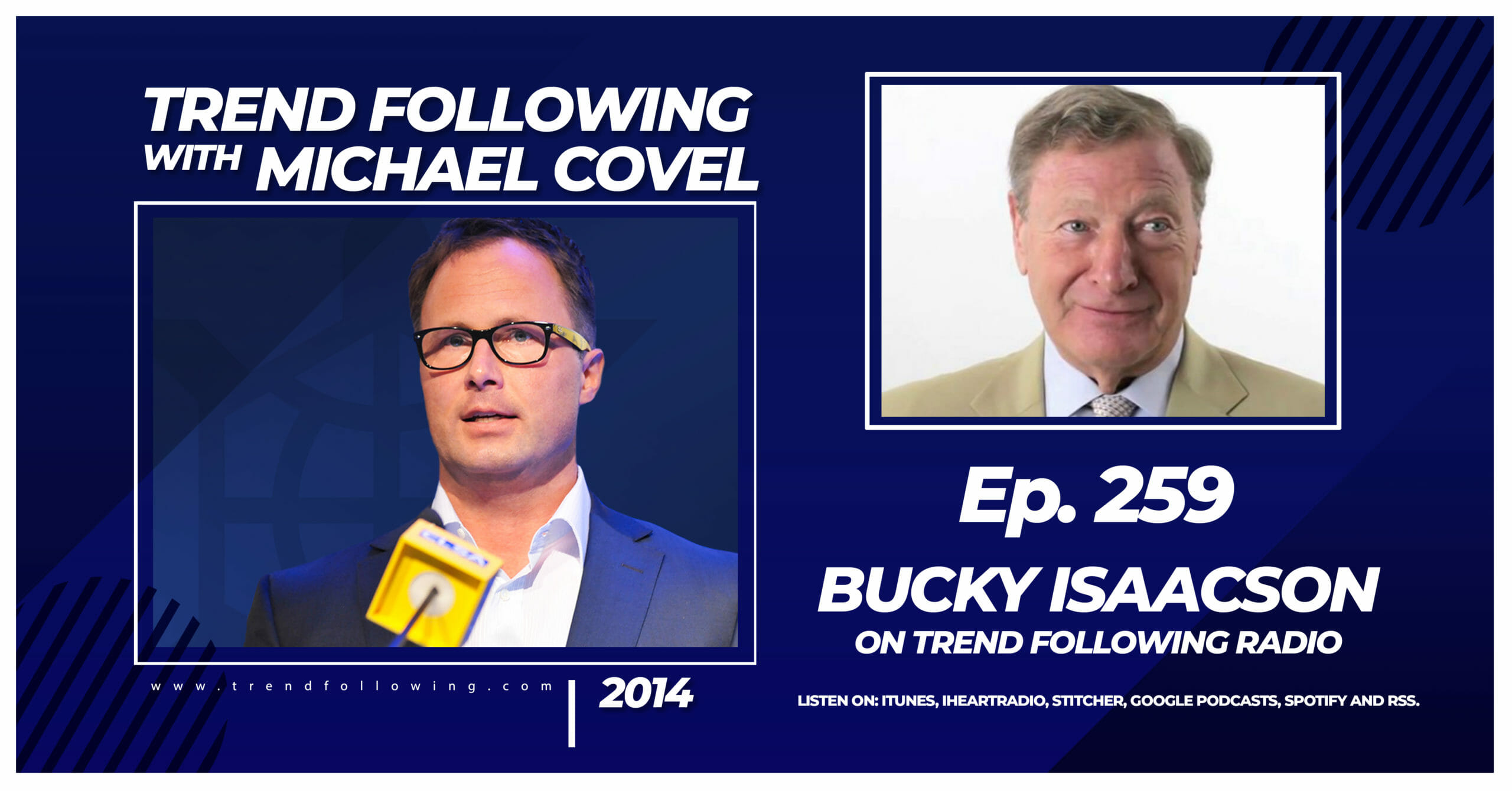
Ep. 259: Bucky Isaacson Interview with Michael Covel on Trend Following Radio

Bucky Isaacson
Bucky Isaacson

My guest today is Bucky Isaacson, one of the early pioneers of managed futures. In 1969, he helped to develop one of the first computerized trading systems. He’s been involved in the managed futures industry ever since, particularly in Asia and the US.

The topic is managed futures.

In this episode of Trend Following Radio we discuss:

  • Fractured state of conferences these days
  • What it was like to be involved with a group developing a computerized trading system in 1969
  • Being with one of the earliest incarnations of a managed futures firm
  • Trading attitudes
  • Marketing and doing business in Asia
  • Differences in business practices between Asian countries
  • Refco, MF Global, PFG and other aberrations that have damaged the Chicago futures brand
  • Madoff as a marketer
  • Raising the initial capital to start a trading venture
  • How to differentiate yourself from a marketing perspective
  • Growth in the managed futures industry

Listen to this episode:

Jump in!

Read more on Christopher Sugrue of Refco.