Subscribe now and watch my free trend following VIDEO.

You Want It All “Cheap”?

You want it all “cheap”?

No.

Wrong way to think.

For example, if you enter a market at price level 50 and it goes to 100, does it really make a difference whether you got in at 52 or 60 or 70? Even if you got in at 70 and the market went to 100, you still made a lot, right? There are plenty of traders out there who think: “Oh, I couldn’t get in at 52, so I won’t get in at all.” Even if you had the chance to get in at 70 on a market that eventually goes to 100, some sit on the sidelines still dreaming of buying ‘cheap’!


How can you move forward immediately to Trend Following profits? My books and my Flagship Course and Systems are trusted options by clients in 70+ countries.

Also jump in:

Trend Following Podcast Guests
Frequently Asked Questions
Performance
Research
Markets to Trade
Crisis Times
Trading Technology
About Us

Trend Following is for beginners, students and pros in all countries. This is not day trading 5-minute bars, prediction or analyzing fundamentals–it’s Trend Following.

Timeless Edward Seykota Trading Wisdom

Please listen to my Ed Seykota podcast, but also recall some timeless Seykota wisdom:

1. “Win or lose, everybody gets what they want out of the market. Some people seem to like to lose, so they win by losing money.”

2. “Fundamentals that you read about are typically useless as the market has already discounted the price, and I call them “funny-mentals”. However, if you catch on early, before others believe, you might have valuable “surprise-a-mentals”.”

3. “If you can’t measure it, you probably can’t manage it… Things you measure tend to improve.”

More.


How can you move forward immediately to Trend Following profits? My books and my Flagship Course and Systems are trusted options by clients in 70+ countries.

Also jump in:

Trend Following Podcast Guests
Frequently Asked Questions
Performance
Research
Markets to Trade
Crisis Times
Trading Technology
About Us

Trend Following is for beginners, students and pros in all countries. This is not day trading 5-minute bars, prediction or analyzing fundamentals–it’s Trend Following.

Jesse Livermore Wisdom

1. The stock market is never obvious. It is designed to fool most of the people, most of the time.

2. Play the market only when all factors are in your favor. No person can play the market all the time and win. There are times when you should be completely out of the market, for emotional as well as economic reasons.

3. Do not use the words “Bullish” or “Bearish.” These words fix a firm market direction in the mind for an extended period of time. Instead, use “Upward Trend” and “Downward Trend” when asked the direction you think the market is headed. Simply say: “The line of least resistance is either upward or downward at this time.” Remember, don’t fight the tape!

4. The game of speculation is the most uniformly fascinating game in the world. But it is not a game for the stupid, the mentally lazy, the person of inferior emotional balance, or the get-rich-quick adventurer. They will die poor.

5. The only thing to do when a person is wrong is to be right, by ceasing to be wrong. Cut your losses quickly, without hesitation. Don’t waste time. When a stock moves below a mental stop, sell it immediately.

6. Emotional control is the most essential factor in playing the market. Never lose control of your emotions when the market moves against you. Don’t get too confident over your wins or too despondent over your losses.

7. All through time, people have basically acted and reacted the same way in the market as a result of: greed, fear, ignorance, and hope. That is why the numerical formations and patterns recur on a constant basis.

8. Watch the market leaders, the stocks that have led the charge upward in a bull market. That is where the action is and where the money is to be made. As the leaders go, so goes the entire market. If you cannot make money in the leaders, you are not going to make money in the stock market. Watching the leaders keeps your universe of stocks limited, focused, and more easily controlled.

9. Failure to take advantage of a serendipitous act of good luck in the stock market is often a mistake.

10. There is nothing new on Wall Street or in stock speculation. What has happened in the past will happen again, and again, and again. This is because human nature does not change, and it is human emotion, solidly build into human nature, that always gets in the way of human intelligence. Of this I am sure.

Note: Read more.


How can you move forward immediately to Trend Following profits? My books and my Flagship Course and Systems are trusted options by clients in 70+ countries.

Also jump in:

Trend Following Podcast Guests
Frequently Asked Questions
Performance
Research
Markets to Trade
Crisis Times
Trading Technology
About Us

Trend Following is for beginners, students and pros in all countries. This is not day trading 5-minute bars, prediction or analyzing fundamentals–it’s Trend Following.
Ep. 253: Perry Kaufman Interview with Michael Covel on Trend Following Radio

Perry Kaufman
Perry Kaufman

My guest today is Perry Kaufman, an American systematic trader, index developer, and quantitative financial theorist. He is considered a leading expert in the development of fully algorithmic trading programs.

The topic is systematic trading.

In this episode of Trend Following Radio we discuss:

  • How Kaufman came to the idea of 100% algorithmic trading systems
  • The difference between being systematic and being automated
  • Optimization vs. validation
  • The biggest advantages of testing
  • Why discretion is not part of Kaufman’s toolbox
  • The problem of tail events
  • Why discipline is the most important characteristic of a systematic trader
  • The “loose pants fit everyone” philosophy
  • Preparing yourself for uncertainty
  • Comparisons between risk management and risk measurement
  • The Sharpe ratio
  • High volatility trades vs. low volatility
  • Why Kaufman places equal weight on both risk management and the underlying system
  • Systematic trading in established mature markets vs. emerging markets

Listen to this episode:

Jump in!

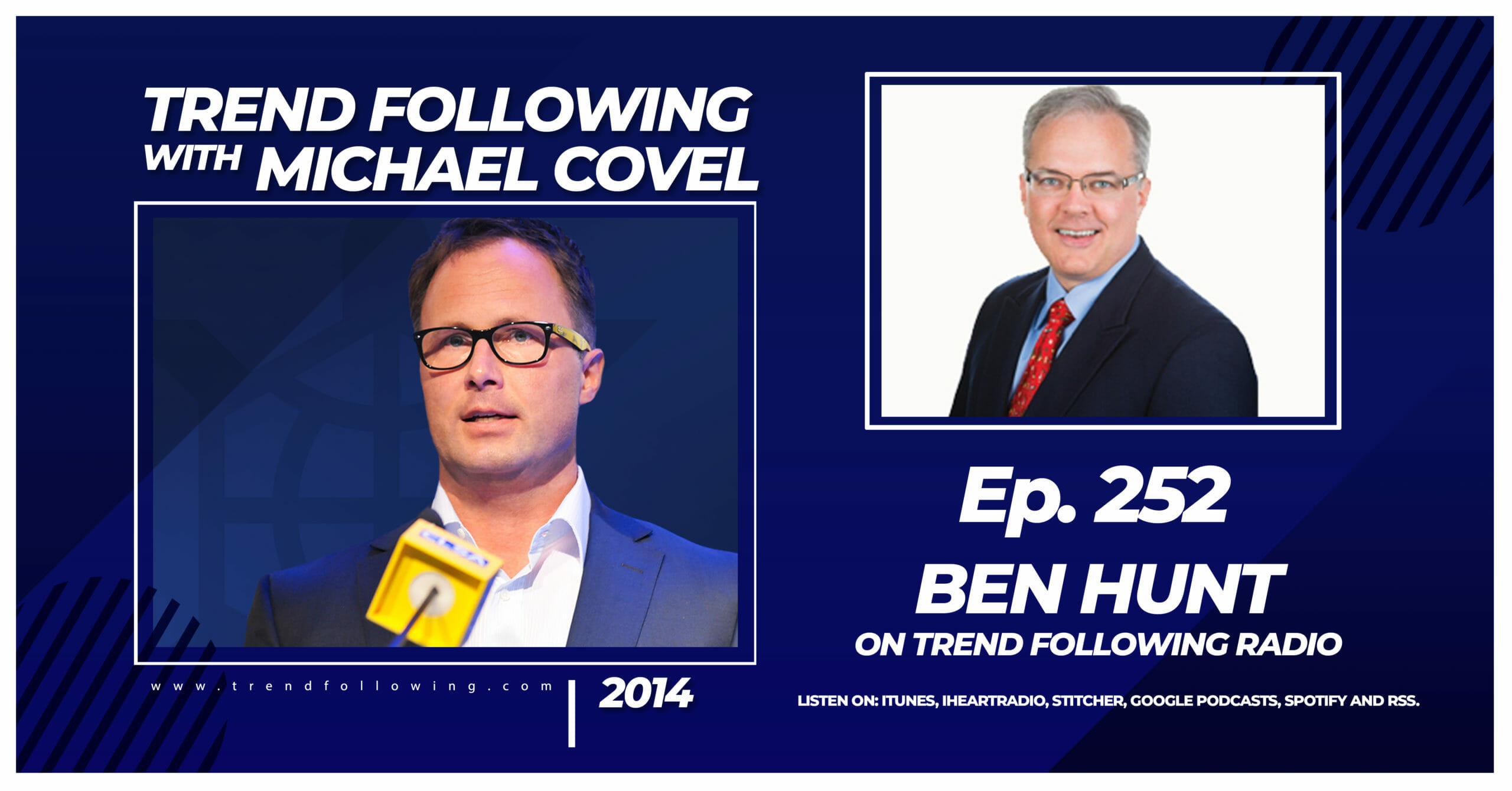
Ep. 252: Ben Hunt Interview with Michael Covel on Trend Following Radio

Ben Hunt
Ben Hunt

My guest today is Ben Hunt, the Chief Risk Officer at Salient Partners. Salient is a 19B AUM manager based in Houston, Texas. As Chief Risk Officer, Hunt writes the Epsilon Theory, viewing capital markets through the lenses of game theory and history.

The topic is Epsilon Theory.

In this episode of Trend Following Radio we discuss:

  • Power of the crowd watching the crowd
  • Game theory
  • Having a profound agnosticism about what the future holds
  • The difference between risk and uncertainty in the context of game theory
  • The Panopticon and the chilling effect of being watched
  • The “common knowledge game” and the missionary
  • The island of the green-eyed tribe

Listen to this episode:

Jump in!

Shout to Marko Graenitz for Nice Feature Article

Read (PDF).

Michael Covel

Source: Jul 2014 www.tradersonline-mag.com.


How can you move forward immediately to Trend Following profits? My books and my Flagship Course and Systems are trusted options by clients in 70+ countries.

Also jump in:

Trend Following Podcast Guests
Frequently Asked Questions
Performance
Research
Markets to Trade
Crisis Times
Trading Technology
About Us

Trend Following is for beginners, students and pros in all countries. This is not day trading 5-minute bars, prediction or analyzing fundamentals–it’s Trend Following.

Ep. 251: Andrew Huszar Interview with Michael Covel on Trend Following Radio

Andrew Huszar
Andrew Huszar

My guest today is Andrew Huszar, a Senior Fellow at Rutgers Business School and also a former Morgan Stanley managing director. In 2009, he managed the Federal Reserve’s 1.25 trillion dollar mortgage-backed security purchase program.

The topic is the direction of the Federal Reserve.

In this episode of Trend Following Radio we discuss:

  • Looking at the short term
  • Black swans
  • Huszar’s history and how he came to work for the Federal Reserve
  • The changing of the banking model in the US from the 1980’s to the late 2000’s
  • Quantitative easing
  • Why Huszar ultimately left the Fed at the beginning of 2011
  • How the Fed has become over five times bigger in recent history
  • The current source of Wall Street money
  • The idea of an overly financialized US economy
  • The need for long-term structural changes in the US

Listen to this episode:

Jump in!