Subscribe now and watch my free trend following VIDEO.

Ep. 284: Jason Fried Interview with Michael Covel on Trend Following Radio

Jason Fried
Jason Fried

My guest today is Jason Fried, the co-founder and President of 37signals, a privately-held Chicago-based company committed to building the best web-based tools possible with the least number of features necessary.

The topic is his book Rework.

In this episode of Trend Following Radio we discuss:

  • The first dollar Fried made online and other formative experiences
  • Keeping business simple
  • Making something more valuable than the dollars people give you
  • The intimacy of exchanging money
  • The idea of doing less than your competitors to beat them
  • Building an audience
  • The “real world”
  • Why an MBA program might not teach you much about entrepreneurism
  • Corporate structure
  • Focusing on what will not change
  • Zen and the moment of right now
  • Not focusing too far into the future
  • Fried’s experience with Jeff Bezos
  • Idea of improvisation or “winging it” in business

Listen to this episode:

Jump in!

Something to Pondor: Baseball’s Behavioral Experiment

Great article from Brian Costa of the WSJ:

Take a peek inside the frazzled mind of a major-league hitter these days. It isn’t a pretty sight.

Pitchers are throwing harder than ever. Batters are striking out more often than ever. And their judgment is getting shakier: Hitters are chasing more pitches outside the strike zone.

It is enough to make some teams wonder: What if we could just rewire hitters’ brains to react to pitches better? As it turns out, at least three major-league teams are engaged in a covert science experiment to find out.

Several years ago, the Boston Red Sox began working with a Massachusetts neuroscience company called NeuroScouting. The objective was to develop software that could improve hitters’ ability to recognize pitch types and decide, with greater speed and accuracy, whether they should swing. The result was a series of no-frills video games that became a required part of hitters’ pregame routines in the minor leagues.

When Theo Epstein left his job as general manager of the Red Sox to become president of baseball operations for the Chicago Cubs in 2011, he brought the same methods to Chicago’s farm system. And last year, the Tampa Bay Rays made the neurological training games mandatory for minor leaguers—threatening to fine those that didn’t complete their assignments.

Now, a startup company with a near-identical name says it is in talks with four other major-league teams about providing tests to evaluate the neurological strengths and weaknesses of their minor-league hitters. The company, Neuroscout, would put electrode caps on players to measure their relevant brain activity during computer simulations of pitches coming at them.

Red Sox general manager Ben Cherington said the idea is to improve the connection in hitters’ brains between the visual stimulus of a pitch and the decision of whether to swing. “There’s a connection there,” he said. “And if you’re trying to hit a baseball moving at 90 miles per hour and moving in different directions, it probably helps for that connection to be strong.”

Though NeuroScouting’s games vary, most of them depict a ball coming from the pitcher’s mound toward the hitter. Using a laptop or tablet, players are given instructions such as, “Hit the space bar when you see the seams on the ball spinning vertically,” and are scored based on their reaction time and accuracy. The Rays have a leaderboard that shows players which of their teammates fared best on a given drill, like the high-scores screen at the end of an arcade game.

NeuroScouting executives declined to go into detail about their methods or their clients, citing teams’ demand for confidentiality. But Wesley Clapp, one of the company’s co-founders, said their software can identify how well each player’s brain reacts to specific pitch types—an outside curveball or a low fastball, for instance—and tailor their training to the areas where they need to improve the most.

“The best players have the best neural skills,” Clapp said. “It’s like a dimmer switch. The more you turn that dimmer up, you see more and more impact on the field.”

The need for hitters to react faster is clear. The average major-league fastball this year is 91.8 mph, according to the statistics website FanGraphs, a figure that has steadily increased from 89.9 in 2002. Hitters’ decision-making is slumping, too. They have swung at 30% of pitches outside the strike zone this season, according to pitch-tracking data, up from 27.9% in 2009.

But players are divided on the benefits of brain games that, for many, feel more like homework than baseball.

“For the most part, guys just seem like, every other day, ‘Ugh, I have to do this again,’ ” Rays outfielder Kevin Kiermaier said. “You try to get in a routine, and it’s like, ‘Oh, you have to do neuroscience or you’re going to get fined.’ ” He said that fines for players who skipped their assigned videogames were in the $25 to $50 range. Rays general manager Andrew Friedman declined to comment.

In the majors, where players have more autonomy, few choose to continue with the games. “People didn’t have that stuff 10 years ago. People could still hit,” Rays outfielder Wil Myers said. “Don’t try to reinvent the game.”

Nonetheless, teams’ interest in the neuroscience of hitting is only growing. What began as a training tool for the Red Sox has also become a scouting device. Before each amateur draft, the Red Sox assess hitting prospects in part based on how well they score on the NeuroScouting games.

Mookie Betts, Boston’s fifth-round draft pick in 2011, recalled meeting with a Red Sox scout in an empty classroom one day during his lunch period at a Tennessee high school. At the scout’s request, he completed a series of games on a laptop. “I was thinking, ‘What does this have to do with baseball?’ ” Betts said. “I guess I did pretty well, since he kept on pursuing me.”

Betts, 21, said the daily NeuroScouting drills he did in the minors helped put him on a fast track to the majors. “It gets your brain going,” he said. In 43 games through Thursday, his .363 on-base percentage ranked second among major-league rookies behind Chicago White Sox star Jose Abreu.

Teams still aren’t sure if any of this will boost their offense. The Red Sox have seen hitters such as Betts rate well on the neuro tests and blossom into productive players. But Cherington said other prospects have scored well and not panned out.

Likewise, Rays catcher Curt Casali said his hitting improved after the team introduced NeuroScouting while he was still in the minors last year, but has no idea if one had anything to do with the other. “You could just be a really good hitter,” Casali said.

The only thing teams know for sure is offense continues to fall. The major-league batting average is .251, which would be the lowest for a single season since 1972, the year before the American League introduced the designated hitter. The leaguewide strikeout total is on pace to reach an all-time high for the seventh consecutive year.

At this point, they don’t need to know an experiment will work. The fact that it might is enough. “Intuitively, it would make sense that this would be a helpful tool,” Cherington said, “but I just don’t know if anyone yet can prove that it’s predictive. The hope is maybe it can be.”

This type of “psych” article is exactly why I pursue so many behavioral experts for my podcast.

Further related Podcasts and Articles from the Trend Following Blog:

Shane Snow Podcast

Thinking to make a living

PhD not required to win at trading

John W Henry

Trend Trading without Charts

Pro Football vs Pro Baseball


How can you move forward immediately to Trend Following profits? My books and my Flagship Course and Systems are trusted options by clients in 70+ countries.

Also jump in:

Trend Following Podcast Guests
Frequently Asked Questions
Performance
Research
Markets to Trade
Crisis Times
Trading Technology
About Us

Trend Following is for beginners, students and pros in all countries. This is not day trading 5-minute bars, prediction or analyzing fundamentals–it’s Trend Following.

Phil Jackson’s 11 Mindful Leadership Principles

Phil Jackson’s 11 Principle’s of Mindful Leadership are worth reviewing, but #10 is the trend following creed:

10. When in Doubt, Do Nothing. “Basketball is an action sport, and most people involved in it are high-energy individuals who love to do something—anything—to solve problems. However, there are occasions when the best solution is to do absolutely nothing. I subscribe to the philosophy of the late Satchel Paige, who said, ‘Sometimes I sits and thinks, and sometimes I just sits.'”

Trend following = do nothing until you have to do something.


How can you move forward immediately to Trend Following profits? My books and my Flagship Course and Systems are trusted options by clients in 70+ countries.

Also jump in:

Trend Following Podcast Guests
Frequently Asked Questions
Performance
Research
Markets to Trade
Crisis Times
Trading Technology
About Us

Trend Following is for beginners, students and pros in all countries. This is not day trading 5-minute bars, prediction or analyzing fundamentals–it’s Trend Following.

Your Feedback Makes the Show

Podcast guest recommendation feedback in:

Dear Michael, I’m not sure how I found your podcasts. Must be a stroke of good luck. I find them to be superb.

In the late 70’s and early 80’s, I had a patient and casual friend who was a financial systems analysis with one of the Kaiser Companies in Oakland, CA. He equaled his yearly Kaiser salary counting cards in Nevada. In October 1987, he was using a rudimentary computer in a small independent stock brokerage office next to my dental office. I remember well that fateful day of the crash. A short time later he purchased a seat on some exchange in Chicago. I saw a wright up on him in a obscure financial magazine which described how he started in Chicago with $100K. He doubled it yearly for about 5 or 6 years. He continued to prosper over the next several years.

In early 2000’s his company was purchased by [name] for around $[xxx] million. In 2004, he ran for the [political office]. He lost to now [politician].

His name is [Name]. His company was [Name]. There is some info on the Internet and he now runs [Name] in Chicago.

I have not seen [Name] for many years but would feel comfortable contacting him to explore speaking with you if you are interested.

I am now 80 years old and have diminished eye sight. Reading is a challenge but I am determined to read all of your books on my iPad. Please give me your recommendation for the order in which to read them.

Warm regards,
[Name]

I know of [Name], and know he built a legendary career. If you could arrange for an introduction that would be great. [Name] would be a natural fit with my guests, and I suspect he knows many of them, i.e. Leo Melamed, Peter Borish, Jerry Parker, Ed Seykota, Larry Hite, etc.


How can you move forward immediately to Trend Following profits? My books and my Flagship Course and Systems are trusted options by clients in 70+ countries.

Also jump in:

Trend Following Podcast Guests
Frequently Asked Questions
Performance
Research
Markets to Trade
Crisis Times
Trading Technology
About Us

Trend Following is for beginners, students and pros in all countries. This is not day trading 5-minute bars, prediction or analyzing fundamentals–it’s Trend Following.

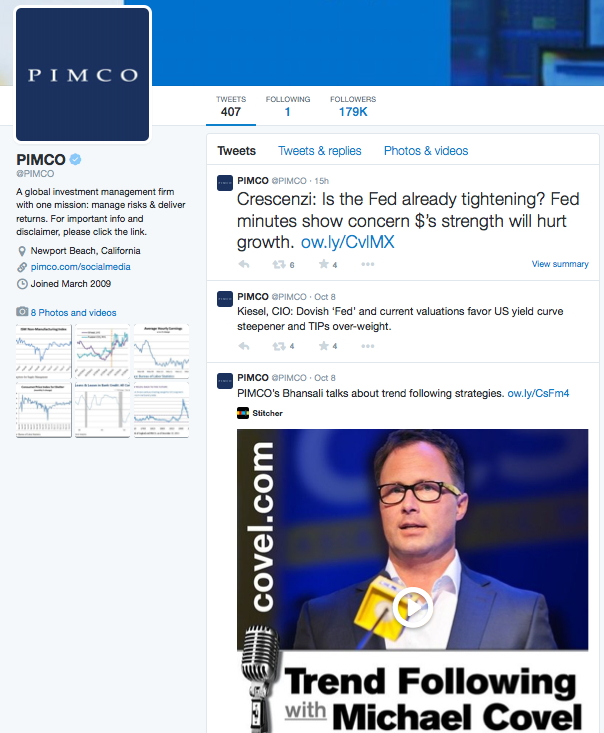
PIMCO Spreading the Trend Following Gospel

Screen shot:

pimco


How can you move forward immediately to Trend Following profits? My books and my Flagship Course and Systems are trusted options by clients in 70+ countries.

Also jump in:

Trend Following Podcast Guests
Frequently Asked Questions
Performance
Research
Markets to Trade
Crisis Times
Trading Technology
About Us

Trend Following is for beginners, students and pros in all countries. This is not day trading 5-minute bars, prediction or analyzing fundamentals–it’s Trend Following.

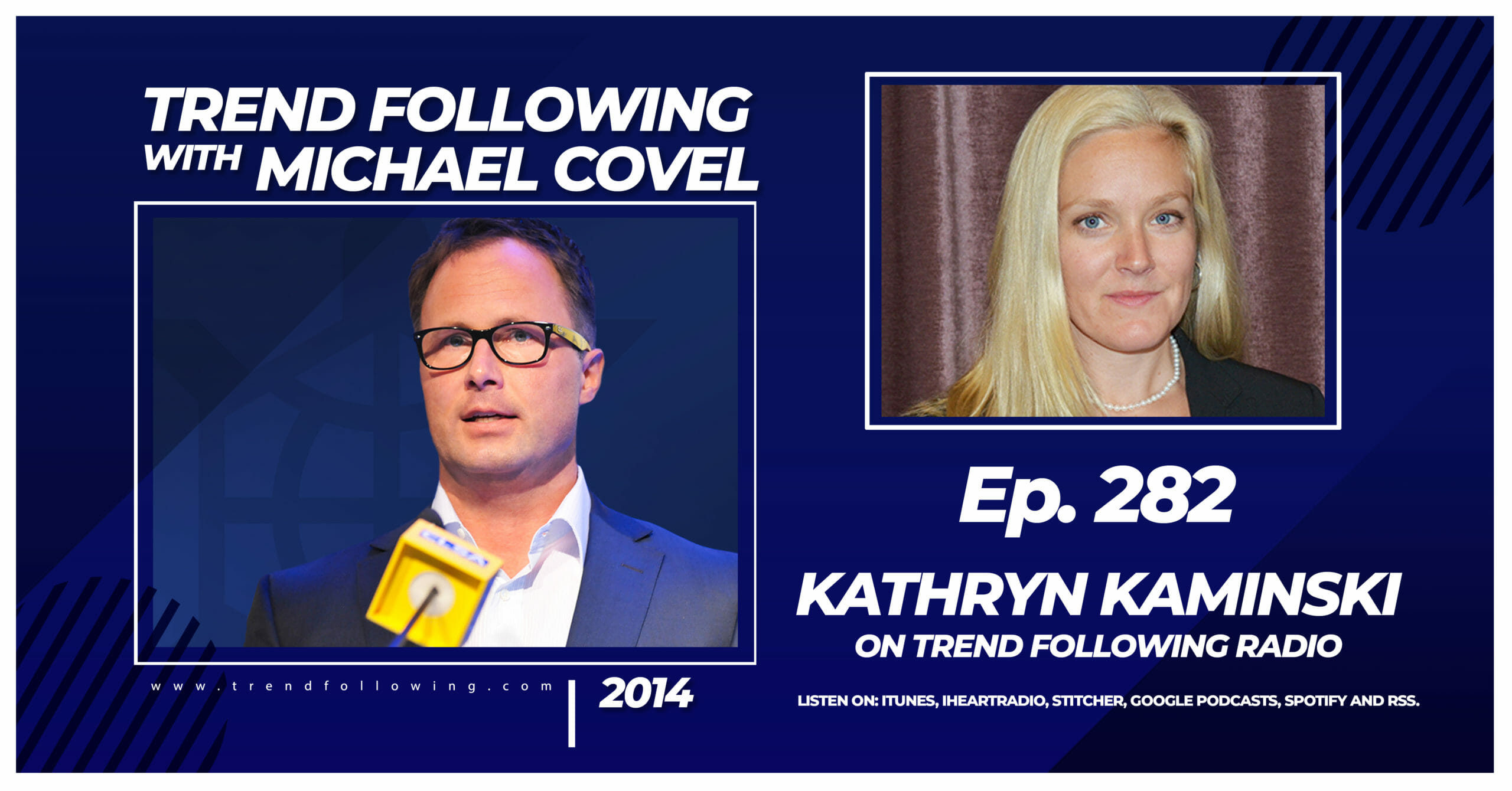
Ep. 282: Kathryn Kaminski Interview with Michael Covel on Trend Following Radio

Kathryn Kaminski
Kathryn Kaminski

My guest today is Kathryn Kaminski, the deputy managing director the institute for financial research (SIFR) Stockholm Sweden. She’s also a contributor to CME Group. She earned her PhD at the MIT Sloan School of Management. At the MIT Laboratory for Financial Engineering, she conducted research on financial heuristics in collaboration with Professor Andrew W. Lo. Her new book, with Alex Greyserman, is “Trend Following with Managed Futures: The Search for Crisis Alpha.”

The topic is Trend Following.

In this episode of Trend Following Radio we discuss:

  • Survivorship bias
  • Kaminski’s background and upbringing
  • Convergent risk-taking strategies and divergent risk-taking strategies
  • Social networking as an example of risk
  • Apple as an example of convergent/divergent
  • The importance of failure
  • The efficient market hypothesis, the idea that trend following is “voodoo”, and the lack of transparency in trend following
  • Critics of trend following
  • Kaminski’s “ah-ha” moment with trend following
  • Why trend following works in times of crisis
  • The adaptive markets hypothesis
  • Looking at markets like ecologies
  • Divergence and “punctured equilibrium”
  • The process of going back 800 years analyzing trend following
  • The idea of black boxes
  • The acceptance of trend following

Listen to this episode:

Jump in!

Make My Dreams A Reality Mr. Covel

Feedback in:

Dear Mr. Covel, Trust you must be doing great.​ ​I ​have read all of your books many times & I really admire you for your methodical approach to markets. I am a IIT-IIM Graduate with more than 22 years of experience in India Capital Markets. I have been able to predict the market turns with close to 90% accuracy with verifiable track record. I appear on CNBC, ZEE Business & ET-NOW regularly. I am really passionate towards my profession. I run a boutique Alternative Investment Management firm specializing in generating positive returns irrespective of Market Direction. We are proficient in all types of Technical Analysis based trading.

1. Conventional Pattern Recognition Based Trading
2. Computerized Algorithm Based Trading
3. Predictive Methodology Based Analysis
4. Behavioral Studies based on Market’s Psychological Profile

I have a proposal to launch an Absolute Alpha Global Hedge Fund using hugely diversified strategies for trading in multiple asset classes such as different Global Equity Indices, Commodities & Currencies. As we will be using just 30% fund in trading, more than 60% funds will be used in Global Arbitrage to generate fixed income for balancing the risk. We are fully confident that we will be able to give more than 20% positive returns per annum in USD terms with less than 10% Equity drawdown. We wish to create a Global Hedge Fund which specializes in generating super normal positive returns every year. This structure has humongous potential to become a hugely successful Fund in just 2 to 3 years. I have 100% conviction in my abilities to deliver the real performance. An association with your company will give us everything what we are looking for. I look forward to hear positively from you soon to make my dream into reality. I promise you to give my 100% efforts to deliver more than the promise.

Thanks & warm regards,
[Name]

I don’t recall ever writing about 90% accuracy. Isn’t that the Holy Grail of all Holy Grails? Even if you had that accuracy how does it guarantee you make money? You could be accurate 90% of the time and still lose massive money on the other 10%. Accuracy talk is not trend following.


How can you move forward immediately to Trend Following profits? My books and my Flagship Course and Systems are trusted options by clients in 70+ countries.

Also jump in:

Trend Following Podcast Guests
Frequently Asked Questions
Performance
Research
Markets to Trade
Crisis Times
Trading Technology
About Us

Trend Following is for beginners, students and pros in all countries. This is not day trading 5-minute bars, prediction or analyzing fundamentals–it’s Trend Following.