Subscribe now and watch my free trend following VIDEO.

Diversification is Key to Trend Following

Feedback:

Hey Mike, I was thinking about your recent podcast where you talked about how the sharks were posting Bill Dunn’s worst years to demonstrate the failure of trading. It reminded me of the recent articles on John Paulson. You may have read that his gold fund is doing horribly this year. Down 65%. Just like with Bill Dunn, people who don’t understand trading are just salivating over this demonstration of the “failure of trading”. The fund only represents 2% of Paulson’s funds. If this fund operates totally independently of his others funds then I might be inclined to agree with some of the criticism Mike. I can’t understand how any professional trader of Paulson’s caliber could allow his fund to lose 65% of assets. Also, I can’t understand why any professional trader could have looked at a gold chart for the past few years and decide to go long which is the only way that I can imagine that he could be down 65%. If he does incorporate counter trending strategies and was long then I don’t understand why his stops didn’t prevent such a massive loss. On the other hand Mike, if this fund does not operate totally independent, but operates as part of all of his assets, then my view would be totally different. A 2% investment of total funds under management while a bit high, is not a totally unreasonable amount for a professional to risk on a trade. Furthermore if that is the case, just think about it Mike. A 65% unrealized loss on a particular trade means you’re still in the trade. We are actually willing to risk 100% of the 1% or so that we risk on each trade. I don’t think some people realize that. If you have $100,000 trading account and you risk $1000, 65% down in that trade means you are still in the trade. The trade doesn’t end until you either get stopped at a 100% loss of the $1,000 or you take profits of 2:1 or 3:1 on that trade. Some people don’t seem to realize that about trading.

Confusion here.

65% loss on one market is not trend following! Where is the cutting of loss? Dunn’s drawdown was from taking many small losses across many markets. They add up. No one drop on one market. Plus there really can’t be a trend following fund on one market alone. That means no diversification and that is a recipe for failure.


How can you move forward immediately to Trend Following profits? My books and my Flagship Course and Systems are trusted options by clients in 70+ countries.

Also jump in:

Trend Following Podcast Guests
Frequently Asked Questions
Performance
Research
Markets to Trade
Crisis Times
Trading Technology
About Us

Trend Following is for beginners, students and pros in all countries. This is not day trading 5-minute bars, prediction or analyzing fundamentals–it’s Trend Following.

Wall Street Gurus Know Investor Brains Are Gullible & Easy to Manipulate

From MarketWatch:

“…the brains of Wall Street gurus and brains of Main Street investors are in a symbiotic relationship, a “dance of death.” Wall Street gurus know the investor’s brain is gullible, easy to manipulate, will ignore facts, historical data, rational judgment, anything to to stay optimistic, even when a crash is imminent, obvious, even in progress. It’s in our DNA, our brains, it’s our nature. Yes, American investors are born optimists. So are Wall Street gurus. Years ago we did a little research study. Turns out that 93% of time Wall Street is bullish. And today, from what we see in the field of behavioral economics, it’s also true that the brains of America’s 95 million investors are also 93% optimistic. Get it? Americans are inherently optimistic, blind optimists. We dismiss facts, block reality, deny history, crashes, meltdowns. Wall Street gurus do it. Main Street’s 95 million investors buy the spin. We secretly want to be deceived. Even in real bad times, deep inside we trust in a better future, want the good news, optimism, happy talk, bull markets. We desperately want to forget the harsh reality of the past. So we deny stuff. Wall Street knows this too. So they profile you. Yes, they know you’re a sucker for happy talk. Warning: This symbiotic relationship is doomed to repeat, forever. And the bubbles will get bigger, we’ll have another, bigger meltdown, even another Great Depression. So expect Wall Street (and their Washington buddies) to just keep feeding sound bites to the media to manipulate the brains of Main Street’s investors. It’s in their DNA. It’s in your brains to trust.

The only proven strategy to profit from that is trend following.


How can you move forward immediately to Trend Following profits? My books and my Flagship Course and Systems are trusted options by clients in 70+ countries.

Also jump in:

Trend Following Podcast Guests
Frequently Asked Questions
Performance
Research
Markets to Trade
Crisis Times
Trading Technology
About Us

Trend Following is for beginners, students and pros in all countries. This is not day trading 5-minute bars, prediction or analyzing fundamentals–it’s Trend Following.

A Debate on Trend Following

A recent email exchange:

Name: Reading “The Talent Code” by Daniel Coyle. A superb book, I wonder if you know it. On the subject of TF may I also suggest you to consider a podcast with Gary Anderson (The Janus Factor). His work is superb because he has developed a way on knowing when to use tf tools or when to be a mean reverting contrarian. We know that TF does not always work: to know WHEN it offer a different edge. I really believe you should talk with him.

Covel: So all those drawdowns taken by some very smart and successful TFs over the decades were all in vane? They could have avoided them all by switching out at the exact right time to another strategy?

Name: Not 100% but to a certain extent it would seem so. Before you dismiss the idea, have a look at his papers / work. You can measure momentum for leaders and laggards separately; then you calculate the spread in relative performance, some sort of relative strength between 2 equity lines: one for a portfolio with only leaders and one with only laggards. Say from the universe of all commodities you look at the top 20% and bottom 20%. TF has its own cycles, they are not of fixed length clearly but its feature, positive feedback, can be measured. This is another level of analysis not seen in the Turtle work: having a plan, having a broad universe of asset classes, normalizing risk, adjusting risk is all a way to mitigate the inherent volatility of trend following. Anderson’s work has, so far, since 2003, limited to stock but there is no reason not to apply to commodities. Consider this: TF works like a peach until it breaks, then it starts to work again. Maybe the WHY cannot be explained but the WHEN, in reasonable terms, can be calculated, plotted and, possibly, integrated in a TF portfolio. Can you remember how from March 2009 the market has gone up overall but it was led by the laggards? Applying TF to stocks would not have generated good profits or even losses (what I call a “dirty” trend, where reversals are deep and costly for TF). Nowhere in the TF work I have done I have seen this interesting concept. Food for thought.

Covel: At first blush if tomorrow can’t be predicted the idea of a money making system that shifts gears such as you propose … would be novel. I would wonder why all the big names over the years have not been available to invent such a fool proof system? And beyond academic efforts, does a track record exist to show this bi-polar trading system in action?

Name: I am working to see if there is a way to use this “technology”. Tomorrow cannot predicted but you can reasonably sure that it is not going to go very far from where you are. There is a gradual transition from TF to MR and that can be measured – the HOW one implements the idea is another matter. Anderson has been working on stocks. No there is no track record.Consider this: work on relative strength goes back to the 60s with Levi’s paper. Only now there is widespread acceptance of momentum. It took ages to dismantle the idea of EMH. Anderson is trying to show / describe why and when TF (momentum) is “shape shifting”. It is a fascinating subject. And Levi’s work was snubbed from academia if you remember. Original ideas take time to establish, to be accepted. In any environment. You are showing yourself that TF works with numbers and yet very few out there are adopting it. It is what someone called one of those “mysteries of life”.

Covel: Good luck here. I would read Taleb’s work, consult with TFs who have come before us, objectively analyze why TF works, and maybe not try to reinvent the wheel.

Name: First I did not say that one could exactly know when to switch from TF to MR. There is of course some lag but what is interesting, is the persistence of a particular “state” until it changes again. I cannot say that TF drawdowns were in “vane” because either they recognized the problem and accepted to go with it anyway by sticking with their strategy no matter what (a-la Dunn) or they have tried to reduce the impact of the rotation between positive and negative feedback by adjusting risk and market exposure by calculating correlation coefficients to change the mix. Also adding more and more markets, reducing exposure when all the markets are working too much too nicely (a sign that risk has gone up too much), or simply by decreasing risk during drawdowns. ALL these methods address the problem from a different point of view without necessarily asking the question: is TF working NOW, is there a way to see if the lack of performance in leaders and laggards from a TF can be distilled in an indicator to warn… I have added some of his work available on internet for you to see and ponder. It’s your call.

Covel: What is the problem? The idea of a drawdown is the problem? Losing any money is the problem? What do you mean by “impact of rotation between positive and negative feedback”? A loss? BTW Connie Brown dodged my podcast. MTA really needs to clean up the hocus pocus on the train!

Name: I agree with that 150% – you know I dislike “normal” TA. But it is YOUR fault! You are going to someone that a.) is not systematic, b.) she uses EWaves, c.) she makes “calls”. Basically your are asking the right questions to the wrong person. Unless you are deliberately an agent provocateur with technicians. My humble suggestion is to interview those technicians that are systematic like Kirkpatrick. Connie Brown is the exact opposite. But you already knew that.

Covel: Yeah, but if the people in MTA let that nonsense in, on their boards, etc. — what value is CMT/MTA?

Addendum for everyone: Yes, that last sentence may be controversial, but tell me how my thought goes in the wrong direction?

Related Content

Next Level thinking by Faulkner

Fascinating Work

Mark Kritzman Interview

A Fresh Start

Morgan Stanley Hit and Run


How can you move forward immediately to Trend Following profits? My books and my Flagship Course and Systems are trusted options by clients in 70+ countries.

Also jump in:

Trend Following Podcast Guests
Frequently Asked Questions
Performance
Research
Markets to Trade
Crisis Times
Trading Technology
About Us

Trend Following is for beginners, students and pros in all countries. This is not day trading 5-minute bars, prediction or analyzing fundamentals–it’s Trend Following.

Right and Wrong

A recent conversation:

Luis: Hi Michael this last podcast is really amazing with Harry Dent. To be honest I live in Portugal and I don´t know what we need more to open our eyes from our Global State of Coma. Keep going with this amazing podcast.

Michael: Why did you like this one so much?

Luis: It is amazing that you keep explaining the manipulation in so many different ways and we just can´t see. And this one is from a more fundamental I hope more people understand now people just love this kind of numbers.

Michael: Some people think it is bad to discuss these issues–trade price alone they say. Sure trade the price for trading, but we as human beings can’t keep ignoring what is the appropriate way to run societies. There is a right and wrong.


How can you move forward immediately to Trend Following profits? My books and my Flagship Course and Systems are trusted options by clients in 70+ countries.

Also jump in:

Trend Following Podcast Guests
Frequently Asked Questions
Performance
Research
Markets to Trade
Crisis Times
Trading Technology
About Us

Trend Following is for beginners, students and pros in all countries. This is not day trading 5-minute bars, prediction or analyzing fundamentals–it’s Trend Following.
Ep. 148: Jerry Parker Interview with Michael Covel on Trend Following Radio

Jerry Parker
Jerry Parker

My guest today is Jerry Parker, a trend following trader with over 25 years of experience. His firm is Chesapeake Capital and he was featured in Covel’s book “The Complete TurtleTrader.”

The topic is Trend Following.

In this episode of Trend Following Radio we discuss:

  • Fitness
  • The Hindenburg “omen”
  • Objective entry/exit criteria
  • Why you’d stay in a long position that you wouldn’t want to enter into today
  • The “oversleeping” hypothetical
  • The idea that reducing volatility increases risk
  • Definitions of volatility and risk
  • Parker’s thoughts on trend followers not really having drawdowns in the typical sense
  • “Managed futures” and why investors may not want that vs. “trend following”
  • Definitions of “managed futures” and “trend following”
  • Why managed futures isn’t a good term for some

Listen to this episode:

Jump in!

Ep. 145: Bubble Pop with Michael Covel on Trend Following Radio

Bubble Pop with Michael Covel on Trend Following Radio

Please enjoy my monologue Bubble Pop with Michael Covel on Trend Following Radio. This episode may also include great outside guests from my archive.

Listen to this episode:

Want to learn more Trend Following? Watch my video here.

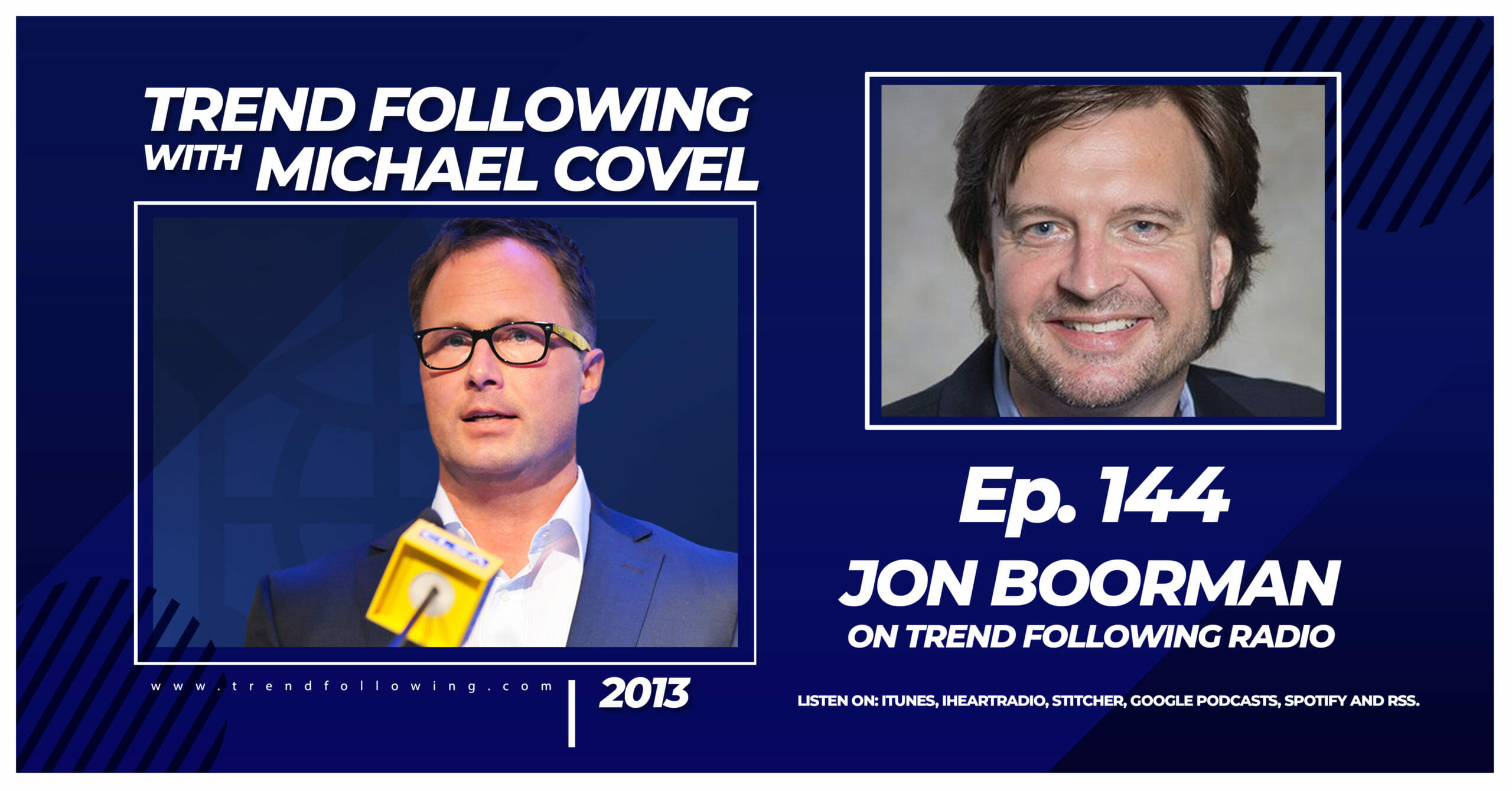
Ep. 144: Jon Boorman Interview with Michael Covel on Trend Following Radio

Jon Boorman
Jon Boorman

My guest today is Jon Boorman, CMT, a market technician, analyst, and trader with 25 years of experience in global equity, FOREX, and futures markets. Boorman employs trend following and momentum strategies to generate actionable trade ideas. Boorman has been with many big firms in the past 25 years, but now works on his own outside of the infrastructure of the big investment banks and brokerage firms.

The topic is Trend Following.

In this episode of Trend Following Radio we discuss:

  • What it was like working within the big firms
  • Boorman’s beginnings and how he found his way to where he is today
  • What advice Boorman would have for newcomers, and whether the training Boorman went through is still relevant to up-and-comers today
  • How regardless of your access, success comes down to the individual
  • Price-based trend following vs. other technical analysis
  • Boorman’s early “a-ha” moments towards trend following
  • Trend following complexity, and why it can be “simple, but not easy”
  • Trading your own personality
  • Van Tharp, risk management and position sizing
  • Trend predicting vs. trend following
  • The fantasy of calling tops and bottoms
  • Why the major media outlets don’t give trend following proper coverage, and why trend followers don’t make good “copy”
  • Mistaken emphasis on entries rather than exits
  • The idea that Boorman “no longer having a need to be right” after he left Lehman Brothers
  • Alpha capture
  • Acceptance of trend following amongst the larger financial community
  • Understanding the legendary trend following traders such as Bill Dunn and Jerry Parker

Listen to this episode:

Jump in!