Subscribe now and watch my free trend following VIDEO.

Ep. 188: Hendry, Harding, The Pope and Acroyoga with Michael Covel on Trend Following Radio

Hendry, Harding, The Pope and Acroyoga with Michael Covel on Trend Following Radio

Please enjoy my monologue Hendry, Harding, The Pope and Acroyoga with Michael Covel on Trend Following Radio. This episode may also include great outside guests from my archive.

Listen to this episode:

Want to learn more Trend Following? Watch my video here.

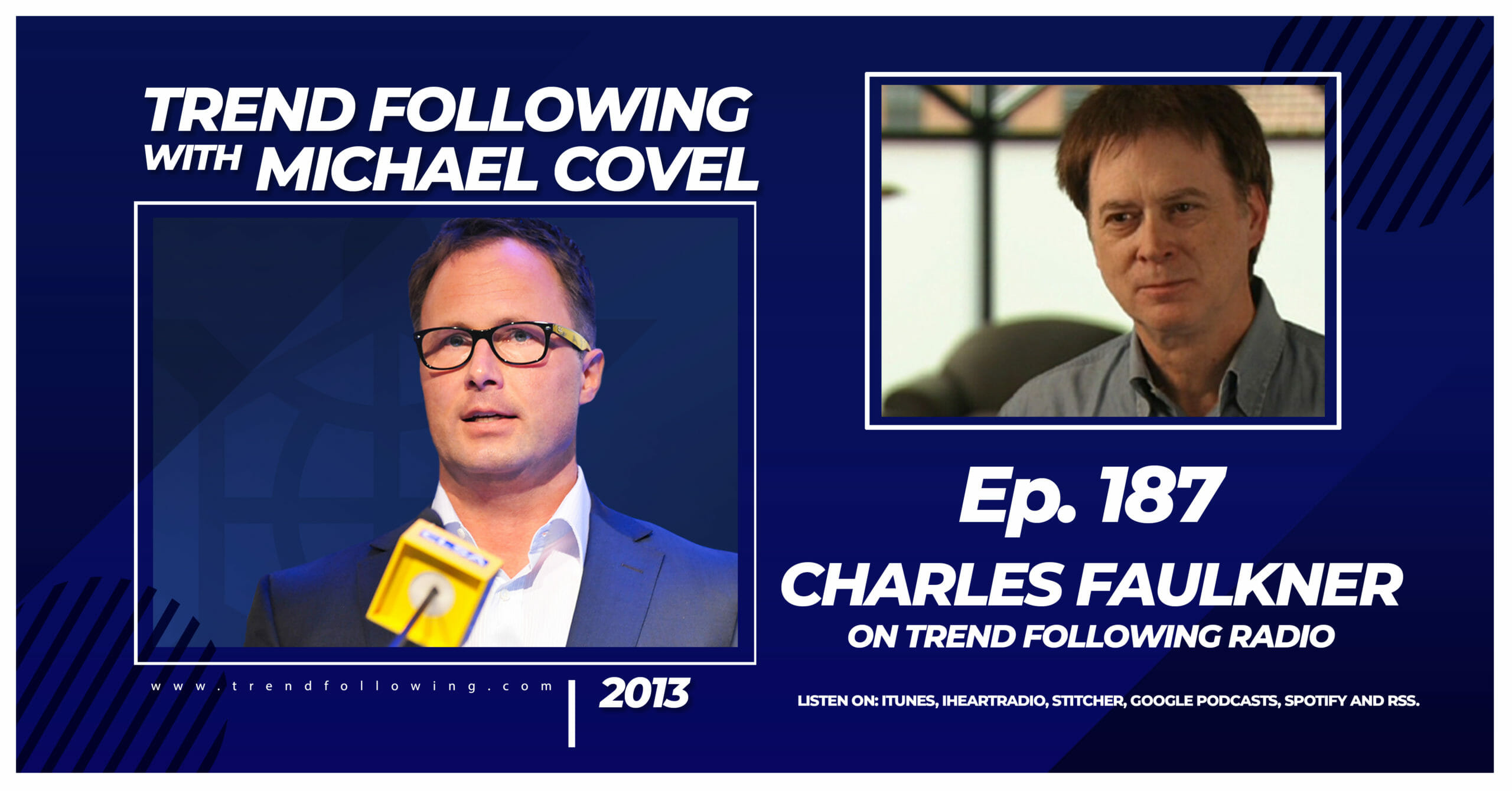
Ep. 187: Charles Faulkner Interview with Michael Covel on Trend Following Radio

Charles Faulkner
Charles Faulkner

My guest today is Charles Faulkner, an author, trader, and international expert on modeling the knowledge and performance of exceptional individuals. He was originally featured in “The New Market Wizards” by Jack Schwager.

The topic is trading psychology.

In this episode of Trend Following Radio we discuss:

  • Behavior, emotions, decision-making, and intuition in the world of money–and what money does to us on a biological level
  • Neurolinguistic Programming
  • How money in the mind influences money in the world
  • The schizophrenic-seeming handout to the two recent Nobel Prize winners
  • “System one” and “system two”
  • How “one” is running all the time, how “two” takes effort–and where Faulkner hopes to take this research
  • How experience can teach “system one”
  • New lightbulb moments in current research
  • How the “afraid to lose” (or in Singapore, Kiasu) concept could be terribly dangerous when applied to money
  • Why the less you know about something, the clearer the image–and the more certain you are that it’s real and true
  • The need for certainty
  • Money as a living metaphor; sunk costs
  • The Myers-Briggs instrument
  • Rituals and money

Listen to this episode:

Jump in!

Exploring Trend Following for the First Time

Feedback:

Michael: I have received [your] CD. Thank you very much for all the work you are doing in compiling this eclectic knowledge and putting that in one central place. I have been in tune with your work through books and podcast last few months. I am on my journey, searching for [a] method that works for me. I have not purchased anything but getting increasing[ly more] curious about your techniques that you have derived [from] primary sources and are not in public domain. Following are basic questions, when you get a chance have someone reply: Do you have one system (set of rules) or many systems that work independently? How much emphasis [do] you have on instrument selection? Out of 30 or so liquid markets even if all signals are taken with 1% risk, that is 30% risk in book? Are your systems incorporating position sizing? How long have you done back testing for systems, is there a way to see back tested data by trade? I am big in looking at contribution of individual trade to total P&L.(I am not looking for all trades to make money, but more interested in P&L distribution). Regards, Maulin P.

There are a few core systems that allow variables to be changed to meet your risk objectives. Portfolio selection is critical and how you manage the risk in said portfolio is critical. I explain all. There is a process. Not as simple as you describe, but always operates under the guise of protecting capital. Yes, position sizing. 100%. No back tests are provided. Clients can choose varying portfolios and varying risk levels. Not one size fits all. Success stories: trendfollowing.com/success.


How can you move forward immediately to Trend Following profits? My books and my Flagship Course and Systems are trusted options by clients in 70+ countries.

Also jump in:

Trend Following Podcast Guests
Frequently Asked Questions
Performance
Research
Markets to Trade
Crisis Times
Trading Technology
About Us

Trend Following is for beginners, students and pros in all countries. This is not day trading 5-minute bars, prediction or analyzing fundamentals–it’s Trend Following.

Harvard Yoga Scientists Find Proof of Meditation Benefit; Trend Following Benefit Too

Trading can be taxing on emotions. Hard on health. Anxiety can arrive. The good news? There is a proactive health process you should consider right along with your position sizing algorithm:

Scientists are getting close to proving what yogis have held to be true for centuries — yoga and meditation can ward off stress and disease.
John Denninger, a psychiatrist at Harvard Medical School, is leading a five-year study on how the ancient practices affect genes and brain activity in the chronically stressed. His latest work follows a study he and others published earlier this year showing how so-called mind-body techniques can switch on and off some genes linked to stress and immune function.

While hundreds of studies have been conducted on the mental health benefits of yoga and meditation, they have tended to rely on blunt tools like participant questionnaires, as well as heart rate and blood pressure monitoring. Only recently have neuro-imaging and genomics technology used in Denninger’s latest studies allowed scientists to measure physiological changes in greater detail.

“There is a true biological effect,” said Denninger, director of research at the Benson-Henry Institute for Mind Body Medicine at Massachusetts General Hospital, one of Harvard Medical School’s teaching hospitals. “The kinds of things that happen when you meditate do have effects throughout the body, not just in the brain.”

The government-funded study may persuade more doctors to try an alternative route for tackling the source of a myriad of modern ailments. Stress-induced conditions can include everything from hypertension and infertility to depression and even the aging process. They account for 60 to 90 percent of doctor’s visits in the U.S., according to the Benson-Henry Institute. The World Health Organization estimates stress costs U.S. companies at least $300 billion a year through absenteeism, turn-over and low productivity.

Seinfeld, Murdoch

The science is advancing alongside a budding “mindfulness” movement, which includes meditation devotees such as Bill George, board member of Goldman Sachs Group and Exxon Mobil Corp., and comedian Jerry Seinfeld. News Corp. Chairman Rupert Murdoch recently revealed on Twitter that he is giving meditation a try.

As a psychiatrist specializing in depression, Denninger said he was attracted to mind-body medicine, pioneered in the late 1960s by Harvard professor Herbert Benson, as a possible way to prevent the onset of depression through stress reduction. While treatment with pharmaceuticals is still essential, he sees yoga and meditation as useful additions to his medical arsenal.

Exchange Program

It’s an interest that dates back to an exchange program he attended in China the summer before entering Harvard as an undergraduate student. At Hangzhou University he trained with a tai chi master every morning for three weeks.

“By the end of my time there, I had gotten through my thick teenage skull that there was something very important about the breath and about inhabiting the present moment,” he said. “I’ve carried that with me since then.”

His current study, to conclude in 2015 with about $3.3 million in funding from the National Institutes of Health, tracks 210 healthy subjects with high levels of reported chronic stress for six months. They are divided in three groups.

One group with 70 participants perform a form of yoga known as Kundalini, another 70 meditate and the rest listen to stress education audiobooks, all for 20 minutes a day at home. Kundalini is a form of yoga that incorporates meditation, breathing exercises and the singing of mantras in addition to postures. Denninger said it was chosen for the study because of its strong meditation component.

Participants come into the lab for weekly instruction for two months, followed by three sessions where they answer questionnaires, give blood samples used for genomic analysis and undergo neuro-imaging tests.

‘Immortality Enzyme’

Unlike earlier studies, this one is the first to focus on participants with high levels of stress. The study published in May in the medical journal PloS One showed that one session of relaxation-response practice was enough to enhance the expression of genes involved in energy metabolism and insulin secretion and reduce expression of genes linked to inflammatory response and stress. There was an effect even among novices who had never practiced before.

Harvard isn’t the only place where scientists have started examining the biology behind yoga.

In a study published last year, scientists at the University of California at Los Angeles and Nobel Prize winner Elizabeth Blackburn found that 12 minutes of daily yoga meditation for eight weeks increased telomerase activity by 43 percent, suggesting an improvement in stress-induced aging. Blackburn of the University of California, San Francisco, shared the Nobel medicine prize in 2009 with Carol Greider and Jack Szostak for research on the telomerase “immortality enzyme,” which slows the cellular aging process.

Build Resilience

Not all patients will be able to stick to a daily regimen of exercise and relaxation. Nor should they have to, according to Denninger and others. Simply knowing breath-management techniques and having a better understanding of stress can help build resilience.

“A certain amount of stress can be helpful,” said Sophia Dunn, a clinical psychotherapist who trained at King’s College London. “Yoga and meditation are tools for enabling us to swim in difficult waters.”

Thanks to Gary Percy for the find. My yoga? See pics on FB.

Similar Posts

Flow State

Dan Ariely Interview

Podcast with Charles Poliquin

Andy Puddicombe

Feedback Email Q and A


How can you move forward immediately to Trend Following profits? My books and my Flagship Course and Systems are trusted options by clients in 70+ countries.

Also jump in:

Trend Following Podcast Guests
Frequently Asked Questions
Performance
Research
Markets to Trade
Crisis Times
Trading Technology
About Us

Trend Following is for beginners, students and pros in all countries. This is not day trading 5-minute bars, prediction or analyzing fundamentals–it’s Trend Following.

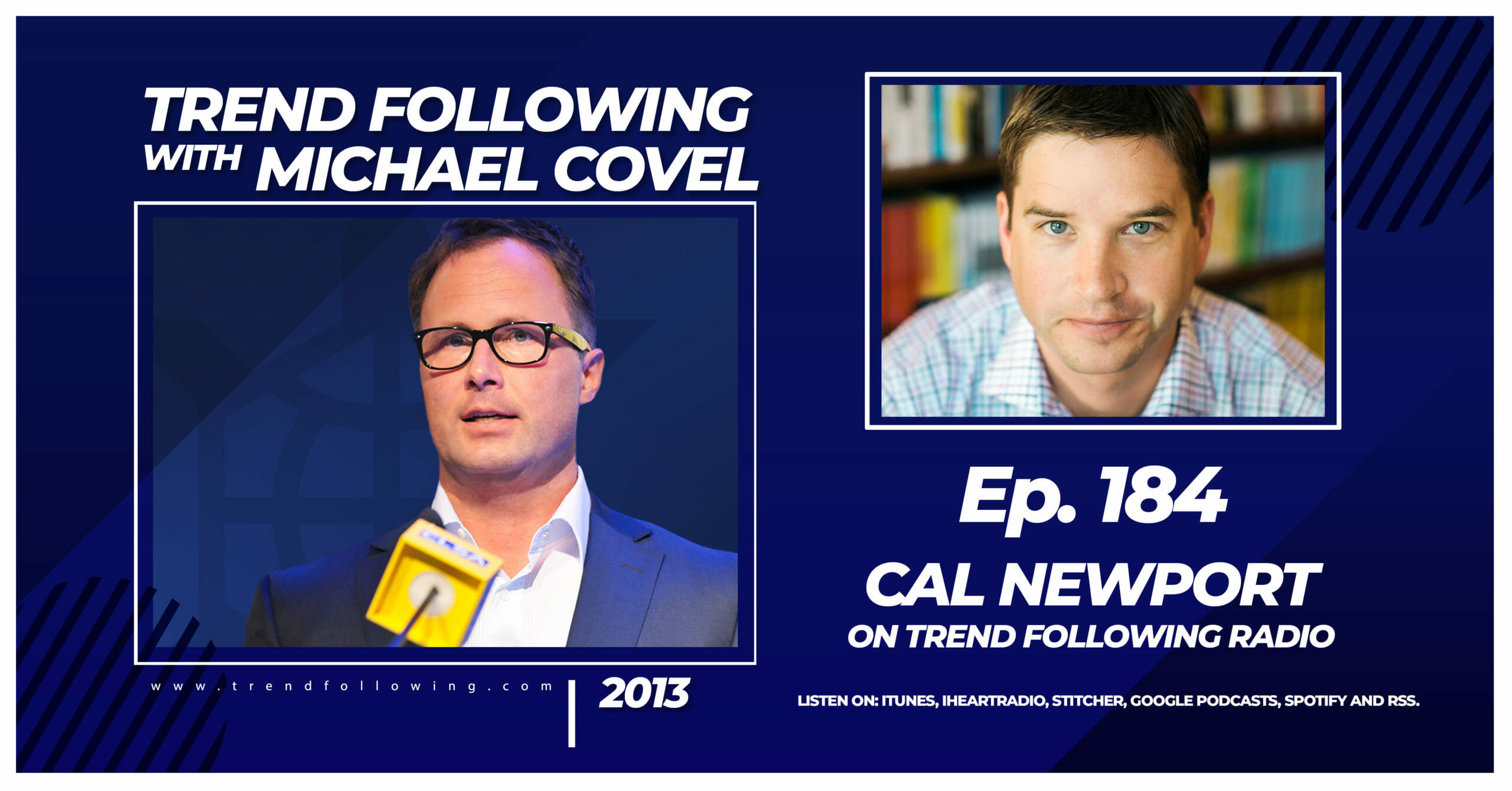
Ep. 184: Cal Newport Interview with Michael Covel on Trend Following Radio

Cal Newport
Cal Newport

My guest today is Cal Newport, an American non-fiction author and associate professor of computer science at Georgetown University.

The topic is passion.

In this episode of Trend Following Radio we discuss:

  • Alan Watts
  • Why following your passion isn’t such a great idea from Newport’s perspective
  • The notion of deliberate practice and the 10000 hour rule, falling back on simplistic strategies that fail
  • Passion following success as the true gauge
  • Misconceptions about passion
  • Thinking of passion as a side-effect of running your career in the right way
  • Overcoming difficulty as a necessary step in the process
  • The work and analysis Newport has done looking at top chess players
  • The systematic aspect of gaining skill and its ties to passion
  • Anxiety and failure

Listen to this episode:

Jump in!

Statistics in Football Can Make You See the Innovative Trend Following Light

Consider a story excerpt about “numbers” that might just help you to make more money:

A high school coach in Arkansas has developed a new football strategy: His team never punts. And he always employs the on-side kick. Coach Kevin Kelley developed these tactics from a study of football statistics; though the team often gives up the ball on downs, the increased number of possessions pays off in the long run. The coach has an .833 record since adopting this strategy, and his team has won the state championship three times. This season the team is 10-0.

Keeping the offense on the field on fourth down allows for more creative play-calling. Third-and-long does not have to be a passing down. The Little Rock school can run the ball, throw a screen pass or use any number of formations. Defenses do not know whether to use a nickel or dime defense. And Pulaski’s offense has less pressure on third down.

“We don’t really worry too much about it,” quarterback Spencer Keith said. “We just get as many yards as we can. We don’t have to go for the first down.”

If Pulaski converts on fourth down, it creates a momentum change similar to a turnover. Other high school coaches have told Kelley they would rather see his team punt. The Bruins even avoid punting when the defense has stopped them inside their own 10-yard line.

“You can just tell people are in the stands thinking, ‘You’re an idiot,’” Kelley said. Kelley supports this rationale with numbers analysis.

If Pulaski has a fourth-and-8 at its own 5-yard line, Kelley said his explosive offense likely will convert a first down at least 50 percent of the time. If it fails to convert, statistical data from the college level shows that an opponent acquiring the ball inside the 10-yard line scores a touchdown 90 percent of the time. If Pulaski punts away (i.e., a 40-yard punt with a 10-yard return) the other team will start with the ball on the 38-yard line and score a touchdown 77 percent of the time. The difference is only 13 percent.

An innovative and statistics-minded coach, Kelley had tinkered with eschewing the punting game since winning his first state championship in 2003. He became further emboldened after reading several studies, including “Do Firms Maximize? Evidence from Pro Football,” by University of California-Berkeley economics professor David Romer. Kelley also examined ZEUS, a computer program developed by Chuck Bower, who has a doctorate in astrophysics, and Frank Frigo, a game theory expert, to model and predict football outcomes.

THAT is exactly how trend following approaches making money in the markets. Question the typical ways of investing and put the odds on your side.

The way to a nice life.


How can you move forward immediately to Trend Following profits? My books and my Flagship Course and Systems are trusted options by clients in 70+ countries.

Also jump in:

Trend Following Podcast Guests
Frequently Asked Questions
Performance
Research
Markets to Trade
Crisis Times
Trading Technology
About Us

Trend Following is for beginners, students and pros in all countries. This is not day trading 5-minute bars, prediction or analyzing fundamentals–it’s Trend Following.

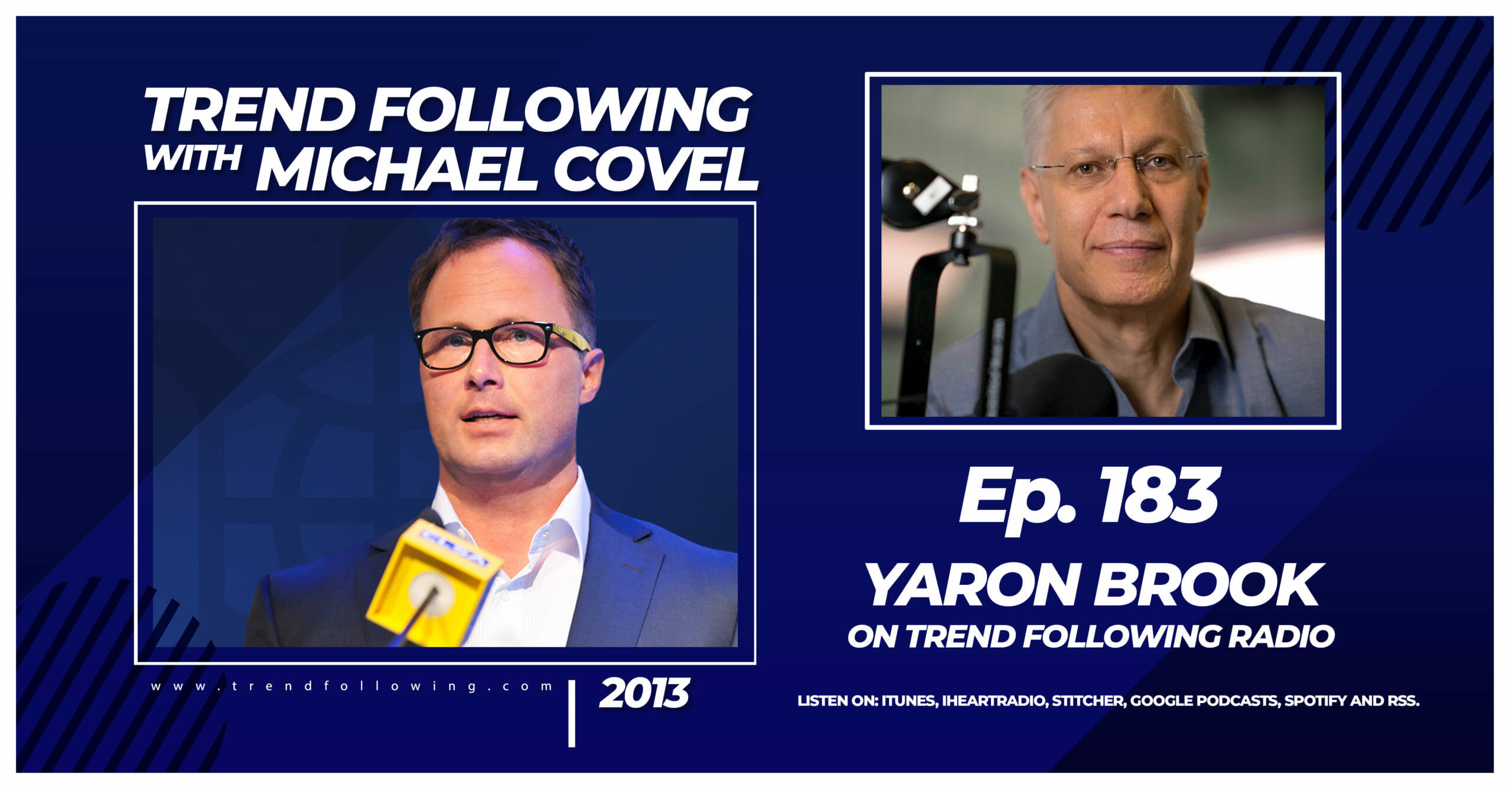
Ep. 183: Yaron Brook Interview with Michael Covel on Trend Following Radio

Yaron Brook
Yaron Brook

My guest today is Yaron Brook, an Israeli-American entrepreneur, writer, and activist. He is an Objectivist and the current chairman of the board at the Ayn Rand Institute, where he is the executive director.

The topic is liberty.

In this episode of Trend Following Radio we discuss:

  • Trading
  • The nature of altruism
  • The idea and definitions of selfishness in the context of objectivism
  • The power of ideas
  • The idea of being a victim
  • Schools, teaching, and political teaching
  • Entitlement leading to victimhood
  • The rise of state power, the ambitious poor, and the minimum wage
  • Free work and internships
  • Alan Greenspan
  • America compared to Singapore

Listen to this episode:

Jump in!