Subscribe now and watch my free trend following VIDEO.

Ep. 389: Joey Yap Interview with Michael Covel on Trend Following Radio

Joey Yap
Joey Yap

Subscribe to Trend Following Radio on iTunes

Please enjoy my monologue Logic Over Faith with Michael Covel on Trend Following Radio. This episode may also include great outside guests from my archive.

In this episode of Trend Following Radio:

  • Experts: get close to them and learn
  • You can’t predict the future, you can only see patterns
  • If you don’t like your destiny, go the other direction
  • Change your environment, change your life
  • Corporate culture: an energy determined by leaders
  • You don’t have to invent – fix something

“There are two kinds of people. People who make things complex, and people who simplify.” – Joey Yap

Mentions & Resources:

Listen to this episode:

Want to learn more Trend Following? Watch my video here.

Get the foundation to making money in up, down and *surprise markets on the Trend Following mailing list.

My Thoughts on Gaining Quick Riches from Day and Short Term Trading

Consider an excerpt from Trend Following:

When you trade more or with higher frequency, the profit that you can earn per trade decreases, whereas your transaction costs stay the same. This is not a winning strategy. Yet, traders still believe that short-term trading is less risky. Short-term trading, by definition, is not less risky, as evidenced by the catastrophic blowout of Victor Niederhoffer and Long Term Capital Management (LTCM). Do some short-term traders excel? Yes. However, think about the likes of whom you might be competing with when you are trading short term. Professional short-term traders, such as Jim Simons, have hundreds of staffers working as a team 24/7. They are playing for keeps, looking to eat your lunch in the zero-sum world. You don’t stand a chance.

Unfortunately, the flaws in day trading are often invisible to those who must know better. Sumner Redstone, CEO of Viacom, was interviewed recently and talked of constantly watching Viacom’s stock price, hour after hour, day after day. Although Redstone is a brilliant entrepreneur and has built one of the great media companies of our time, his obsession with following his company’s share price is not a good example to follow. Redstone might feel his company is undervalued, but staring at the screen will not boost his share price.

The logic is clear. However, emails still arrive:

Listener: Good morning. I am fairly knowledgeable about Trend Following as a result of reading some of your books. My current plan is to successfully and consistently day trade the e-Mini S&P, then take those profits and learn Trend Following via your course and then successfully trade that way as well. So for the past almost 6 months I have been studying, following and recording daily price action and trading the S&P futures with varying degrees of success and failure. I believe that I am poised for a major breakthrough in my trading plan. As a result of hundreds of hours of studying and recording I have noticed some correlations of overnight price activity with daily price activity, price movement that is inter-related and occurs on a regular basis. To me, these are identifiable events (patterns) on the charts that reveal the “invisible hands” that influence and drive market activity, and perhaps tip off their thinking of where they are going to move the market to. I am now able to use this information on a small scale to take profits out of the market, and continue to make excellent progress. However, I still can’t pinpoint exactly how to use this information on a larger scale to make profitable trading decisions . I have an idea of how to conduct a study to determine if indeed this realization can or cannot be used to make consistently profitable trading decisions, but am not very sure if it would be correct or the best way to conduct a study. I would like to enlist the services of an individual who is well-versed in these types of studies using statistics, probabilities, time and percentages to determine possible outcomes. For example, if I see that a certain overnight price action occurred and it was inter-related with yesterday’s activity and/or recent overnight prices in a certain way, then what are the percentages/probability that today’s activity will be X. As I said earlier, I have recorded these relationships for just shy of 6 months now and suspect there is a way to use this information to make profitable trading decisions, but I’m not quite sure. So, my question for you is can you recommend anybody who you know that has the skill set to do this type of study, and may consider helping me make this determination? Of course I understand that there would be fair compensation for this service. I have already reached out to [name] but have not received a response, so I thought this may be a better way to go. I’ve also been to the Mathematics department at Ohio State University searching for help there, but to no avail. Please let me know what your thoughts are, and thank you very much for your time and for reading this.

Covel: Just to clarify you are asking only about short term S&P trading? To be direct: I have zero leads to help you on that front. I counsel all to avoid day trading. Feel free to follow up.

Listener: Understood. Yes, I am in an S&P trade for 2-3 minutes on average, 12-15 trades per day on average. This is due to the minimal margin requirements, only $500 per contract. It is definitely a very difficult type of trading, but I am using it to be able to afford to Trend Trade. I have been blessed to be shown a system that works which I discovered through much charting and effort. I call it RcS MP for “Reversal continuation System using Magnet Prices”. There is price action that occurs regularly that is “hidden in plain sight”. For instance, look at the 1 minute chart on the left in my attachment. From 1111 to 1122 the price action is a high possibility indication that prices will go down. I drew the grey lines (ON50%- 73, etc.) on the chart at about 730AM, and 4 hours later it is telling me that there’s a good chance of prices going down. They hit the ONT2a- 70 exactly, then went down to within .75 pt to the ONT3- 66.75. Short 2 contracts from 72 to 70, short 2 contracts from 72 to 68 equals 12 pts total, $600. It happens over and over again all week long. I’m looking for help to verify whether or not certain correlations can give me a high probability of larger profits in a longer time frame. Anyway, please do not share this with anybody. I appreciate your time, thank you again.

Covel: From a past thread: Ed Seykota on short-term trading.


How can you move forward immediately to Trend Following profits? My books and my Flagship Course and Systems are trusted options by clients in 70+ countries.

Also jump in:

Trend Following Podcast Guests
Frequently Asked Questions
Performance
Research
Markets to Trade
Crisis Times
Trading Technology
About Us

Trend Following is for beginners, students and pros in all countries. This is not day trading 5-minute bars, prediction or analyzing fundamentals–it’s Trend Following.

Ep. 388: Logic Over Faith with Michael Covel on Trend Following Radio

Logic Over Faith with Michael Covel on Trend Following Radio

Subscribe to Trend Following Radio on iTunes

Please enjoy my monologue Logic Over Faith with Michael Covel on Trend Following Radio. This episode may also include great outside guests from my archive.

In this episode of Trend Following Radio:

  • Logic over faith
  • Financial advisors: there to give mutual fund advice
  • Adapting your strategy
  • How quitting can keep you in the game
  • Forcing yourself to make decisions
  • Risk and reward

“What I say is, at what price? If low interest rates were just that simple of a panacea, we would never have recessions. We would never have these crises, we would never have these panics.” – Carl Icahn

Mentions & Resources:

Listen to this episode:

Want to learn more Trend Following? Watch my video here.

Get the foundation to making money in up, down and *surprise markets on the Trend Following mailing list.

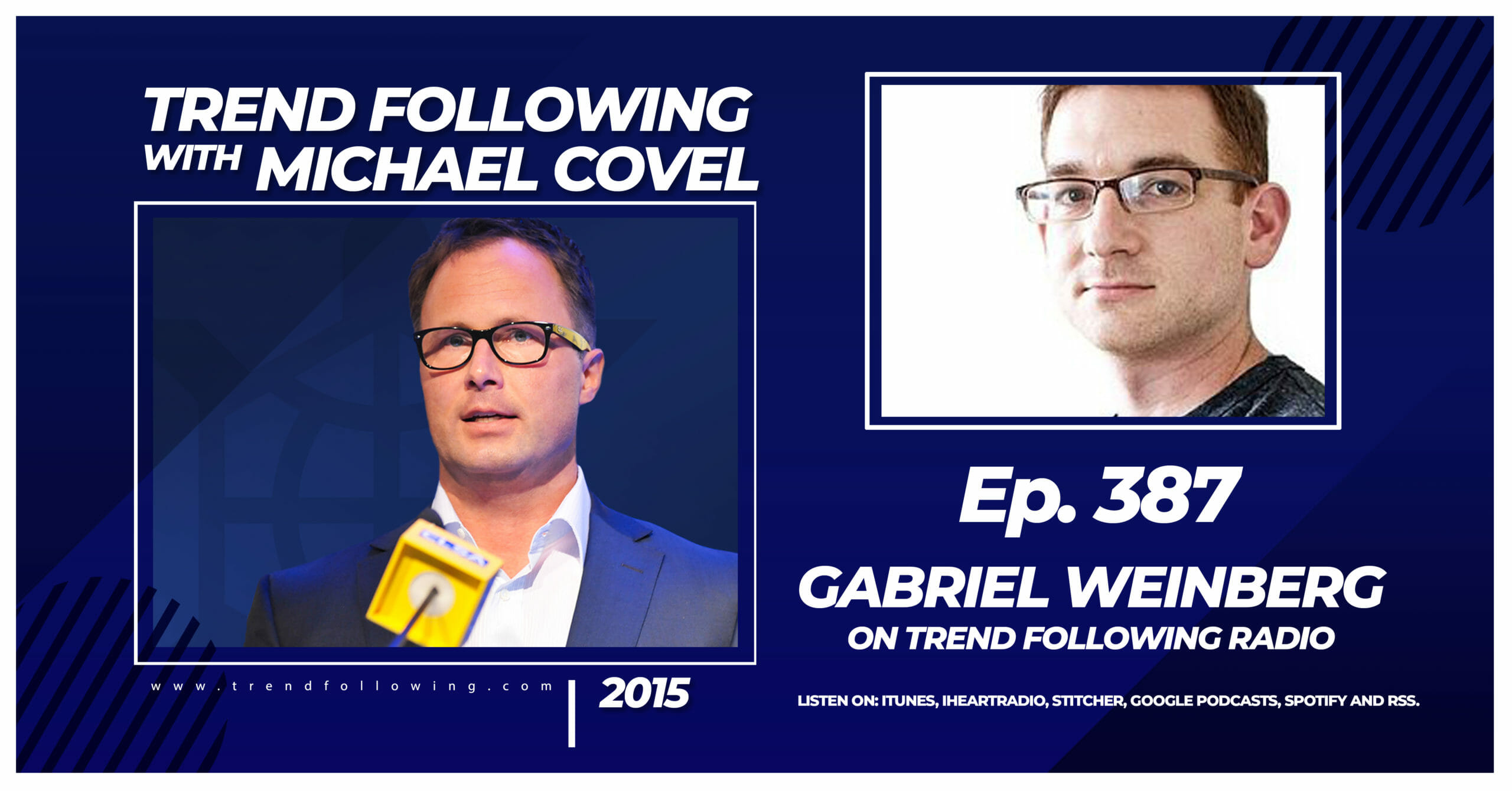
Ep. 387: Gabriel Weinberg Interview with Michael Covel on Trend Following Radio

Gabriel Weinberg
Gabriel Weinberg

Subscribe to Trend Following Radio on iTunes

My guest today is Gabriel Weinberg, the CEO and Founder of DuckDuckGo, a search engine. What sets DuckDuckGo apart from other search engines is the privacy that it guarantees its users. DuckDuckGo promises to never track a user’s clicks, or use previous searchers to aid current results. Since creating it 11 years ago, his engine has reached 30 million searches a day in 2018, up 50% from a year before, and is poised to grow even faster since Google added DuckDuckGo as a default search-engine option in its latest Chrome browser in more than 60 markets in March 2019.

The topic is startup entrepreneur.

In this episode of Trend Following Radio we discuss:

  • Reaching your goal, then setting another
  • Resilience: vital to the entrepreneur
  • Committing to your idea
  • Psychology: the main barrier to success
  • Understanding that it’s okay to fail
  • Enjoy the challenge – or go do something else

“And so if you think of your initial product as a leaky bucket – you know, you pour in customers at the top and customers leak out of the bucket because your product’s not good yet…You need a steady stream of cold customers with fresh eyes to tell you where those leaks are, and if you don’t have that when you launch you’re still gonna have leaks more of the time than not.” – Gabriel Weinberg

Mentions & Resources:

Listen to this episode:

Jump in!

Get the foundation to making money in up, down and *surprise markets on the Trend Following mailing list.

The Annie Duke Episode: Poker and Trend Following

There are many correlations between trading and poker. Consider this excerpt from my best selling, Trend Following:

In the book Absolute Returns, Alexander Ineichen stresses that trading is a “game.” He sees no rules for the game except the constant of change, but more importantly, he reminds us that it is crucial to avoid becoming the “game.” There are three types of players in the game:

• Those who know they are in the game.
• Those who don’t know they are in the game.
• Those who don’t know they are in the game and have become the game.

If, within a half of an hour of playing poker (or trading for that matter), you don’t know who the patsy is, you’re the patsy, or as Ineichen calls it “the game.” I have introduced those traders who didn’t know they were in the game and therefore became the game in the big events of the Long Term Capital Management hedge fund implosion, the Barings Bank collapse, and the October 2008 market crash. I introduced those traders and investors who did not know they were in the game pursuing Holy Grails that never panned out. And I introduced trend followers who knew they were in a game and brought an edge to the table every time they played. If you know trading is a game and you want to be a part of it, these are stark choices.

Recently I had Annie Duke on my podcast. She is an author, entrepreneur and professional poker player. We discussed several ways in which the psychology of gambling overlaps with that of trading, investment and other aspects of business. The following is brief feedback from that interview:

Mike, loved, loved, loved the Annie Duke episode. My favorite one yet. GREAT STUFF! [Name]

Thanks! More on gaming and betting? Go.


How can you move forward immediately to Trend Following profits? My books and my Flagship Course and Systems are trusted options by clients in 70+ countries.

Also jump in:

Trend Following Podcast Guests
Frequently Asked Questions
Performance
Research
Markets to Trade
Crisis Times
Trading Technology
About Us

Trend Following is for beginners, students and pros in all countries. This is not day trading 5-minute bars, prediction or analyzing fundamentals–it’s Trend Following.

Ep. 386: Expanding Your Thinking with Michael Covel on Trend Following Radio

Expanding Your Thinking with Michael Covel on Trend Following Radio

Subscribe to Trend Following Radio on iTunes

Please enjoy my monologue Expanding Your Thinking with Michael Covel on Trend Following Radio. This episode may also include great outside guests from my archive.

In this episode of Trend Following Radio:

  • Why embracing uncertainty pays big
  • Trend following: it’s human nature
  • Losses: acceptable when you strategize to cover them
  • The sunk cost fallacy
  • Opening your mind to alternative ways of thinking
  • The mistake of blindly accepting the word of “authorities”

“I remind you there is a new kind of special occupation. I refuse to call it a discipline or a field of study. It’s called futurism. The notion here is that there is a way to study trends and know what the future holds. That would indeed be valuable if it were possible. But it isn’t possible. Futurists don’t know any more about the future than you or I. Read their magazines from a couple years ago and you’ll see an endless parade of error.” – Michael Crichton

Mentions & Resources:

Listen to this episode:

Want to learn more Trend Following? Watch my video here.

Get the foundation to making money in up, down and *surprise markets on the Trend Following mailing list.

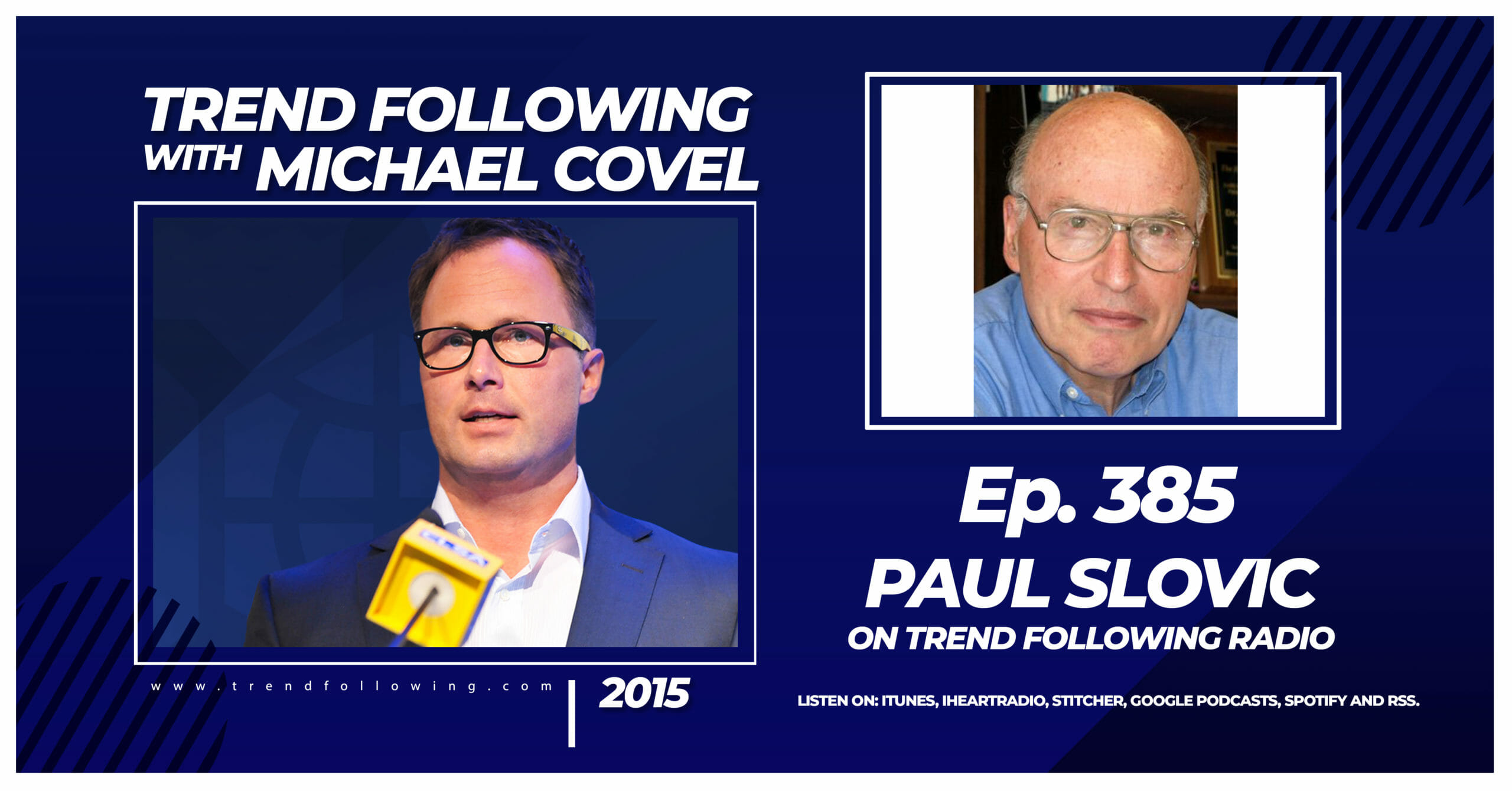
Ep. 385: Paul Slovic Interview with Michael Covel on Trend Following Radio

Paul Slovic Interview with Michael Covel on Trend Following Radio
Paul Slovic

Subscribe to Trend Following Radio on iTunes

My guest today is Paul Slovic, a professor of psychology at the University of Oregon and the president of Decision Research. Decision Research is a collection of scientists from all over the nation and in other countries that study decision-making in times when risks are involved. He study the psychology of risk and decision making. Current interests are motivating action to prevent genocides and nuclear war.

The topic is his paper Perception of Risk.

In this episode of Trend Following Radio we discuss:

  • The psychometric paradigm of risk perception
  • Balancing risk vs. reward
  • The concept of affect heuristics
  • How the media sways the public’s risk assessment
  • Fast vs. slow thinking
  • Risk in the context of decision making

“Bad is stronger than good. If something goes wrong in a system it decreases our trust in the management of that system more than when something goes right. Something goes right, it doesn’t really boost our trust and confidence. It’s the negative that outweighs the positive, and the negative is being conveyed to us much more frequently and forcefully through the media than the positive is.” – Paul Slovic

Mentions & Resources:

Listen to this episode:

Jump in!

Get the foundation to making money in up, down and *surprise markets on the Trend Following mailing list.