
Subscribe now and watch my free trend following VIDEO.

Something to Pondor: Baseball’s Behavioral Experiment

Great article from Brian Costa of the WSJ:

Take a peek inside the frazzled mind of a major-league hitter these days. It isn’t a pretty sight.

Pitchers are throwing harder than ever. Batters are striking out more often than ever. And their judgment is getting shakier: Hitters are chasing more pitches outside the strike zone.

It is enough to make some teams wonder: What if we could just rewire hitters’ brains to react to pitches better? As it turns out, at least three major-league teams are engaged in a covert science experiment to find out.

Several years ago, the Boston Red Sox began working with a Massachusetts neuroscience company called NeuroScouting. The objective was to develop software that could improve hitters’ ability to recognize pitch types and decide, with greater speed and accuracy, whether they should swing. The result was a series of no-frills video games that became a required part of hitters’ pregame routines in the minor leagues.

When Theo Epstein left his job as general manager of the Red Sox to become president of baseball operations for the Chicago Cubs in 2011, he brought the same methods to Chicago’s farm system. And last year, the Tampa Bay Rays made the neurological training games mandatory for minor leaguers—threatening to fine those that didn’t complete their assignments.

Now, a startup company with a near-identical name says it is in talks with four other major-league teams about providing tests to evaluate the neurological strengths and weaknesses of their minor-league hitters. The company, Neuroscout, would put electrode caps on players to measure their relevant brain activity during computer simulations of pitches coming at them.

Red Sox general manager Ben Cherington said the idea is to improve the connection in hitters’ brains between the visual stimulus of a pitch and the decision of whether to swing. “There’s a connection there,” he said. “And if you’re trying to hit a baseball moving at 90 miles per hour and moving in different directions, it probably helps for that connection to be strong.”

Though NeuroScouting’s games vary, most of them depict a ball coming from the pitcher’s mound toward the hitter. Using a laptop or tablet, players are given instructions such as, “Hit the space bar when you see the seams on the ball spinning vertically,” and are scored based on their reaction time and accuracy. The Rays have a leaderboard that shows players which of their teammates fared best on a given drill, like the high-scores screen at the end of an arcade game.

NeuroScouting executives declined to go into detail about their methods or their clients, citing teams’ demand for confidentiality. But Wesley Clapp, one of the company’s co-founders, said their software can identify how well each player’s brain reacts to specific pitch types—an outside curveball or a low fastball, for instance—and tailor their training to the areas where they need to improve the most.

“The best players have the best neural skills,” Clapp said. “It’s like a dimmer switch. The more you turn that dimmer up, you see more and more impact on the field.”

The need for hitters to react faster is clear. The average major-league fastball this year is 91.8 mph, according to the statistics website FanGraphs, a figure that has steadily increased from 89.9 in 2002. Hitters’ decision-making is slumping, too. They have swung at 30% of pitches outside the strike zone this season, according to pitch-tracking data, up from 27.9% in 2009.

But players are divided on the benefits of brain games that, for many, feel more like homework than baseball.

“For the most part, guys just seem like, every other day, ‘Ugh, I have to do this again,’ ” Rays outfielder Kevin Kiermaier said. “You try to get in a routine, and it’s like, ‘Oh, you have to do neuroscience or you’re going to get fined.’ ” He said that fines for players who skipped their assigned videogames were in the $25 to $50 range. Rays general manager Andrew Friedman declined to comment.

In the majors, where players have more autonomy, few choose to continue with the games. “People didn’t have that stuff 10 years ago. People could still hit,” Rays outfielder Wil Myers said. “Don’t try to reinvent the game.”

Nonetheless, teams’ interest in the neuroscience of hitting is only growing. What began as a training tool for the Red Sox has also become a scouting device. Before each amateur draft, the Red Sox assess hitting prospects in part based on how well they score on the NeuroScouting games.

Mookie Betts, Boston’s fifth-round draft pick in 2011, recalled meeting with a Red Sox scout in an empty classroom one day during his lunch period at a Tennessee high school. At the scout’s request, he completed a series of games on a laptop. “I was thinking, ‘What does this have to do with baseball?’ ” Betts said. “I guess I did pretty well, since he kept on pursuing me.”

Betts, 21, said the daily NeuroScouting drills he did in the minors helped put him on a fast track to the majors. “It gets your brain going,” he said. In 43 games through Thursday, his .363 on-base percentage ranked second among major-league rookies behind Chicago White Sox star Jose Abreu.

Teams still aren’t sure if any of this will boost their offense. The Red Sox have seen hitters such as Betts rate well on the neuro tests and blossom into productive players. But Cherington said other prospects have scored well and not panned out.

Likewise, Rays catcher Curt Casali said his hitting improved after the team introduced NeuroScouting while he was still in the minors last year, but has no idea if one had anything to do with the other. “You could just be a really good hitter,” Casali said.

The only thing teams know for sure is offense continues to fall. The major-league batting average is .251, which would be the lowest for a single season since 1972, the year before the American League introduced the designated hitter. The leaguewide strikeout total is on pace to reach an all-time high for the seventh consecutive year.

At this point, they don’t need to know an experiment will work. The fact that it might is enough. “Intuitively, it would make sense that this would be a helpful tool,” Cherington said, “but I just don’t know if anyone yet can prove that it’s predictive. The hope is maybe it can be.”

This type of “psych” article is exactly why I pursue so many behavioral experts for my podcast.

Further related Podcasts and Articles from the Trend Following Blog:

Shane Snow Podcast

Thinking to make a living

PhD not required to win at trading

John W Henry

Trend Trading without Charts

Pro Football vs Pro Baseball


How can you move forward immediately to Trend Following profits? My books and my Flagship Course and Systems are trusted options by clients in 70+ countries.

Also jump in:

Trend Following Podcast Guests
Frequently Asked Questions
Performance
Research
Markets to Trade
Crisis Times
Trading Technology
About Us

Trend Following is for beginners, students and pros in all countries. This is not day trading 5-minute bars, prediction or analyzing fundamentals–it’s Trend Following.
Phil Jackson’s 11 Mindful Leadership Principles

Phil Jackson’s 11 Principle’s of Mindful Leadership are worth reviewing, but #10 is the trend following creed:

10. When in Doubt, Do Nothing. “Basketball is an action sport, and most people involved in it are high-energy individuals who love to do something—anything—to solve problems. However, there are occasions when the best solution is to do absolutely nothing. I subscribe to the philosophy of the late Satchel Paige, who said, ‘Sometimes I sits and thinks, and sometimes I just sits.'”

Trend following = do nothing until you have to do something.


How can you move forward immediately to Trend Following profits? My books and my Flagship Course and Systems are trusted options by clients in 70+ countries.

Also jump in:

Trend Following Podcast Guests
Frequently Asked Questions
Performance
Research
Markets to Trade
Crisis Times
Trading Technology
About Us

Trend Following is for beginners, students and pros in all countries. This is not day trading 5-minute bars, prediction or analyzing fundamentals–it’s Trend Following.
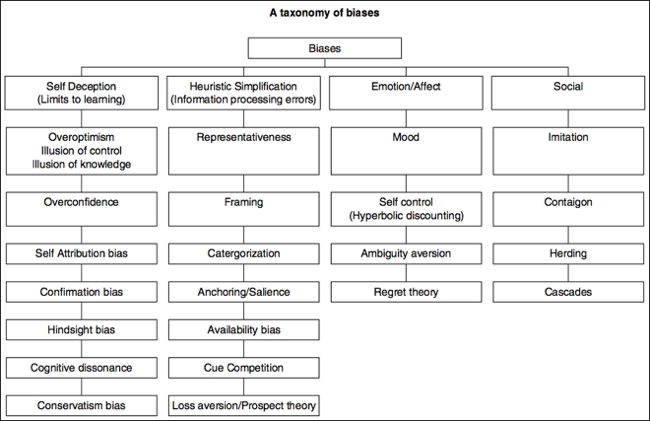
Handling the Biases: Trend Following

Trend following handles the biases:

biases

Chart H/T: James Montier.


How can you move forward immediately to Trend Following profits? My books and my Flagship Course and Systems are trusted options by clients in 70+ countries.

Also jump in:

Trend Following Podcast Guests
Frequently Asked Questions
Performance
Research
Markets to Trade
Crisis Times
Trading Technology
About Us

Trend Following is for beginners, students and pros in all countries. This is not day trading 5-minute bars, prediction or analyzing fundamentals–it’s Trend Following.

Humans Naturally Follow Crowd Behavior

Great article in the Wall Street Journal by Alison Gopnik titled, “Humans Naturally Follow Crowd Behavior”:

It happened last Sunday at football stadiums around the country. Suddenly, 50,000 individuals became a single unit, almost a single mind, focused intently on what was happening on the field—that particular touchdown grab or dive into the end zone. Somehow, virtually simultaneously, each of those 50,000 people tuned into what the other 49,999 were looking at.

Becoming part of a crowd can be exhilarating or terrifying: The same mechanisms that make people fans can just as easily make them fanatics. And throughout human history we have constructed institutions that provide that dangerous, enthralling thrill. The Coliseum that hosts my local Oakland Raiders is, after all, just a modern knockoff of the massive theater that housed Roman crowds cheering their favorite gladiators 2,000 years ago.

(For Oakland fans, like my family, it’s particularly clear that participating in the Raider Nation is responsible for much of the games’ appeal—it certainly isn’t the generally pathetic football.)

In fact, recent studies suggest that our sensitivity to crowds is built into our perceptual system and operates in a remarkably swift and automatic way. In a 2012 paper in the Proceedings of the National Academy of Sciences, A.C. Gallup, then at Princeton University, and colleagues looked at the crowds that gather in shopping centers and train stations.

In one study, a few ringers simply joined the crowd and stared up at a spot in the sky for 60 seconds. Then the researchers recorded and analyzed the movements of the people around them. The scientists found that within seconds hundreds of people coordinated their attention in a highly systematic way. People consistently stopped to look toward exactly the same spot as the ringers.

The number of ringers ranged from one to 15. People turn out to be very sensitive to how many other people are looking at something, as well as to where they look. Individuals were much more likely to follow the gaze of several people than just a few, so there was a cascade of looking as more people joined in.

In a new study in Psychological Science, Timothy Sweeny at the University of Denver and David Whitney at the University of California, Berkeley, looked at the mechanisms that let us follow a crowd in this way. They showed people a set of four faces, each looking in a slightly different direction. Then the researchers asked people to indicate where the whole group was looking (the observers had to swivel the eyes on a face on a computer screen to match the direction of the group).

Because we combine head and eye direction in calculating a gaze, the participants couldn’t tell where each face was looking by tracking either the eyes or the head alone; they had to combine the two. The subjects saw the faces for less than a quarter of a second. That’s much too short a time to look at each face individually, one by one.

It sounds impossibly hard. If you try the experiment, you can barely be sure of what you saw at all. But in fact, people were amazingly accurate. Somehow, in that split-second, they put all the faces together and worked out the average direction where the whole group was looking.

In other studies, Dr. Whitney has shown that people can swiftly calculate how happy or sad a crowd is in much the same way.

Other social animals have dedicated brain mechanisms for coordinating their action—that’s what’s behind the graceful rhythms of a flock of birds or a school of fish. It may be hard to think of the eccentric, gothic pirates of Oakland’s Raider Nation in the same way. A fan I know says that going to a game is like being plunged into an unusually friendly and cooperative postapocalyptic dystopia—a marijuana-mellowed Mad Max.

But our brains seem built to forge a flock out of even such unlikely materials.

For more see:

Nice perspective.


How can you move forward immediately to Trend Following profits? My books and my Flagship Course and Systems are trusted options by clients in 70+ countries.

Also jump in:

Trend Following Podcast Guests
Frequently Asked Questions
Performance
Research
Markets to Trade
Crisis Times
Trading Technology
About Us

Trend Following is for beginners, students and pros in all countries. This is not day trading 5-minute bars, prediction or analyzing fundamentals–it’s Trend Following.

Finding Opportunity Means Taking Shots: Same for Football, Same for Trend Following

Excerpt from here:

In finding Leach, an alumnus and fellow acolyte of BYU, Mumme stumbled upon the Paul McCartney to his John Lennon. Neither one of them gave a damn about college football’s hallowed traditions. Both cherished the lessons you could learn from heroic iconoclasts like Davy Crockett or Geronimo. And both liked getting in the car, blasting Jimmy Buffett and driving to any football practice in the country where they thought they could snatch up another crazy idea and make it part of their oeuvre.

More:

Well before Gus Malzahn and Chip Kelly were riding their wide splits and hurry-up offenses all the way to the BCS championship game, Mumme and Leach were running the concept on a small practice field in Mount Pleasant, Iowa. “The more shots on goal you get, the better,” Leach says. “That’s how we saw it. And with so many people touching the ball, it elevates the enthusiasm of the whole team.” In their three years at Iowa Wesleyan, the Mumme and Leach show went 25-10 and led the nation in passing once and finished second twice.

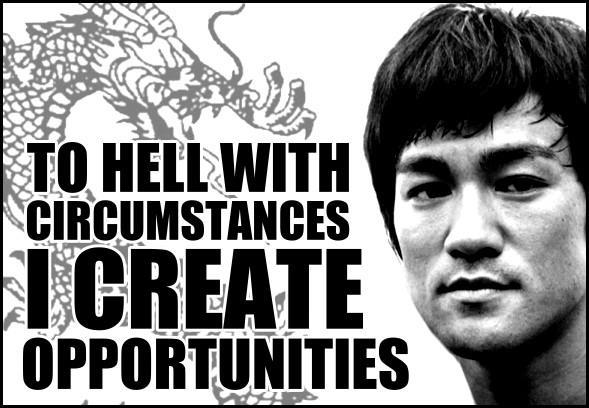
“The more shots on goal you get, the better” is the reason why you CAN’T be a trend follower on one market alone. You need opportunity. Trade one market, you are limited to one opportunity. It’s like running the fullback straight ahead for 3 yards every play. Bad strategy. You need diversity in opportunity.

Bruce Lee on Opportunity


How can you move forward immediately to Trend Following profits? My books and my Flagship Course and Systems are trusted options by clients in 70+ countries.

Also jump in:

Trend Following Podcast Guests
Frequently Asked Questions
Performance
Research
Markets to Trade
Crisis Times
Trading Technology
About Us

Trend Following is for beginners, students and pros in all countries. This is not day trading 5-minute bars, prediction or analyzing fundamentals–it’s Trend Following.

What is My Personality Type?

What is my Myers Briggs personality type?

Greetings Mr. Covel, during your most recent podcast, you stated that you are classified as an introvert according to the Briggs Myers Type Indicator. I am curious as to what is your four letter personality type because I am willing to bet it is INTJ? Of course, I understand if you do not wish to reveal personal details about yourself.

Regards,
[Name]

INTP


How can you move forward immediately to Trend Following profits? My books and my Flagship Course and Systems are trusted options by clients in 70+ countries.

Also jump in:

Trend Following Podcast Guests
Frequently Asked Questions
Performance
Research
Markets to Trade
Crisis Times
Trading Technology
About Us

Trend Following is for beginners, students and pros in all countries. This is not day trading 5-minute bars, prediction or analyzing fundamentals–it’s Trend Following.

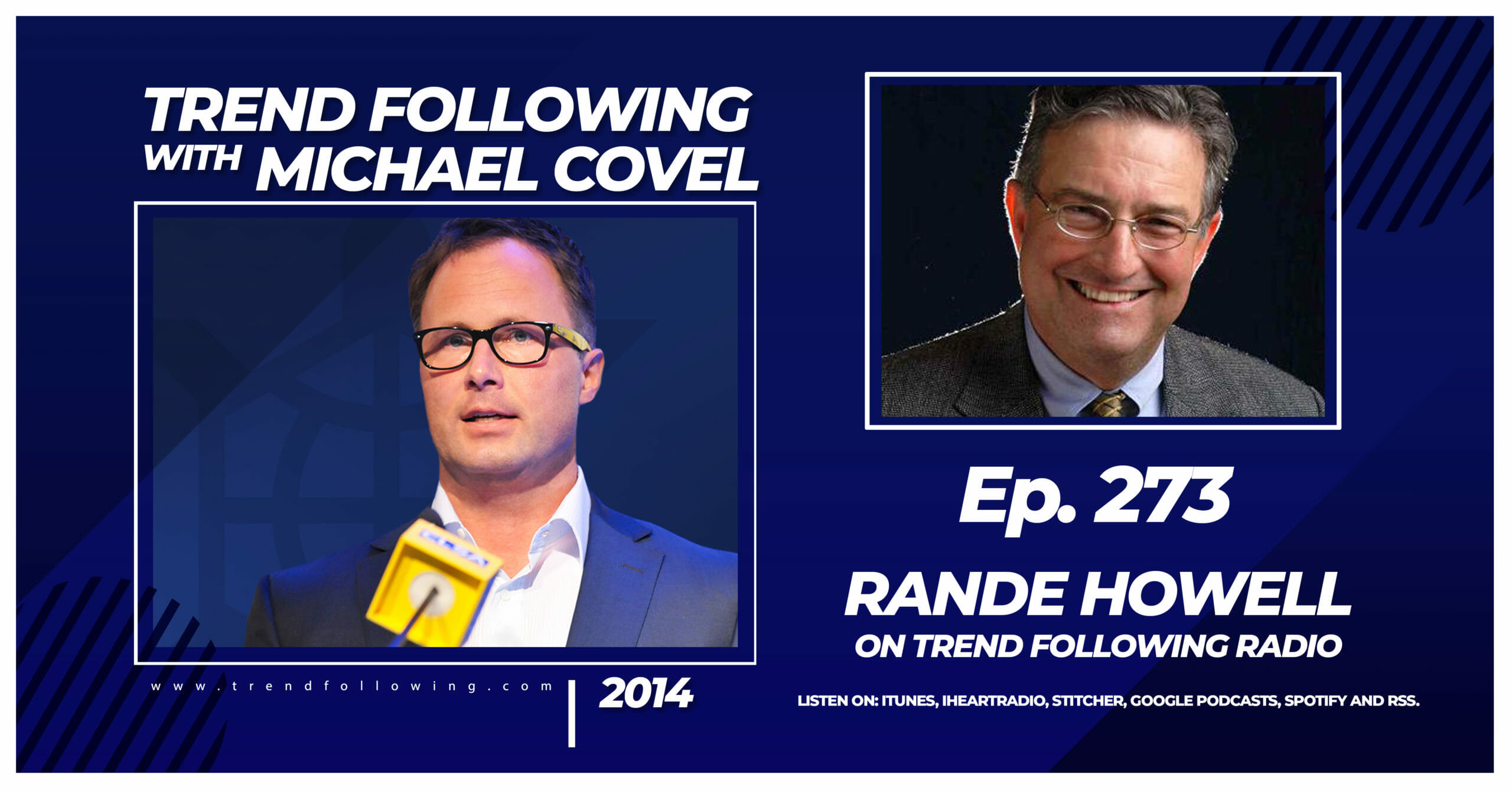
Ep. 273: Rande Howell Interview with Michael Covel on Trend Following Radio

Rande Howell
Rande Howell

My guest today is Rande Howell. Howell has a therapeutic background combined with personal coaching in the fields of human potential and leadership. He has fifteen years of practice as a licensed professional counselor with a Masters in Counseling.

The topic is counseling.

In this episode of Trend Following Radio we discuss:

  • What the performance mind is in regards to trading
  • Trading, emotions, and uncertainty
  • Why irrational pessimism is deadly in trading
  • Emotional regulation and mastering emotions
  • The blurry line between the casino and trading, particularly in Asia
  • Euphoria vs. fear in a trading context
  • Why what you’re afraid of owns you
  • Jungian archetypes
  • The Myers-Briggs instrument
  • Biological threat vs. psychological discomfort
  • The mistake of using trading to measure your worth
  • Getting your emotions right but your strategy wrong
  • Why success in one endeavor doesn’t necessarily mean success in trading
  • The importance of patience
  • The panther vs. the African lion

Listen to this episode:

Jump in!