
Subscribe now and watch my free trend following VIDEO.

The TurtleTraders Had 5 Questions for Their Trading

The Turtles’ core axioms were the same ones practiced by the great speculators from one hundred years earlier:

“Do not let emotions fluctuate with the up and down of your capital.”
“Be consistent and even-tempered.”
“Judge yourself not by the outcome, but by your process.”
“Know what you are going to do when the market does what it is going to do.”
“Every now and then the impossible can and will happen.”
“Know each day what your plan and your contingencies are for the next day.”
“What can I win and what can I lose? What are probabilities of either happening?”

However, there was precision behind the familiar-sounding euphemisms. From the first day of training, William Eckhardt outlined five questions that were relevant to what he called an optimal trade. The Turtles had to be able to answer these questions at all times:

1. What is the state of the market?
2. What is the volatility of the market?
3. What is the equity being traded?
4. What is the system or the trading orientation?
5. What is the risk aversion of the trader or client?

There was no messing around in Eckhardt’s tone, as he suggested that these were the only things that had any importance.

What is it the state of the market? The state of the market simply means. “What is the price that the market is trading at?” If Microsoft is trading at 40 a share today, then that is the state of that market.

What is the volatility of the market? Eckhardt taught the Turtles that they had to know on a daily basis how much any market goes up and down. If Microsoft on an average trades at 50, but typically bounces up and down on any given day between 48 and 52, then Turtles were taught that the volatility of that market was four. They had their own jargon to describe daily volatilities. They would say that Microsoft had an “N” of four. More volatile markets generally carried more risk.

What is the equity being traded? The Turtles had to know how much money they had at all times, because every rule they would learn adapted to their given account size at that moment.

What is the system or the trading orientation? Eckhardt instructed the Turtles that in advance of the market opening, they had to have their battle plan set for buying and selling. They couldn’t say, “Okay, I’ve got $100,000; I’m going to randomly decide to trade $5,000 of it.” Eckhardt did not want them to wake up and say, “Do I buy if Google hits 500 or do I sell if Google hits 500?” They were taught precise rules that would tell them when to buy or sell any market at any time based on the movement of the price. The Turtles had two systems: System One (S1) and System Two (S2). These systems governed their entries and exits. S1 essentially said you would buy or sell short a market if it made a new twenty-day high or low.

What is the risk aversion of the trader or client? Risk management was not a concept that the Turtles grasped immediately. For example, if they had $10,000 in their account, should they bet all $10,000 on Google stock? No. If Google all of a sudden dropped, they could lose all $10,000 fast. They had to bet a small amount of the $10,000, because they didn’t know whether or not a trade was going to go in their favor. Small betting (for example, 2 percent of $10,000 on initial bets) kept them in the game to play another day, all the while waiting for a big trend.

Note: Excerpt from The Complete TurtleTrder.


How can you move forward immediately to Trend Following profits? My books and my Flagship Course and Systems are trusted options by clients in 70+ countries.

Also jump in:

Trend Following Podcast Guests
Frequently Asked Questions
Performance
Research
Markets to Trade
Crisis Times
Trading Technology
About Us

Trend Following is for beginners, students and pros in all countries. This is not day trading 5-minute bars, prediction or analyzing fundamentals–it’s Trend Following.
“More Sellers than Buyers”

What causes a crash? Four words:

“More sellers than buyers.”

That’s it.
\


How can you move forward immediately to Trend Following profits? My books and my Flagship Course and Systems are trusted options by clients in 70+ countries.

Also jump in:

Trend Following Podcast Guests
Frequently Asked Questions
Performance
Research
Markets to Trade
Crisis Times
Trading Technology
About Us

Trend Following is for beginners, students and pros in all countries. This is not day trading 5-minute bars, prediction or analyzing fundamentals–it’s Trend Following.

Efficient Markets: Killing Off the Monster

From the Economist:

Having lived through the financial crisis of 2007-08, the man in the street might find the idea that markets are “efficient” incredible. But the efficient-market hypothesis, like a Hollywood monster, has proved very hard to kill off. From the truism that the average investor could not beat the market after costs, academics developed the insight that obvious market-beating opportunities would quickly be arbitraged away.

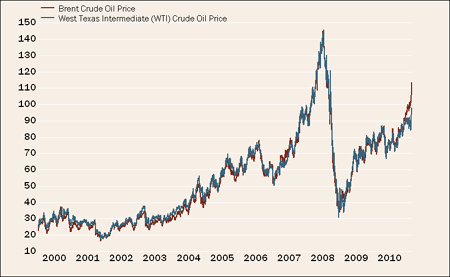
Here is a great example of efficient markets — not:

That chart could only have been effectively traded as a trend following trader. You used fundamentals to trade that? You are full of it or you were flipping coins and hit heads.


How can you move forward immediately to Trend Following profits? My books and my Flagship Course and Systems are trusted options by clients in 70+ countries.

Also jump in:

Trend Following Podcast Guests
Frequently Asked Questions
Performance
Research
Markets to Trade
Crisis Times
Trading Technology
About Us

Trend Following is for beginners, students and pros in all countries. This is not day trading 5-minute bars, prediction or analyzing fundamentals–it’s Trend Following.

William Worthington Fowler’s 1870s Wisdom? Yup

Consider William Worthington Fowler’s description of Wall Street circa 1870:

“To the merchant and banker it is a financial centre, collecting and distributing money, regulating the exchanges of a continent and striking balances of trade with London and Frankfort. To the outside observer and novice it is a kind of work-shop thronged by cunning artisans who work in precious metals, where vessels of gold and silver are wrought or made to shine with fresh luster, and where old china is fire-gilt as good as new. The moralist and philosopher look upon it as a gambling-den, a cage of unclean birds, an abomination where men drive a horrible trade, fattening and battening on the substance of their friends and neighbors—or perhaps a kind of modern coliseum where gladiatorial combats are joined, and bulls, bears and other ferocious beasts gore and tear each other for public amusement. The brokers regard it as a place of business where, in mercantile parlance, they may ply a legitimate trade, buying and selling for others on commission. To the speculators it is a caravansera where they may load or unload their camels and drive them away betimes to some pleasant oasis. To the financial commanders it is an arsenal in which their arms and chariots are stored, the stronghold to be defended or besieged, the field for strategy, battles and plunder.”

More.


How can you move forward immediately to Trend Following profits? My books and my Flagship Course and Systems are trusted options by clients in 70+ countries.

Also jump in:

Trend Following Podcast Guests
Frequently Asked Questions
Performance
Research
Markets to Trade
Crisis Times
Trading Technology
About Us

Trend Following is for beginners, students and pros in all countries. This is not day trading 5-minute bars, prediction or analyzing fundamentals–it’s Trend Following.

Dickson Watts: He Never Goes Stale

Dickson Watts (PDF) has been dead for decades, but his wisdom never dies. Some fine lines:

“Many lean, few lift.”

“The man who conforms never transforms.”

“Rest with descending wave; mount with the ascending wave.”

“There is many a slip between the cup and the lip, but only one slip between the cup and the ground.”

“The unpardonable sin — not to make money.”

“Some men are alive after they are dead; others are dead while still alive.”

Nice.


How can you move forward immediately to Trend Following profits? My books and my Flagship Course and Systems are trusted options by clients in 70+ countries.

Also jump in:

Trend Following Podcast Guests
Frequently Asked Questions
Performance
Research
Markets to Trade
Crisis Times
Trading Technology
About Us

Trend Following is for beginners, students and pros in all countries. This is not day trading 5-minute bars, prediction or analyzing fundamentals–it’s Trend Following.

“I Have No Clue, But Please Post My Anonymous Post!”

This anonymous blog comment (well, he changed his name, but used the same IP as other non-anonymous posts) is quite possibly the most ignorant comment yet on my blog:

“Madoff’s monthly returns (before the fraud was exposed) looked like a trend follower’s nirvana — constantly rising NAV without drawdowns. Madoff investors showed trend-following “savvy” by investing with him knowing that the trend-is-your-friend-until-it-ends (Unfortunately the drawdown came instantaneously — and the Madoff NAV was limit down in perpetuity.)”

How do you spot the next Madoff? Anyone making 1-2% every month is either a scam or will blow up.

How is that remotely related to trend following?


How can you move forward immediately to Trend Following profits? My books and my Flagship Course and Systems are trusted options by clients in 70+ countries.

Also jump in:

Trend Following Podcast Guests
Frequently Asked Questions
Performance
Research
Markets to Trade
Crisis Times
Trading Technology
About Us

Trend Following is for beginners, students and pros in all countries. This is not day trading 5-minute bars, prediction or analyzing fundamentals–it’s Trend Following.

Nassim Taleb on Buffett v. Soros

Nassim Taleb:

Asked…if returns such as those posted by Berkshire Hathaway Inc. Chief Executive Officer Warren Buffett — who amassed the world’s third-biggest personal fortune through decades of stock picks and takeovers — are the product of luck or talent, Taleb said both played a part. If given a choice between investing with Buffett and billionaire investor George Soros, Taleb also said he would probably pick the latter. “I am not saying Buffett isn’t as good as Soros,” he said. “I am saying that the probability Soros’s returns come from randomness is much smaller because he did almost everything: he bought currencies, he sold currencies, he did arbitrages. He made a lot more decisions. Buffett followed a strategy to buy companies that had a certain earnings profile, and it worked for him. There is a lot more luck involved in this strategy.”

Much wisdom there. More.


How can you move forward immediately to Trend Following profits? My books and my Flagship Course and Systems are trusted options by clients in 70+ countries.

Also jump in:

Trend Following Podcast Guests
Frequently Asked Questions
Performance
Research
Markets to Trade
Crisis Times
Trading Technology
About Us

Trend Following is for beginners, students and pros in all countries. This is not day trading 5-minute bars, prediction or analyzing fundamentals–it’s Trend Following.