Please enjoy my monologue Market Timing Confusion with Michael Covel on Trend Following Radio. This episode may also include great outside guests from my archive.
In this episode of Trend Following Radio:
Diversification
Seth Godin’s 2016 predictions
Market timing
Understanding psychology in trading
Pitfalls of overconfidence
“Conflict is fed by overconfidence.” – Daniel Kahneman
“If market timing is a sin, then there are times when even saints can be tempted into sinning a little.”- Clifford Asness, Antti Ilmanen and Thomas Maloney
“Most of the misinformation is not deliberate. People want to be led astray. They constantly ask the wrong questions, and those selling information get rewarded by giving them the answers they want.” -Van K. Tharp, Trade Your Way to Financial Freedom
I think CNBC will be around in 50 years, probably answering the same types of questions.
Michael Covel recently interviewed my son, Dr. Jason Williams, a psychiatrist, who has done a good deal of research and work with professional traders. I thought you might enjoy the interview. Here is the link.
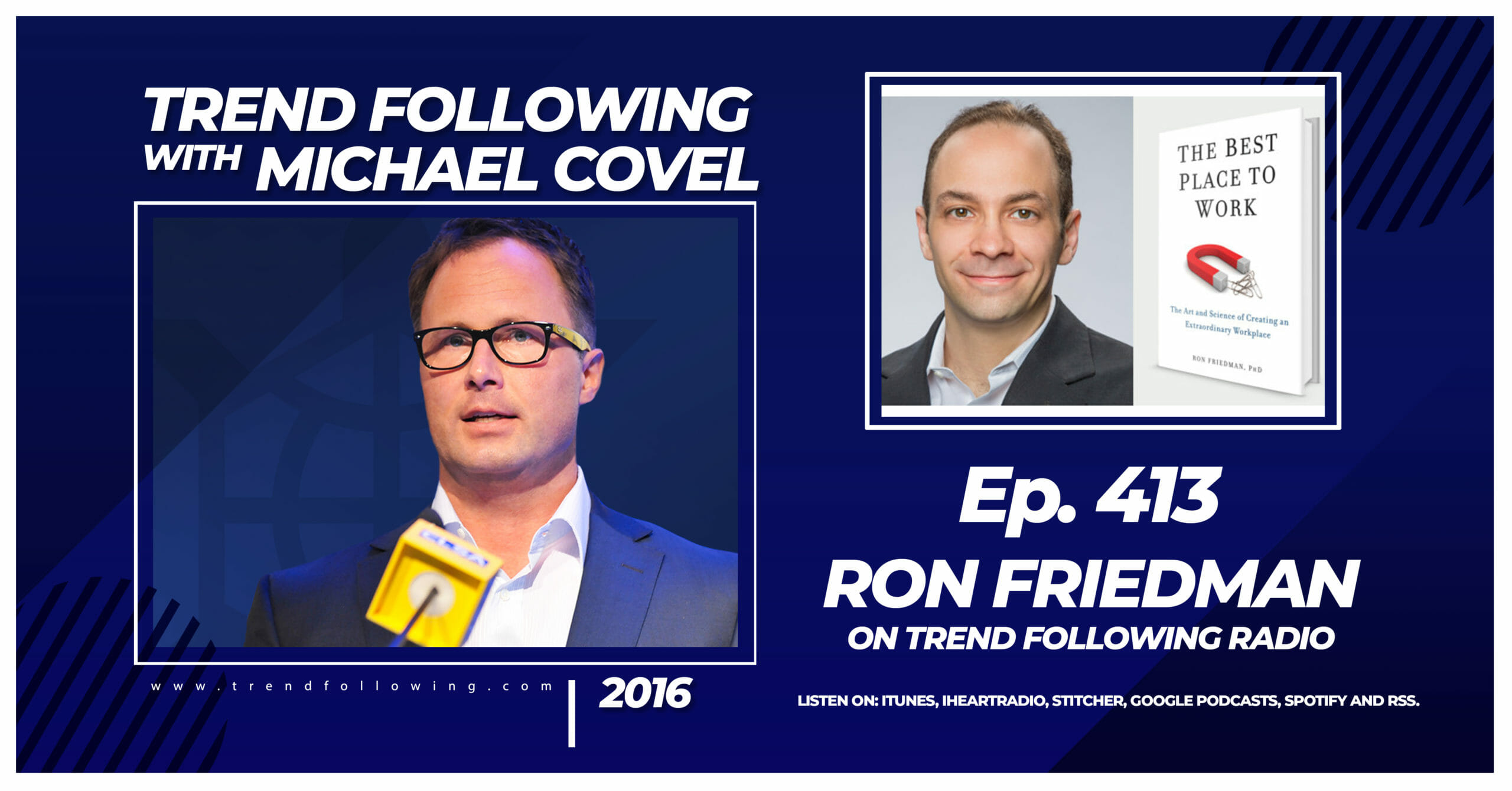
My guest today is Ron Friedman, an award winning social psychologist that specializes in human motivation. He is a frequent contributor to the Harvard Business Review, CNN, Fast Company, and Psychology Today, as well as the author of the best-selling non-fiction book The Best Place to Work: The Art and Science of Creating an Extraordinary Workplace.
The topic is his book The Best Place to Work: The Art and Science of Creating an Extraordinary Workplace.
In this episode of Trend Following Radio we discuss:
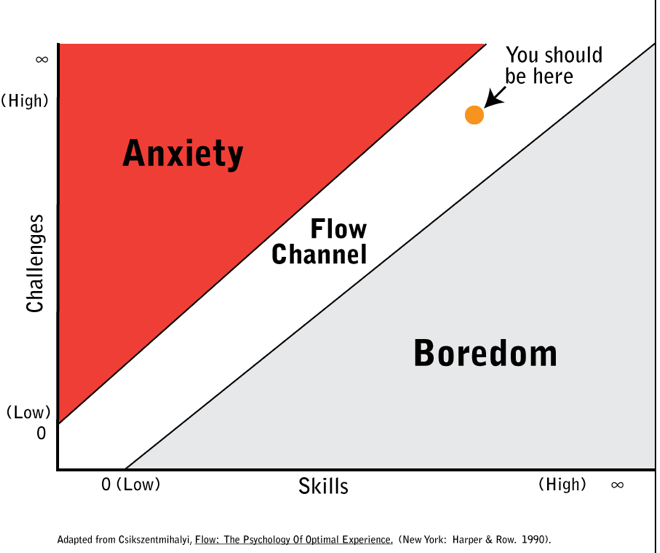
Flow in the Workplace
Creating a good work space
Disconnecting from work after hours
Creating balance in your life
Importance of exercise and naps
“When it comes to happiness, frequency is more important than size.” – Ron Friedman
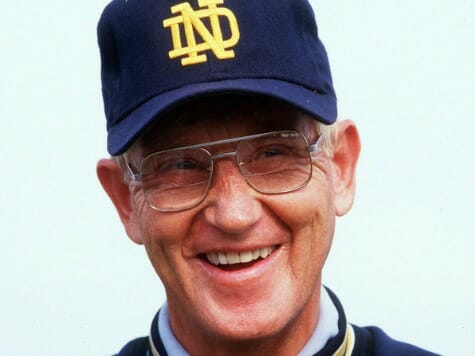
I like what Lou Holtz says here, but it’s better IMO without “names”. So I made that edit:
—
The [name] are right, there are two Americas. The America that works and the America that doesn’t. The America that contributes and the America that doesn’t. It’s not the haves and the have nots, it’s the dos and the don’ts. Some people do their duty as Americans, obey the law, support themselves, contribute to society and others don’t. That’s the divide in America.
It’s not about income inequality, it’s about civic irresponsibility. It’s about a political party that preaches hatred, greed and victimization in order to win elective office. It’s about a political party that loves power more than it loves its country.
That’s not invective, that’s truth, and it’s about time someone said it.
The politics of envy was on proud display a couple weeks ago when [name] pledged the rest of [name] term to fighting “income inequality.” [name] noted that some people make more than other people, that some people have higher incomes than others, and [name] says that’s not just. That is the rationale of thievery.
The other guy has it, you want it, [name] will take it for you. Vote [name]. That is the philosophy that produced [name].
It is the electoral philosophy that is destroying America. It conceals a fundamental deviation from American values and common sense because it ends up not benefiting the people who support it, but a betrayal.
The [name] have not empowered their followers, they have enslaved them in a culture of dependence and entitlement, of victim-hood and anger instead of ability and hope. The [name] premise – that you reduce income inequality by debasing the successful–seeks to deny the successful the consequences of their choices and spare the unsuccessful the consequences of their choices. Because, by and large, income variations in society are a result of different choices leading to different consequences.
Those who choose wisely and responsibly have a far greater likelihood of success, while those who choose foolishly and irresponsibly have a far greater likelihood of failure.
Success and failure usually manifest themselves in personal and family income. You choose to drop out of high school or to skip college – and you are apt to have a different outcome than someone who gets a diploma and pushes on with purposeful education.
You have your children out of wedlock and life is apt to take one course; you have them within a marriage and life is apt to take another course. Most often in life our destination is determined by the course we take.
My doctor, for example, makes far more than I do. There is significant income inequality between us. Our lives have had an inequality of outcome, but, our lives also have had an in equality of effort. While my doctor went to college and then devoted his young adulthood to medical school and residency, I got a job in a restaurant. He made a choice, I made a choice, and our choices led us to different outcomes. His outcome pays a lot better than mine. Does that mean he cheated and [name] needs to take away his wealth? No, it means we are both free men in a free society where free choices lead to different outcomes.
It is not inequality [name] intends to take away, it is freedom. The freedom to succeed, and the freedom to fail. There is no true option for success if there is no true option for failure. The pursuit of happiness means a whole lot less when you face the punitive hand of government if your pursuit brings you more happiness than the other guy. Even if the other guy sat on his arse and did nothing. Even if the other guy made a lifetime’s worth of asinine and short sighted decisions.
[name] and the [name] preach equality of outcome as a right, while completely ignoring inequality of effort. The simple Law of the Harvest – as ye sow, so shall ye reap – is sometimes applied as, “The harder you work, the more you get.”
[name] would turn that upside down. Those who achieve are to be punished as enemies of society and those who fail are to be rewarded as wards of society. Entitlement will replace effort as the key to upward mobility in American society if [name] gets his way. [name] seeks a lowest common denominator society in which the government besieges the successful and productive to foster equality through mediocrity. [name] and [name] party speak of two Americas, and their grip on power is based on using the votes of one to sap the productivity of the other. America is not divided by the differences in our outcomes, it is divided by the differences in our efforts.
It is a false philosophy to say one man’s success comes about unavoidably as the result of another man’s victimization.
What [name] offered was not a solution, but a separatism. [name] fomented division and strife, pitted one set of Americans against another for [name] own political benefit. That’s what socialists offer. Marxist class warfare wrapped up with a bow. Two Americas, coming closer each day to proving the truth to Lincoln’s maxim that a house divided against itself cannot stand.
“Life is ten percent what happens to you and ninety percent how you respond to it.”
Please enjoy my monologue Flow State with Michael Covel on Trend Following Radio. This episode may also include great outside guests from my archive.
In this episode of Trend Following Radio:
What is flow
How does flow happen
Dealing with worry
Addiction to thoughts
How to obtain happiness
“If you have a fairly comfortable childhood, but without too much support and too much challenge, you don’t see the necessity to stretch yourself, to get into new situations to explore or to break boundaries. You are just comfortable.” – Mihaly Csikszentmihalyi
Charles Faulkner has been featured in many Trend Following Radio episodes and across all of my books. An excerpt from “The Little Book of Trading”:
Perhaps you have heard the expression about living in the moment of now. What do I mean? The past is gone and the future is unknowable, but we have right now. That does not mean we cannot consider our past experiences or mistakes as useful references. Nor does that mean we cannot prepare and plan for the future. It does mean that making decisions based upon what is actually happening in the moment of right now is how great trend following traders organize their lives and produce their fortunes.
While not primarily a trader, Charles Faulkner brings a tremendously useful insight to the table. In all my years I can think of no one who does a better job of bringing traders and investors to a better understanding of themselves. Understanding yourself as a trader is the needed introduction to the journey of success in trend following profits.
Faulkner sees the world from a very wide and novel perspective, and you should too.
Case in point: A crucial lesson to understand is that when entering the market game, losses are part of the game. No matter the amount of experience you have, there will always be losses. That said, you want to make sure your losses are ones that you can handle—knowing that they are emotionally going to affect you.
People in sports understand this. Professional game players understand that to build your skill, you need to take losses and learn from them. You hope to play against people better than you because that is what makes you better.
Studying traders is very useful because everything in their world is extremely focused due to the intensity of their profession. What might take months or years to unfold in an ordinary life can unfold very quickly for traders.
For example, for many people the biggest purchase they make is a house or a car. And for many successful trend traders that kind of money can go through their hands within an hour, or even minutes.
This means, when trading, you don’t want to view money in terms of dollars as if you were going to buy a new car, but rather use the dollars to keep score. Putting yourself into that mental framework is critical. Releasing your mind from how you value money in terms of shopping, and instead focusing on it as a score during the game, is a huge first step.
—
A nice email came across my desk:
Good day Michael,
First I want to thank you for sharing your work with me and the rest of the world. I first read your work about 5 years ago and have not missed a podcast. Many podcasts I have returned to repeatedly for the timeless information and thought-provoking content. Another resource I don’t miss is the Epsilon Theory notes by Ben Hunt (thanks for introducing me to his work as well). I just wanted to suggest to you if you have not already read Ben’s latest note “I know it was you, Fredo” it is worth the time, like all of his notes. The information you have shared has not only changed my approach to the market but to nearly every aspect of my life. The exposure you provided me to the works of Charles Faulkner and Alan Watts two examples of many that have shaped the way I think about the world.
I felt it was time I thanked for what your work has meant to me.