Subscribe now and watch my free trend following VIDEO.

Ep. 355: Ed Seykota Interview with Michael Covel on Trend Following Radio

Ed Seykota
Ed Seykota

My guest today is Ed Seykota, a commodities trader, who earned S.B. degrees in Electrical Engineering from MIT and Management from the MIT Sloan School of Management, both in 1969. In 1970 he pioneered Systems trading by using early punched card computers to test ideas on trading the markets. Originally profiled in the classic book ‘The Market Wizards’, Seykota has played a pivotal role in the growth of trend following trading for 40 years.

The topic is Trend Following.

In this episode of Trend Following Radio we discuss:

  • Govopoly
  • Trading Tribe
  • Trend Following

Listen to this episode:

Jump in!

Ep. 354: The Babe Ruth Effect: Frequency v. Magnitude with Michael Covel on Trend Following Radio

The Babe Ruth Effect: Frequency v. Magnitude with Michael Covel on Trend Following Radio

Please enjoy my monologue The Babe Ruth Effect: Frequency v. Magnitude with Michael Covel on Trend Following Radio. This episode may also include great outside guests from my archive.

Listen to this episode:

Want to learn more Trend Following? Watch my video here.

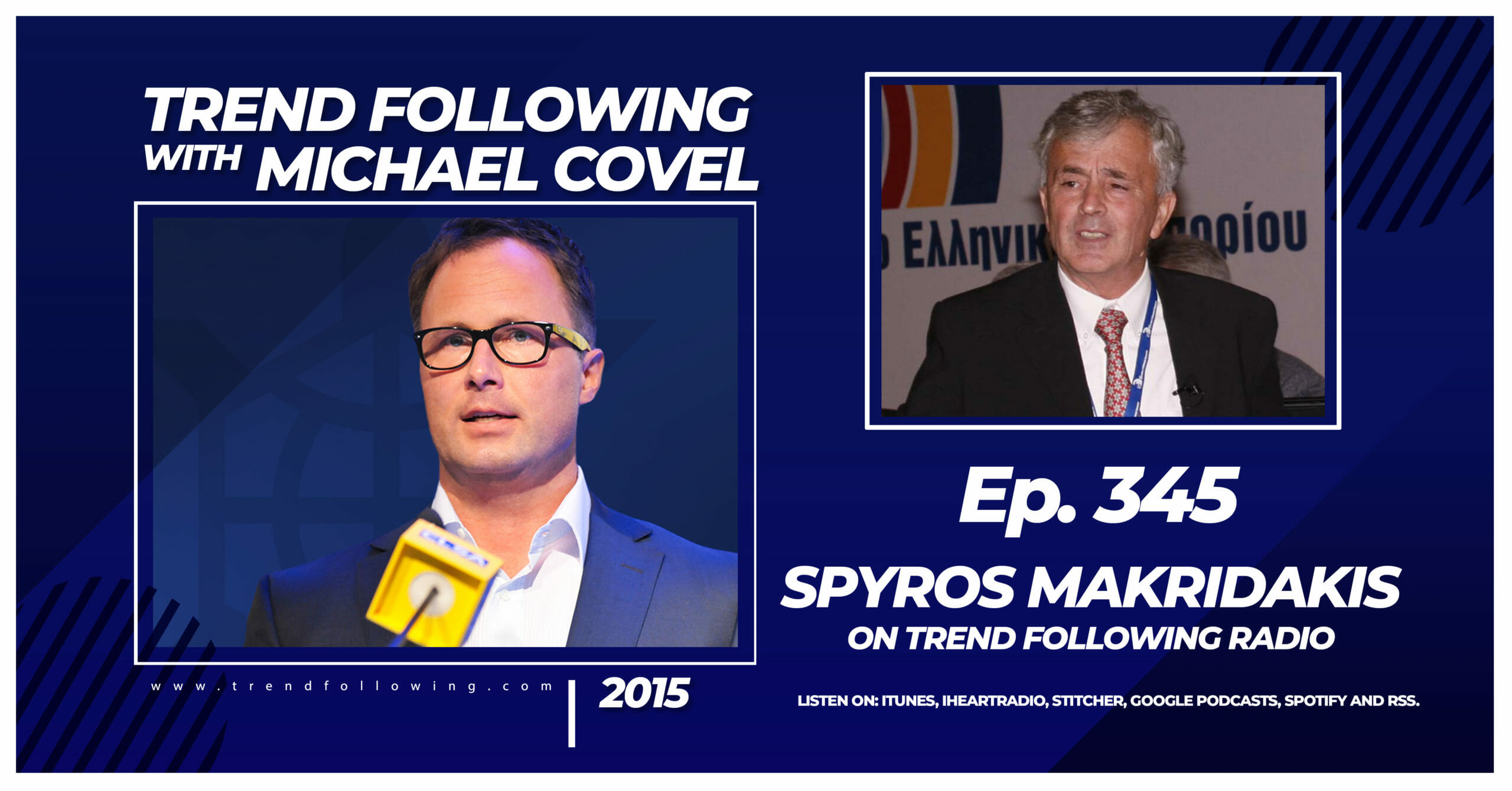
Ep. 345: Spyros Makridakis Interview with Michael Covel on Trend Following Radio

Spyros Makridakis
Spyros Makridakis

My guest today is Spyros Makridakis, the Rector of the Neapolis University of Pafos NUP and an Emeritus Professor of Decision Sciences at INSEAD as well as the University of Piraeus and one of the world’s leading experts on forecasting, with many journal articles and books on the subject. He is famous as the organizer of the Makridakis Competitions, known in the forecasting literature as the M-Competitions. His calling is to poke holes in the notion that we can forecast with accuracy.

The topic is his paper Why Forecasts Fail. What to Do Instead.

In this episode of Trend Following Radio we discuss:

  • Known knowns, known unknowns, and unknown unknowns
  • The two main types of uncertainty–“subway” and “coconut”
  • Jim Collins, one of the best-selling business book authors of all time, and why it might not have any use to us
  • Medicine and chance
  • The placebo effect
  • Acceptance of an uncertain world
  • The illusion of control

Listen to this episode:

Jump in!

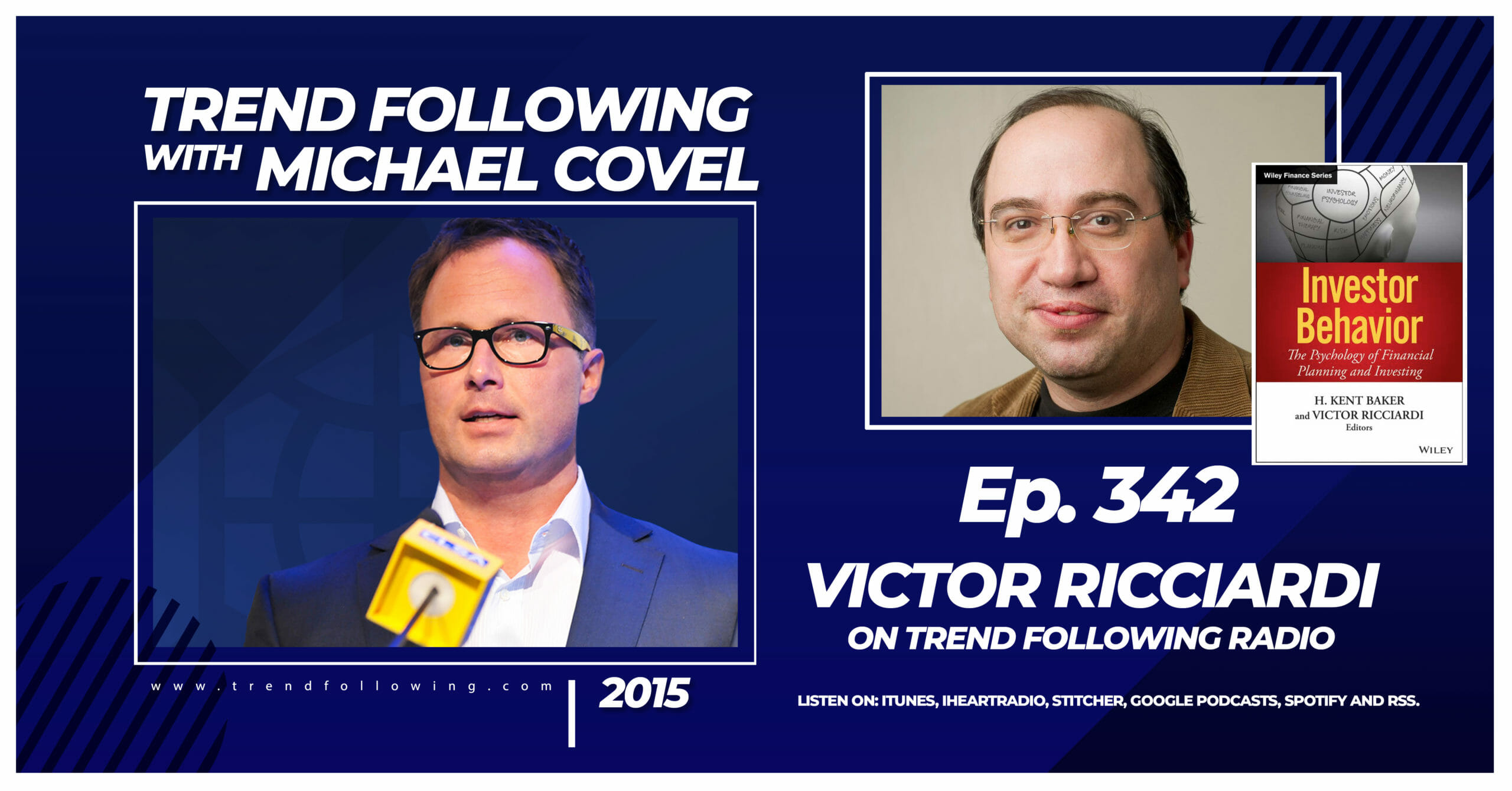
Ep. 342: Victor Ricciardi Interview with Michael Covel on Trend Following Radio

Victor Ricciardi
Victor Ricciardi

My guest today is Victor Ricciardi, an Assistant Professor of Financial Management at Goucher College. Professor Ricciardi is a leading expert on the academic literature and emerging research issues in behavioral finance. He is the editor of several eJournals distributed by the Social Science Research Network (SSRN). Ricciardi is also the co-editor of the book Investor Behavior: The Psychology of Financial Planning and Investing.

The topic is behavioral finance.

In this episode of Trend Following Radio we discuss:

  • Risk perception vs. risk tolerance
  • The affect and the anchoring heuristic
  • Behavioral finance vs. behavioral economics
  • Looking at behavioral finance in the context of specific strategies
  • Behavioral economics in the context of asset bubbles and the popping of asset bubbles
  • Why economic growth does not increase happiness; mindfulness as an assist in the notion of good decision-making; the notion of animal spirits
  • Behavioral school vs. the classical school in academia

Listen to this episode:

Jump in!

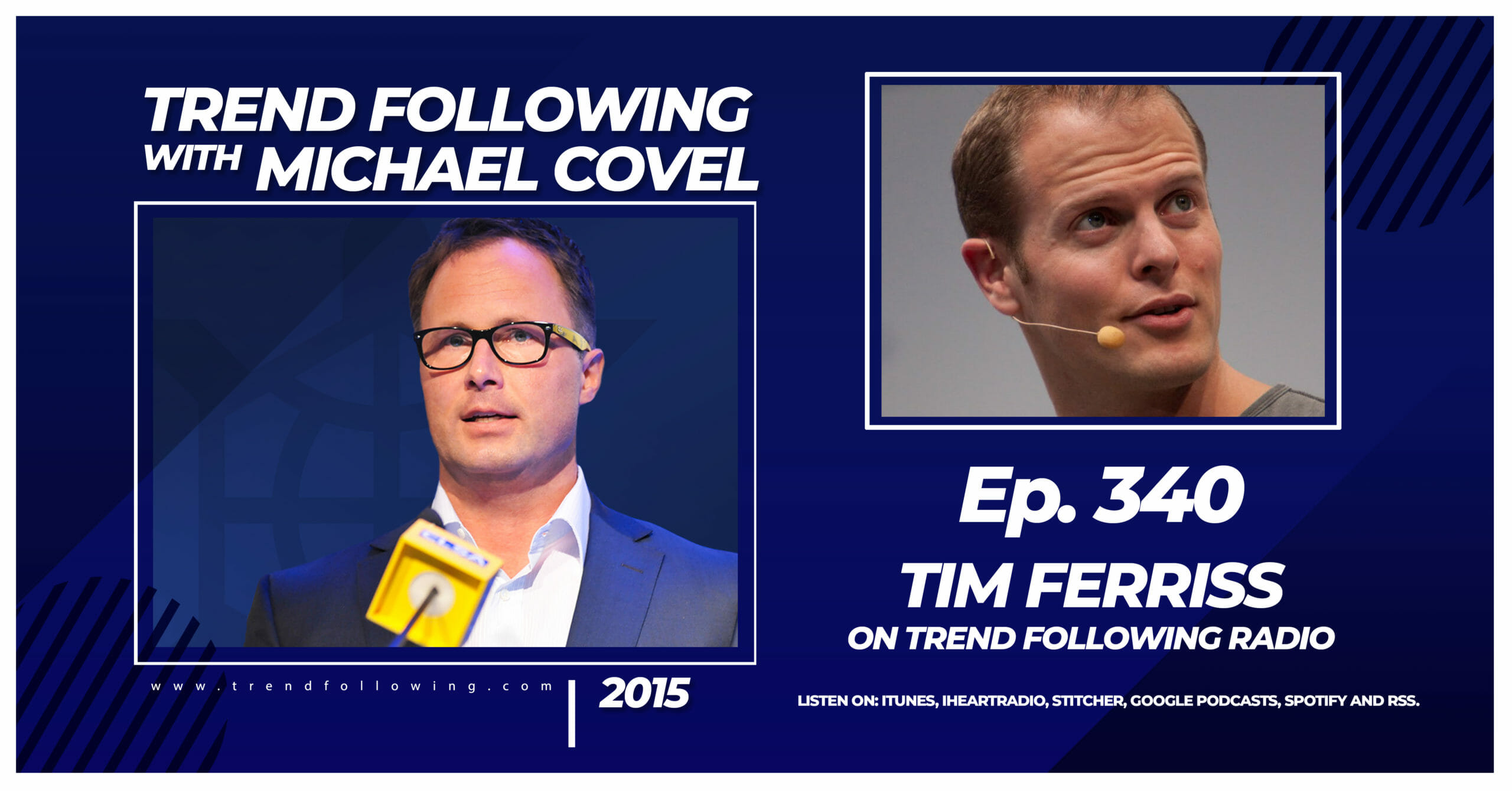
Ep. 340: Tim Ferriss Interview with Michael Covel on Trend Following Radio

Tim Ferriss
Tim Ferriss

My guest today is Tim Ferriss, an author, blogger and motivational speaker known for his bestselling books The 4-Hour Workweek, The 4-Hour Body and The 4-Hour Chef. Ferriss is otherwise known as the guy who has revolutionized the idea of writing a book; he has engineered the process of a bestseller.

The topic is his TV show The Tim Ferriss Experiment.

In this episode of Trend Following Radio we discuss:

  • Why the wrestler Dan Gable is part of Ferriss’ drive
  • The “grinding” aspect of wrestling, and how that has played into Ferriss’ career
  • The early lessons learned about making a TV show
  • The 80/20 rule
  • Comparisons to the Turtle experiment
  • The idea of getting older, recovery, and athletics

Listen to this episode:

Jump in!

Ep. 336: Colin Camerer Interview with Michael Covel on Trend Following Radio

Colin Camerer
Colin Camerer

My guest today is Colin Camerer, an American behavioral economist and a Robert Kirby Professor of Behavioral Finance and Economics at the California Institute of Technology (Caltech). Camerer’s research is on the interface between cognitive psychology and economics. This work seeks a better understanding of the psychological and neurobiological basis of decision-making in order to determine the validity of models of human economic behavior. His research uses mostly economics experiments—and occasionally field studies—to understand how people behave when making decisions (e.g., risky gambles for money), in games, and in markets (e.g., speculative price bubbles).

The topics are cognitive psychology and economics.

In this episode of Trend Following Radio we discuss:

  • Why Camerer was called a child prodigy, and how he looks at that term in the context of nurture vs. nature
  • Synthesizing behavioral economics and neuroscience; understanding Camerer’s studies when traders aren’t looking at the market on a day-to-day basis; how we can stimulate the brain to create a bubble
  • The ethical issues surrounding Camerer’s work
  • Machine learning and data mining
  • Neuroscience and game theory
  • Comparing humans and chimps in the study of neuroscience
  • How trust correlates with economic growth
  • How emotion functions in the modern world

Listen to this episode:

Jump in!

David Harding: “We Must Either Be Cheats, Charlatans or Crooks”

While going through some of my old Trend Following Radio monologues I came across this excerpt from a David Harding interview:

Interviewer: Okay, one final question. When you look back at your long and successful career, was courage rewarded in your investment decisions?

Harding: The main place I would say that courage had entered into my career, and I’m not sure whether this is virtuous courage or not, [Name] this morning differentiated between good courage and bad courage and I’m not sure whether mine is good courage or bad courage. But I can tell you that everybody, most of my career, all of the intellectual orthodoxy and all the professors and the businessmen and all the forces of respectability said that what we did was impossible. Completely theoretically impossible and therefore we must either be cheats, charlatans or crooks. To go on running your business when everyone says that what you’re doing is theoretically impossible clearly means you’re in a very lonely position. I think part of the reason I’ve been very well rewarded is out of sheer perversity. I went on doing what I was doing because I trusted the evidence of my scientific research and the evidence of my senses over received wisdom of the powers that be and the authorities in the world. So if I had any lesson, Mark Twain said, “How come when physical courage is so common, moral courage is so rare.” That saying has always had a special meaning for me because I’m particularly cowardly physically as well.

Wisdom.


How can you move forward immediately to Trend Following profits? My books and my Flagship Course and Systems are trusted options by clients in 70+ countries.

Also jump in:

Trend Following Podcast Guests
Frequently Asked Questions
Performance
Research
Markets to Trade
Crisis Times
Trading Technology
About Us

Trend Following is for beginners, students and pros in all countries. This is not day trading 5-minute bars, prediction or analyzing fundamentals–it’s Trend Following.