Subscribe now and watch my free trend following VIDEO.

Ep. 279: Mark Broadie Interview with Michael Covel on Trend Following Radio

Mark Broadie
Mark Broadie

My guest today is Mark Broadie, the Carson Family Professor of Business and Vice Dean at the Columbia Business School. His research focuses on quantitative finance and sports analytics. His golf research has appeared in academic journals and many golf publications. He developed the new strokes gained approach to analyze the performance of amateur and professional golfers and worked with the PGA Tour on their implementation of the strokes gained putting stat.

The topic is his book Every Shot Counts: Using the Revolutionary Strokes Gained Approach to Improve Your Golf Performance and Strategy.

In this episode of Trend Following Radio we discuss:

  • How he became, in Covel’s words, the “Bill James of golf”
  • How Broadie connected his finance work to the sport of golf
  • Why certain golfers win
  • Why approach shots are the most important
  • “Drive for show, putt for dough”
  • How Broadie started, the software he used, and how he got better data
  • Whether Broadie had any sense of where the data might go when he first collected it
  • Power as a separator
  • The connection between sports anaylitics, business analytics, and investing
  • The psychology of golf
  • First putts vs. second putts
  • The world golf rankings, and how these can be fixed

Listen to this episode:

Jump in!

Humans Naturally Follow Crowd Behavior

Great article in the Wall Street Journal by Alison Gopnik titled, “Humans Naturally Follow Crowd Behavior”:

It happened last Sunday at football stadiums around the country. Suddenly, 50,000 individuals became a single unit, almost a single mind, focused intently on what was happening on the field—that particular touchdown grab or dive into the end zone. Somehow, virtually simultaneously, each of those 50,000 people tuned into what the other 49,999 were looking at.

Becoming part of a crowd can be exhilarating or terrifying: The same mechanisms that make people fans can just as easily make them fanatics. And throughout human history we have constructed institutions that provide that dangerous, enthralling thrill. The Coliseum that hosts my local Oakland Raiders is, after all, just a modern knockoff of the massive theater that housed Roman crowds cheering their favorite gladiators 2,000 years ago.

(For Oakland fans, like my family, it’s particularly clear that participating in the Raider Nation is responsible for much of the games’ appeal—it certainly isn’t the generally pathetic football.)

In fact, recent studies suggest that our sensitivity to crowds is built into our perceptual system and operates in a remarkably swift and automatic way. In a 2012 paper in the Proceedings of the National Academy of Sciences, A.C. Gallup, then at Princeton University, and colleagues looked at the crowds that gather in shopping centers and train stations.

In one study, a few ringers simply joined the crowd and stared up at a spot in the sky for 60 seconds. Then the researchers recorded and analyzed the movements of the people around them. The scientists found that within seconds hundreds of people coordinated their attention in a highly systematic way. People consistently stopped to look toward exactly the same spot as the ringers.

The number of ringers ranged from one to 15. People turn out to be very sensitive to how many other people are looking at something, as well as to where they look. Individuals were much more likely to follow the gaze of several people than just a few, so there was a cascade of looking as more people joined in.

In a new study in Psychological Science, Timothy Sweeny at the University of Denver and David Whitney at the University of California, Berkeley, looked at the mechanisms that let us follow a crowd in this way. They showed people a set of four faces, each looking in a slightly different direction. Then the researchers asked people to indicate where the whole group was looking (the observers had to swivel the eyes on a face on a computer screen to match the direction of the group).

Because we combine head and eye direction in calculating a gaze, the participants couldn’t tell where each face was looking by tracking either the eyes or the head alone; they had to combine the two. The subjects saw the faces for less than a quarter of a second. That’s much too short a time to look at each face individually, one by one.

It sounds impossibly hard. If you try the experiment, you can barely be sure of what you saw at all. But in fact, people were amazingly accurate. Somehow, in that split-second, they put all the faces together and worked out the average direction where the whole group was looking.

In other studies, Dr. Whitney has shown that people can swiftly calculate how happy or sad a crowd is in much the same way.

Other social animals have dedicated brain mechanisms for coordinating their action—that’s what’s behind the graceful rhythms of a flock of birds or a school of fish. It may be hard to think of the eccentric, gothic pirates of Oakland’s Raider Nation in the same way. A fan I know says that going to a game is like being plunged into an unusually friendly and cooperative postapocalyptic dystopia—a marijuana-mellowed Mad Max.

But our brains seem built to forge a flock out of even such unlikely materials.

For more see:

Nice perspective.


How can you move forward immediately to Trend Following profits? My books and my Flagship Course and Systems are trusted options by clients in 70+ countries.

Also jump in:

Trend Following Podcast Guests
Frequently Asked Questions
Performance
Research
Markets to Trade
Crisis Times
Trading Technology
About Us

Trend Following is for beginners, students and pros in all countries. This is not day trading 5-minute bars, prediction or analyzing fundamentals–it’s Trend Following.

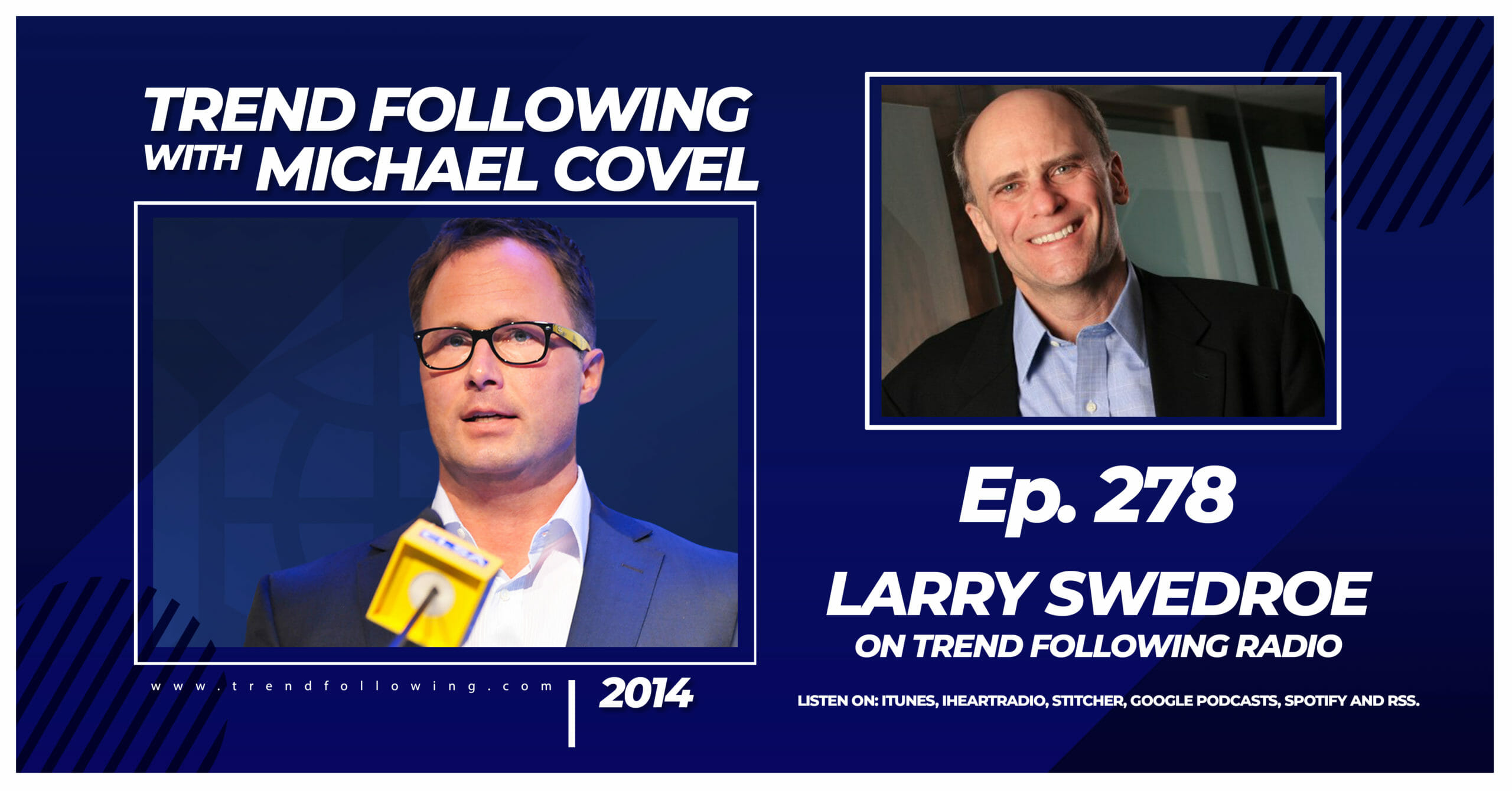
Ep. 278: Larry Swedroe Interview with Michael Covel on Trend Following Radio

Larry Swedroe
Larry Swedroe

My guest today is Larry Swedroe, a Buckingham Asset Management principal. He is also a principal and co-founder of BAM Advisor Services, LLC, and serves as the director of research for both entities. Swedroe has authored or co-authored fourteen books and comes at investing from an evidence-based approach.

The topic is outside the box market perspectives.

In this episode of Trend Following Radio we discuss:

  • Forecasters and prediction
  • The three types of forecasters
  • Confirmation bias
  • How your political affiliation might change your willingness to listen to forecasts
  • Value perspective vs. momentum perspective
  • The anomaly of momentum
  • The evidence-based thinking approach
  • Momentum trading in 2008
  • How Swedroe prepares for the unexpected
  • Not treating the unlikely like it’s impossible
  • Managing your risk
  • Process vs. outcome
  • The equity risk premium and bear markets
  • Commonplace crises
  • Planning ahead
  • Diversification attempts to get outside of equities

Listen to this episode:

Jump in!

Nice Work Sir!

Podcast feedback:

Since discovering your podcasts, I have not gotten much else done. Nice work sir.

A fun comment from Brad Rotter (a guest!).


How can you move forward immediately to Trend Following profits? My books and my Flagship Course and Systems are trusted options by clients in 70+ countries.

Also jump in:

Trend Following Podcast Guests
Frequently Asked Questions
Performance
Research
Markets to Trade
Crisis Times
Trading Technology
About Us

Trend Following is for beginners, students and pros in all countries. This is not day trading 5-minute bars, prediction or analyzing fundamentals–it’s Trend Following.

Trend Following: Freedom and Opportunity

Feedback in:

Greetings Michael, My name is [Name] and I am a relatively new investor/trader. I have been unsuccessfully trading the stock market since early 2012. I have approximately $30K invested in the stock market and have seen that investment go down by $6K twice including today’s massive sell-off as well as up $8K twice. For some reason i keep making the same mistakes and I would appreciate some help with sticking to some rules. I really see myself as a trend follower because the stock market is very unpredictable. I would love for some help and guidance with this. I actually just finished your interview with Kevin Bruce and my goal in achieving high returns in the stock market is for “Freedom” and opportunity for various choices. I follow tweets from both you and Jon Boorman.

Regards,
[Name]

My options: books and podcast. Great place to start. Also, for more hand holding: go.


How can you move forward immediately to Trend Following profits? My books and my Flagship Course and Systems are trusted options by clients in 70+ countries.

Also jump in:

Trend Following Podcast Guests
Frequently Asked Questions
Performance
Research
Markets to Trade
Crisis Times
Trading Technology
About Us

Trend Following is for beginners, students and pros in all countries. This is not day trading 5-minute bars, prediction or analyzing fundamentals–it’s Trend Following.

Ep. 277: A Million Words and Justifications with Michael Covel on Trend Following Radio

A Million Words and Justifications with Michael Covel on Trend Following Radio

Please enjoy my monologue A Million Words and Justifications with Michael Covel on Trend Following Radio. This episode may also include great outside guests from my archive.

Listen to this episode:

Want to learn more Trend Following? Watch my video here.

PIMCO: Trend Following Through the Rates Cycle

From PIMCO:

Some investors have been concerned that the historical success of trend following–a quantitative strategy that seeks positive returns by capturing momentum across major asset classes–would unravel in a period of range-bound or rising interest rates. PIMCO’s New Neutral thesis anticipates that interest rates will remain lower for longer. Eventually, however, rates are likely to rise from today’s rock-bottom levels. Even so, history shows that trend following strategies have the potential to generate positive returns amid rising rates–and indeed, across all interest rate environments. Most asset classes have benefited from 30 years of falling interest rates, as future cash flows have been discounted at steadily lower rates, boosting present values. Accordingly, passive long-only strategies now face a challenge in generating positive returns in a period of range-bound–or worse, rising–rates, which could partially reverse this discounting windfall. Trend following strategies, which take long or short positions across equity, bond, currency and commodity futures markets consistent with trends in these markets, rode the long downward trend in rates and often profited. However, unlike most passive strategies (and many active ones), trend followers have no fixed directional bias and can short any and all markets that are falling. By their nature, trend followers will often miss turning points. But whether markets are rising or falling, if trends are persistent and strong, trend following strategies are designed to seek profits.

Nice.


How can you move forward immediately to Trend Following profits? My books and my Flagship Course and Systems are trusted options by clients in 70+ countries.

Also jump in:

Trend Following Podcast Guests
Frequently Asked Questions
Performance
Research
Markets to Trade
Crisis Times
Trading Technology
About Us

Trend Following is for beginners, students and pros in all countries. This is not day trading 5-minute bars, prediction or analyzing fundamentals–it’s Trend Following.