
Subscribe now and watch my free trend following VIDEO.

Volatility as the Measure of Risk; Not Wise

Feedback in:

Greetings Mr. Covel,

During one of your recent podcasts, you and Wesley Gray were discussing how the academic community considers the volatility of an asset’s price to be its risk while you and Gray consider the permanent loss of the capital invested in an asset to be its risk. Many years ago, I read an interview of Harry Markowitz where he stated that he used volatility to measure the risk of an asset because “it made the math easy.” I was completely shocked. The father of Modern Portfolio Theory chose his measure of risk based on its mathematical convenience.

I searched for the interview again because I wanted to send a link of it to you so that you could read it for yourself. Unfortunately, I could not find the interview but I still remember the feeling of complete shock that I felt when I read that Markowitz chose volatility as the measure of risk because “it made the math easy.”

What is your understanding of how volatility became the primary measure of risk in finance?

Regards,
[Name]

I don’t believe Markowitz believed that as you state, but rather was designing for theory. As you might recall he was surprised that modern finance was built off his work. He wrote the PhD paper, and others extrapolated his work into something else. Markowitz, himself, stated that “semi-variance is the more plausible measure of risk.”

But I have also see this:

“I would’ve created CAPM around semi-variance, but no one would have understood the math and I wouldn’t have won Nobel Prize…” –Harry Markowitz

Harry Markowitz
Harry Markowitz

How can you move forward immediately to Trend Following profits? My books and my Flagship Course and Systems are trusted options by clients in 70+ countries.

Also jump in:

Trend Following Podcast Guests
Frequently Asked Questions
Performance
Research
Markets to Trade
Crisis Times
Trading Technology
About Us

Trend Following is for beginners, students and pros in all countries. This is not day trading 5-minute bars, prediction or analyzing fundamentals–it’s Trend Following.
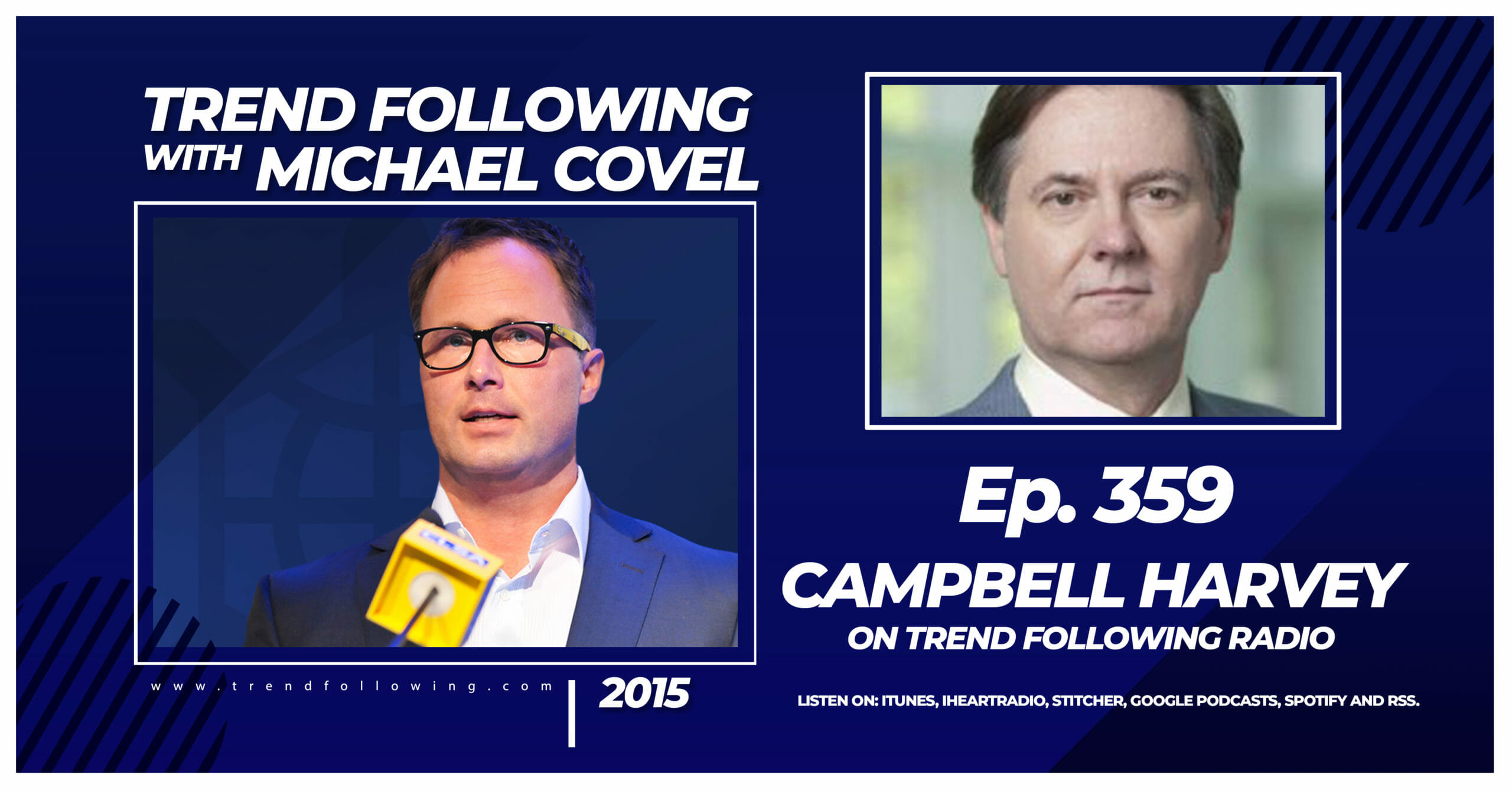
Ep. 359: Campbell Harvey Interview with Michael Covel on Trend Following Radio

Campbell Harvey
Campbell Harvey

Subscribe to Trend Following Radio on iTunes

My guest today is Campbell Harvey, a finance professor at Duke university, and research associate with the National Bureau of Economic Research in Massachusetts. His research papers on these subjects have been published in many scientific journals.

The topic is Trend Following.

In this episode of Trend Following Radio we discuss:

  • Survivorship bias, and not being fooled by randomness
  • Why people with higher risk tolerance experience much higher upsides
  • Understanding process vs. outcome
  • The difference between volatility and skew
  • The importance of recognizing that asset returns are rarely “normally distributed”
  • When it is appropriate to apply a general framework, and when it is not
  • The Sharpe ratio – is it always relevant?
  • Harry Markowitz, Jim Simons, and Nassim Taleb

“These people that are taking a lot of risk, with enough luck, will rise to the top. The person that is risk-averse is stuck in the middle” – Campbell Harvey

Mentions & Resources:

Listen to this episode:

Jump in!

Rate and Review Trend Following Radio on iTunes

Get the foundation to making money in up, down and *surprise markets on the Trend Following mailing list.

Have a question or comment about this episode? Post it below.

Wisdom from William Eckhardt

1. What is the state of the market?
2. What is the volatility of the market?
3. What is the equity being traded?
4. What is the system or the trading orientation?
5. What is the risk aversion of the trader or client?

Regardless of how you trade or invest … you better have those answers in advance of betting real money. Thank William Eckhardt for those perspective pearls. And yes–you answer with a number.


More on Pricetrader Bill Exkhardt.


How can you move forward immediately to Trend Following profits? My books and my Flagship Course and Systems are trusted options by clients in 70+ countries.

Also jump in:

Trend Following Podcast Guests
Frequently Asked Questions
Performance
Research
Markets to Trade
Crisis Times
Trading Technology
About Us

Trend Following is for beginners, students and pros in all countries. This is not day trading 5-minute bars, prediction or analyzing fundamentals–it’s Trend Following.

Risk, Volatility and Returns

Ed Moy turned me onto a whitepaper that trend followers will find of interest: PDF.


How can you move forward immediately to Trend Following profits? My books and my Flagship Course and Systems are trusted options by clients in 70+ countries.

Also jump in:

Trend Following Podcast Guests
Frequently Asked Questions
Performance
Research
Markets to Trade
Crisis Times
Trading Technology
About Us

Trend Following is for beginners, students and pros in all countries. This is not day trading 5-minute bars, prediction or analyzing fundamentals–it’s Trend Following.

Trend Follower David Druz on Systems

From The Little Book of Trading trend follower David Druz has a plan:

Once a system’s algorithms and parameters are established, the system must be followed exactly and religiously. A system cannot be second-guessed or used intermittently. Values of variables cannot be altered. Parameters cannot be arbitrarily changed. A robust system works over many types of market conditions and over many timeframes. It works in German Bund futures and it works in wheat. It works when tested over 1950-1960 or over 1990-2000. Robust systems tend to be designed around successful trading tactics not designed around specific types of markets or market action. And here is the amazing thing about robust systems: The more robust a system, the more volatile it tends to be! Druz gives this advice: “There are whole families of trend trading ideas that seem to work forever on any market. The down side is they are very volatile because they are never curve-fit. They’re never exactly fit to any particular market or market condition. But over the long run, they do extract money from the market. You want to be focused on how you divvied up the risk in your portfolio, how much risk you take in each market, how many contracts you trade in each market, that’s the stuff that really counts…if you have money management wired, you can let volatility go because you know it doesn’t have any correlation with the risk of ruin. You can use volatility to your advantage.”

Wise.


How can you move forward immediately to Trend Following profits? My books and my Flagship Course and Systems are trusted options by clients in 70+ countries.

Also jump in:

Trend Following Podcast Guests
Frequently Asked Questions
Performance
Research
Markets to Trade
Crisis Times
Trading Technology
About Us

Trend Following is for beginners, students and pros in all countries. This is not day trading 5-minute bars, prediction or analyzing fundamentals–it’s Trend Following.