Please enjoy my monologue Sunrise Capital with Michael Covel on Trend Following Radio. This episode may also include great outside guests from my archive.
In this episode of Trend Following Radio:
Brexit and systematic trading
Price distribution
Price action
Directional betting on a coin flip event
Preparing for black swan events
Are computers good or bad?
MAR ratio
Diversification
“Systems control the trading ideas. What they do is they give you a statistical edge in creating your trading ideas.” – Chris Stanton
“It’s a bad idea to get the insurance after the catastrophe.” – Jason Gerlach
Not that I would expend an ounce of energy to defend any NY-based hedge fund (says the Chicago CTA), but as if this has just been a typical period since Mar ’09 “No more than 23% of active managers in any segment of the U.S. equities market outperformed the S&P 500 over the past 5 years” practically brings tears to my eyes – in laughter. And also hope. Hope that we are close to the next “unforeseen sequence of events” typically favorable for our preferred style of trading.
Almost finished your “Trend Following” and noticed there are…[some] people having negative issues with trend following. Well, I can tell them something…
In 2006 I started with 20,000 USD, no trading training and I [took training]. The key here is that I had no trading education. In Oct 2008 I made 300,000 USD and after 7 years of trend following I turned the initial 20,000 into almost 800,000. I then thought I know how to trade and started day trading and then (as many traders before me) lost everything. I [then] came to the conclusion that I knew nothing about trading… expensive lesson for me, but I knew what was possible [with trend following].
I have for the past year gone through an extensive training process [books and a course with (name)]. I still get the [name] data every day and will soon start again. Obviously I know a lot more than before, but the important thing is that I could turn 20,000 into almost 800,000 (drawdowns, etc. included) and I made money on ONLY 35% of my trades, that is without ANY formal trading knowledge, just following the trend.
So, no one [will] tell me trend following does not work, is dead, or anything else. It is alive and well and will be forever.
Are all trend followers use spreadsheet alone to trade? Or they also use charts for visualization? I am having a hard time trading using spreadsheet alone and I tend to see a chart. It provides the visualization I need.
Thank you
Best Regards,
[Name]
What does the visualization do?
Are your trading decisions based on the price or visualization of a chart?
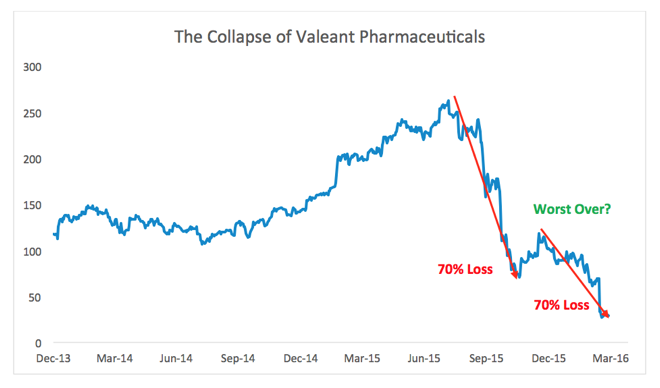
A host of high profile money managers learned that the hard way recently when their investments in Valeant Pharmaceuticals reversed course.
For example, the Sequoia fund returned four times as much money as the stock market from 1970 through July 2015. What’s more, they did it with less volatility and lower drawdowns.
But Sequoia Fund’s brilliant performance came to a halt in the last year because of a single investment in Valeant.
At the peak, Valeant made up more than 30% of Sequoia’s portfolio. When Valeant began losing altitude, Sequoia’s managers failed to consider an exit plan. Instead of pulling the ripcord and exiting their positions, they added 1.5 million shares at the end of 2015 – only to see the stock nose dive a further 70%.
Valeant
Trust the process
The lesson here is clear. You won’t always be right, and you must have a process in place for the inevitable times when you will be wrong.
A rules-based investment process like trend following establishes predefined exit points before entering each position. This process defines exactly how much capital is at risk with each position across the portfolio. That allows you to cut losing trades quickly – before they ever have the opportunity to grow into career-ending losses.
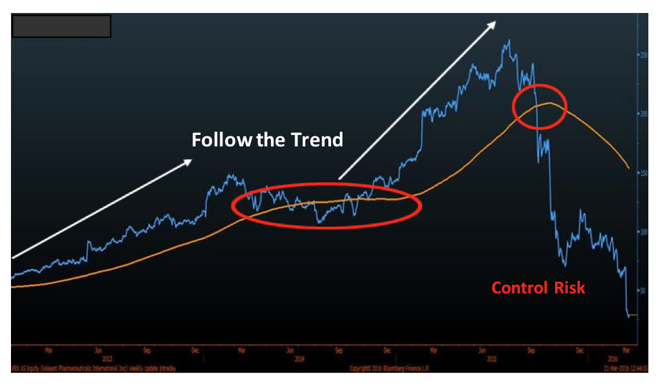
Here’s how a simple trend-following strategy could have worked on Valeant:
Using a 200-day moving average would have gotten you into the stock during much of its move higher through 2013 and 2014. Then you would have gotten out of the stock above $200 per share – before it lost nearly 90% of its value.
With this kind of strategy, you will give up some profits when stocks fail to trend higher, like in 2014. But giving up this relatively small upside allows you to systematically avoid disastrous losses.
In 1995, psychologist Daniel Goleman published his best-seller Emotional Intelligence, a powerful case for broadening the meaning of intelligence to include our emotions. Drawing on brain and behavioral research, Goleman demonstrated why people with high IQs often flounder, while people with modest IQs often do extremely well. The factors that influence how well we do in life include self-awareness, self-discipline, intuition, empathy, and an ability to enter the flow of life, character traits most traders would not consider particularly useful for garnering profits from the markets.
Being self-aware also means understanding what you want out of life. You know what your goals and values are and you are able to stick to them. For instance, if you’re offered a high-paying job that doesn’t square with your values or your long-term goals, you can turn it down promptly and without regret. If one of your employees breaches corporate ethics, you deal with it instead of either ignoring it or worse yet making a half-hearted response because you pretend to yourself it won’t happen again.
Emotional self-control makes anyone more productive. However, Goleman is not saying we should repress our feelings of anxiety, fear, anger, or sadness. We must acknowledge and understand our emotions for what they are. Like animals, biological impulses drive our emotions. There is no way to escape them, but we can learn to self-regulate our feelings and, in so doing, manage them. Self-regulation is the ongoing inner conversation that emotionally intelligent engage in to be free from being prisoners of their feelings. If we are able to engage in such a conversation, we still feel bad moods and emotional impulses just as everyone else does, but we can learn to control them and even to channel them in useful ways.
A trend follower’s ability to delay gratification, stifle impulsiveness, and shake off the market’s inevitable setbacks and upsets, makes him not only a successful trader, but also a leader. Goleman found that effective leaders all had a high degree of emotional intelligence along with the relevant IQ and technical skills. While other “threshold capabilities” were entry-level requirements for executive positions, emotional intelligence was the “sine qua non” of leadership. Without emotional intelligence, someone can have superior training, an incisive and analytical mind, and infinite creativity, but still won’t make a great leader.
Now consider recent feedback to me in email:
Psychology is not a science, an art, a philosophy nor a religion. Why would I want to waste my time with people whose subject is completely unworkable?.
Yours truly,
[Name], a satisfied Scientologist for 48 years.
I can understand that. If I was in a cult I would say the same.
Note: Take a listen to some of the best minds in the field of psychology here.
“Listened to your interview with Bill Bonner. Your comments on economists made me think of this old joke. Click on image and move mouse: here.”
Summed up nicely:
“The fed’s try and stretch the addiction out as long as possible. Why? Because running a rehab clinic can be a good business, especially if the patients never recover. Patients are never allowed to hit bottom. They never get better, and the quacks bring more and more wealth and power to themselves and their friends.” – Bill Bonner