Subscribe now and watch my free trend following VIDEO.

Ep. 145: Bubble Pop with Michael Covel on Trend Following Radio

Bubble Pop with Michael Covel on Trend Following Radio

Please enjoy my monologue Bubble Pop with Michael Covel on Trend Following Radio. This episode may also include great outside guests from my archive.

Listen to this episode:

Want to learn more Trend Following? Watch my video here.

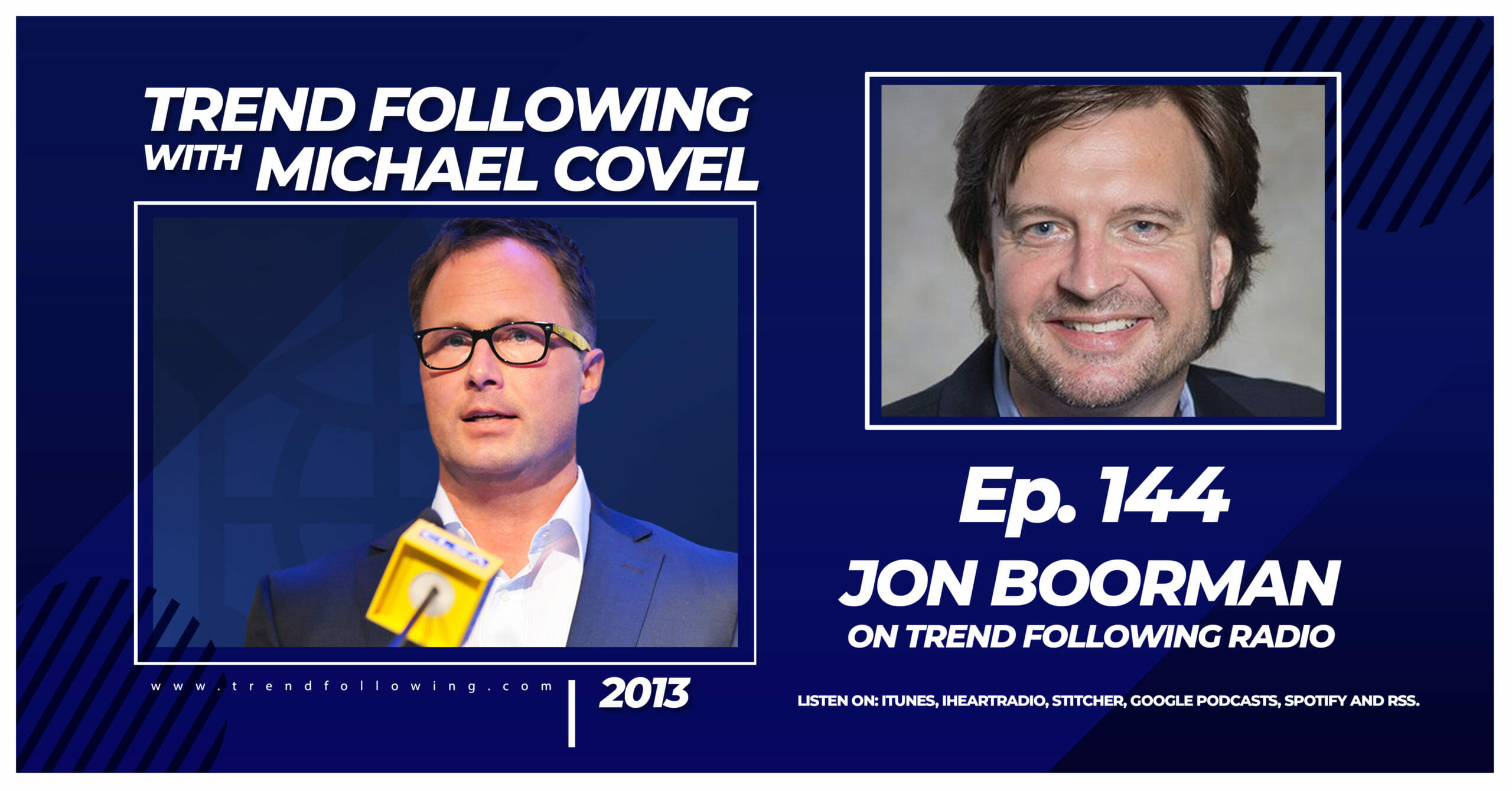
Ep. 144: Jon Boorman Interview with Michael Covel on Trend Following Radio

Jon Boorman
Jon Boorman

My guest today is Jon Boorman, CMT, a market technician, analyst, and trader with 25 years of experience in global equity, FOREX, and futures markets. Boorman employs trend following and momentum strategies to generate actionable trade ideas. Boorman has been with many big firms in the past 25 years, but now works on his own outside of the infrastructure of the big investment banks and brokerage firms.

The topic is Trend Following.

In this episode of Trend Following Radio we discuss:

  • What it was like working within the big firms
  • Boorman’s beginnings and how he found his way to where he is today
  • What advice Boorman would have for newcomers, and whether the training Boorman went through is still relevant to up-and-comers today
  • How regardless of your access, success comes down to the individual
  • Price-based trend following vs. other technical analysis
  • Boorman’s early “a-ha” moments towards trend following
  • Trend following complexity, and why it can be “simple, but not easy”
  • Trading your own personality
  • Van Tharp, risk management and position sizing
  • Trend predicting vs. trend following
  • The fantasy of calling tops and bottoms
  • Why the major media outlets don’t give trend following proper coverage, and why trend followers don’t make good “copy”
  • Mistaken emphasis on entries rather than exits
  • The idea that Boorman “no longer having a need to be right” after he left Lehman Brothers
  • Alpha capture
  • Acceptance of trend following amongst the larger financial community
  • Understanding the legendary trend following traders such as Bill Dunn and Jerry Parker

Listen to this episode:

Jump in!

A Very Hippie Way of Thinking About Trend Following


How can you move forward immediately to Trend Following profits? My books and my Flagship Course and Systems are trusted options by clients in 70+ countries.

Also jump in:

Trend Following Podcast Guests
Frequently Asked Questions
Performance
Research
Markets to Trade
Crisis Times
Trading Technology
About Us

Trend Following is for beginners, students and pros in all countries. This is not day trading 5-minute bars, prediction or analyzing fundamentals–it’s Trend Following.

John Paulson -65%

Davie Tate III writes:

Hey Mike. Davie Tate here. I was thinking about your recent podcast where you talked about how the sharks were posting Bill Dunn’s worst years to demonstrate the failure of trading. It reminded me of the recent articles on John Paulson. You may have read that his gold fund is doing horribly this year. Down 65%. Just like with Bill Dunn, people who don’t understand trading are just salivating over this demonstration of the “failure of trading”. The fund only represents 2% of Paulson’s funds. If this fund operates totally independently of his others funds then I might be inclined to agree with some of the criticism Mike. I can’t understand how any professional trader of Paulson’s caliber could allow his fund to lose 65% of assets. Also, I can’t understand why any professional trader could have looked at a gold chart for the past few years and decide to go long which is the only way that I can imagine that he could be down 65%. If he does incorporate counter trending strategies and was long then I don’t understand why his stops didn’t prevent such a massive loss. On the other hand Mike, if this fund does not operate totally independent, but operates as part of all of his assets, then my view would be totally different. A 2% investment of total funds under management while a bit high, is not a totally unreasonable amount for a professional to risk on a trade. Furthermore if that is the case, just think about it Mike. A 65% unrealized loss on a particular trade means you’re still in the trade. We are actually willing to risk 100% of the 1% or so that we risk on each trade. I don’t think some people realize that. If you have $100,000 trading account and you risk $1000, 65% down in that trade means you are still in the trade. The trade doesn’t end until you either get stopped at a 100% loss of the $1,000 or you take profits of 2:1 or 3:1 on that trade. Some people don’t seem to realize that about trading.

65% loss in one market is not trend following. Where is the cutting of loss? Maybe his strategy will work, but it’s not loss cutting. Dunn’s DD was from taking many small losses across many markets. Those add up to a DD. No one drop on one market. Plus, there really can’t be a TF fund on one market alone. No diversification.


How can you move forward immediately to Trend Following profits? My books and my Flagship Course and Systems are trusted options by clients in 70+ countries.

Also jump in:

Trend Following Podcast Guests
Frequently Asked Questions
Performance
Research
Markets to Trade
Crisis Times
Trading Technology
About Us

Trend Following is for beginners, students and pros in all countries. This is not day trading 5-minute bars, prediction or analyzing fundamentals–it’s Trend Following.

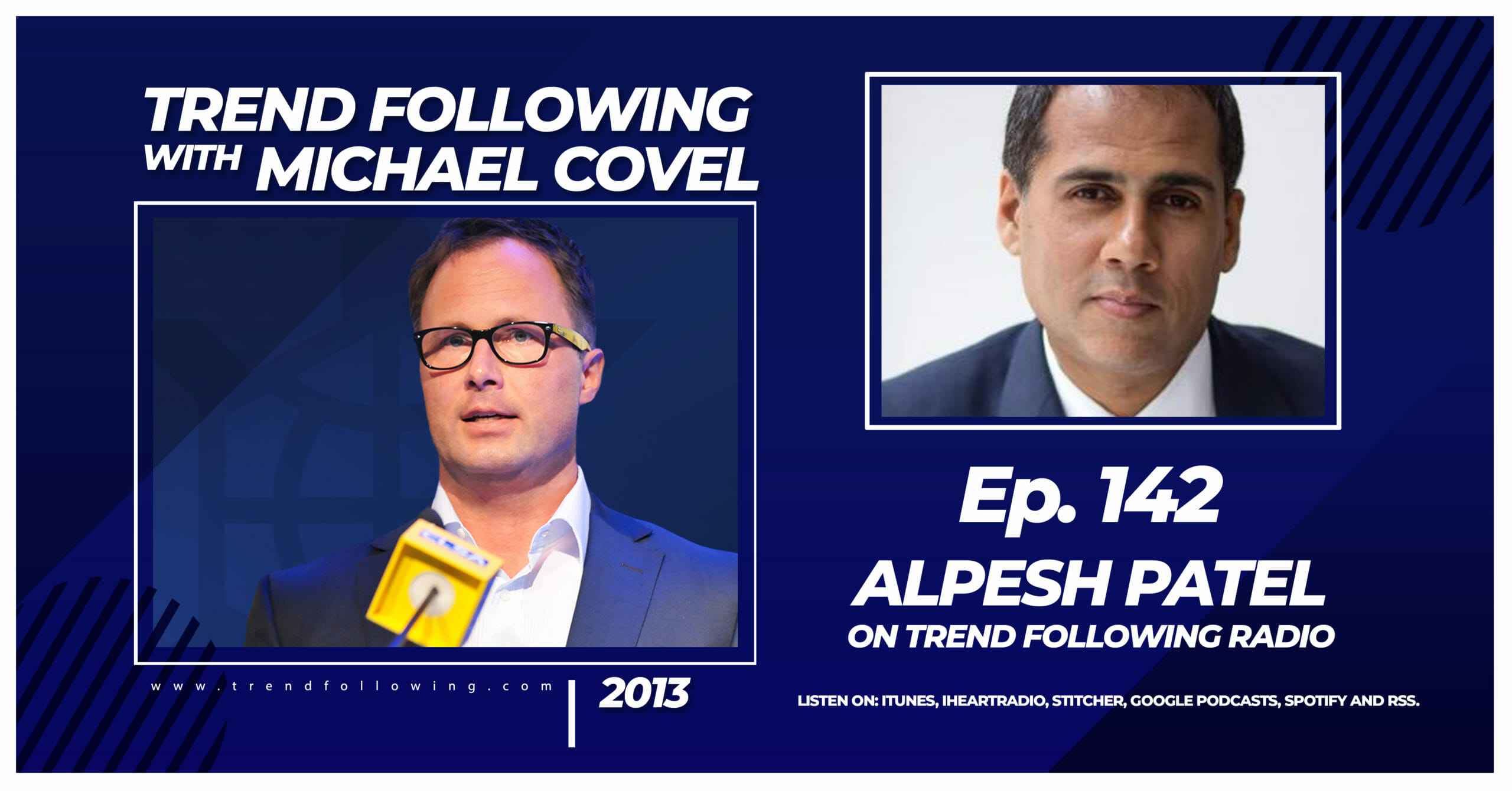
Ep. 142: Alpesh Patel Interview with Michael Covel on Trend Following Radio

Alpesh Patel
Alpesh Patel

My guest today is Alpesh Patel, a hedge fund manager, Financial Times columnist and Bloomberg TV presenter.

The topic is his book How to Win at Spread Betting: An Analysis of Why Some People Win at Spread Betting and Some Lose.

In this episode of Trend Following Radio we discuss:

  • Comparisons betweens stocks and futures
  • What the winners have in common
  • Trade frequency, and why active traders tended to do better in Patel’s study
  • Buy & holders vs. spread betters
  • Academic vs. practical insights
  • Whether Patel finds himself at odds with other Financial Times writers
  • Why people like to imagine that trend following and momentum trading doesn’t exist
  • Patel’s experience as an expert witness with “trend following on trial”
  • Why the average person has difficulty with betting small, cutting losses, and letting winners ride
  • George Soros, game theory and trading psychology
  • Win/loss ratios
  • A coin flipping experiment performed with Ph.D’s, the importance of position sizing, and why systems aren’t everything
  • Why gut instinct is the opposite of what professional traders use

Listen to this episode:

Jump in!

When the Trend Following Light Bulb Hits

Excerpts from nice feedback in tonight:

Michael, I want to thank you for pursuing your passion for trend following so tenaciously. I consider myself very new to the concept of trend following. I was first introduced to this style of trading and the story of the turtles traders in 2007 by a mentor of mine. I was 25 years old. At the time, I had become very interested in trading, stocks, and the allure of making money in the market. All the “knowledgeable and older” people I spoke to of this passion said there’s no such thing as fast money and it was best to stick with a buy and hold strategy. The message was, I should save 10% of my income and wait 40 years and I’d retire as a wealthy person. During this period, I read a few books on trading, mostly about using fundamental analysis and executing a buy and hold strategy to identify stocks with a high growth potential. I executed a few trades, made some money, lost some money and than walked away from trading believing it just wasn’t for me. I started funding my IRA and 401K using run of the mill mutual funds and put my active trading interest on hold. Fast forward to last summer, I am sitting in a tent in Kandahar, Afghanistan working for the U.S. Air Force. It’s the middle of the night and after reading on the Internet for days about trend following and the turtle traders story, I declared to a partner of mine. “I am going to teach myself how to trade.” He laughed at me and said you’ll likely lose all your money and for Gods sakes don’t buy some canned trading training program. He told me if your going to learn to trade, teach yourself, because that’s probable the only way that’s you’ll be successful. I thought it was good advice and I followed it. By the middle of the summer of 2012, I had become disgusted with the options I had for a executing a traditional buy and hold strategy. I had watched friends and family lose thousands of dollars in the 2008 crash, than gain some of it back, but at the same time, intuitively it didn’t seem right to me that I should be investing my hard earned money in mutual funds knowing those fund managers must be making millions on us “Joe Public”. Do they have my best interests in their hearts? What makes them smarter than me? How come it seems like the game everyone is playing is fixed? Additionally, I felt like having to be an expert in stock picking by reading companies balance sheets, or discerning broad trends, or by identifying hot market sectors through the news wasn’t going to work for me. I thought diversification only meant buying and holding different asset classes based on a defined time horizon. I didn’t understand what technical analysis was. By this time, I was trading here and there, but all the time, I felt like my activity was no better than guessing. I had no idea how much of an equity to buy, how long to hold, or what the function of a stop loss was. I didn’t understand the concept and application of trending following. I’d never heard of an automated trading system. Sitting in that tent, that very night, I went on Amazon bought 3 of your books, had them shipped to me in Afghanistan. I than began reading everything I could find on trending following, the turtle story and alternatives to discretionary trading. After I made this decision to teach myself to trade, it was as though something clicked in my mind. Ed Seykota says “intention = results”. Well I intended to learn to trade and I intended to use trending following as the vehicle. Thanks to the guidance, data, results, and discussions on trading software outlined in your books I’ve been able to make this happen. From your books, I’ve learned 90 percent of what I need to know about trend following and the rest was filled in by additional reading and through though trial and error. I kept thinking back to my past trading successes and failures, and realized I had been blindly making classic trading mistakes. After I made the decision to pursue developing an automated trending following system. I found the work in your books invaluable in solidifying and clearly defining a path to an alternative way of thinking and trading. Something about your descriptions of taking emotion out of the trading process was deeply appealing to my mind. Armed with all the evidence and knowledge from your work, I am now able to confidently say trend following is really the only method for trading that I can see will win in the long term. It was through your work that you lifted the val on this style of trading for me, and I’m sure, many other people like. In closing, I want to thank you for being so passionate about this style of trading. It comes through clearing in your books, on your websites, and in your podcast. Without your dedication and passion for trend trading, I wouldn’t be applying my own passion for being successful in my life. I just wanted to tell my story about teaching myself how to trade; going from zero to an active trading system by sheer determination with an intention to following a different path outlined through your work and others like you. Hopefully, I can endure the inevitable draw downs and second guessing that comes with trend following. Armed with the knowledge outlined in your work, I think I can.

Thanks,
Daniel

Winners just win. They want it. He wants it.


How can you move forward immediately to Trend Following profits? My books and my Flagship Course and Systems are trusted options by clients in 70+ countries.

Also jump in:

Trend Following Podcast Guests
Frequently Asked Questions
Performance
Research
Markets to Trade
Crisis Times
Trading Technology
About Us

Trend Following is for beginners, students and pros in all countries. This is not day trading 5-minute bars, prediction or analyzing fundamentals–it’s Trend Following.
Inspirational Proof

Feedback in:

Hi Mike. Thank you for the latest newsletter and for introducing me to Asacker and Watts. The podcast with Tom Asacker is superb. The final part, listening to Alan Watts moved me to tears, what he said is so true and said so eloquently. I have two daughters and hope to convince them to work for themselves when they get through their education. I hope they will listen to your podcast at some point – they’re aged 11 and 13. Your own story of itself is inspirational and proof that belief is crucial. Incidentally, JOB, stands for; JUST OVER BROKE! I heard that many years ago, and how true it is. Which ever part of the world you’re in, have a good day.
Best wishes,
Rob

Thanks!


How can you move forward immediately to Trend Following profits? My books and my Flagship Course and Systems are trusted options by clients in 70+ countries.

Also jump in:

Trend Following Podcast Guests
Frequently Asked Questions
Performance
Research
Markets to Trade
Crisis Times
Trading Technology
About Us

Trend Following is for beginners, students and pros in all countries. This is not day trading 5-minute bars, prediction or analyzing fundamentals–it’s Trend Following.