My guest today is Steven Pinker, a Canadian-born American cognitive scientist, psychologist, linguist, and popular science author. He is Johnstone Family Professor in the Department of Psychology at Harvard University, and is known for his advocacy of evolutionary psychology and the computational theory of mind. He covers phenomena that have traditionally not been looked at scientifically such as: visual perception, war and peace, and differences in writing styles. He has authored numerous books with his most recent being, “The Sense of Style.”
The topics are his books The Sense of Style: The Thinking Person’s Guide to Writing in the 21st Century and Blank Slate.
In this episode of Trend Following Radio we discuss:
Evolution
Natural selection
War statistics
Cognitive science
Evolutionary psychology
“I don’t think there is any single procedure called the scientific method. I think that science just is the attempt to explain phenomena using explanations that you can show to the best of your ability are true.” – Steven Pinker
Trend Followers don’t shy away from losses. Losses provide valuable feedback that helps them improve as traders. Sometimes, losses occur despite solid strategies and perfect execution.
Such is life when participating in markets. Some trend followers break down, change their approach and pursue a career of trying to find consistent gains day after day, month after month, year after year.
Every so often, all traders experience a painful losing period that can last a while. Trend Followers, after conducting endless hours of research, know that their strategy will experience losses from time to time. They accept this from the very beginning before they even make a trade with real money.
In general, investors take losses personally and purposely try to avoid them. They have positive intentions though. They want to protect themselves from the feelings that come up during losses; that sinking feeling in their stomach; headaches; cold sweats that comes with anxiety.
Fundamentalists avoid losses; instead, preferring to be right and feel smart. As a result, they sometimes ignore the reality and hold onto losing positions – sometimes long enough to put themselves out of business. Here’s an all too common exchange between two very different types of investors – Fundamentalists and Trend Followers.
Fundamentalist: “XYZ has to rise. The fundamentals are strong – earnings growth is positive; valuation is reasonable; it’s positioned well in a vibrant industry.”
Trend Follower: “Hmm…well, despite your optimism, I notice the stock price moving downwards.”
Fundamentalist: “Yea, but this is a temporary dip. It has to go back up at some point. The fundamentals are too good for it to stay down.”
Trend Follower: “Maybe, but what if it keeps going down? What if it’s strong fundamentals aren’t enough to make it move higher? What if the broader market fundamentals and sentiment drag it down? Your analysis won’t mean sh*t then.”
Fundamentalist: “You’re a simpleton technical trader. You care only about the price now. You do not and cannot see the stock’s future potential like me. I know this company inside and out. Based on it’s fundamentals, this stock will be a homerun one day. Any dip in price should be viewed as a buying opportunity.”
Trend Follower: “I don’t need to know the fundamentals if I know the price. Nothing else matters besides the price. If I buy a stock that appreciates in price, I make money regardless of what the fundamental story is. Plus, earnings reports can be easily manipulated. The stock price is real; it cannot be faked; it’s the only thing that can be trusted.”
Fundamentalist: “Whatever, trend boy.”
Back to avoiding losses – in all likelihood, investors avoid losses because they don’t want to accept them as part of the deal. They simply want to win all the time. Those who do the work, and who don’t live in fantasy land, know that this is impossible to achieve, so they prepare for losses by budgeting for them.
As a result, these investors, humbled by the facts that research taught them, learn that budgeting for losses can help improve overall returns better than trying to avoid losses altogether.
Trend Followers accept losses as part of the process – a tax, if you will, on the path of achieving long-term success. Before placing a trade, trend followers assess the market, its behavior and their financial condition (what positions they currently hold; risk exposure in each position, sector and portfolio overall; their capital base).
Trend Followers take risks within their budget, so if a particular trade does not work out, they lose an amount within our budget. When you take risks within your budget, you survive; you survive through the dips with enough capital to take advantage of the big opportunities when they come along.
Make losses affordable and learn to live with them, especially you win-at-all-costs alpha males out there. Take small ones more frequently, so you can avoid big ones less frequently.
Michael G. Melissinos
Melissinos Trading, LLC
www.melissinostrading.com
Note: You can also find an appearance by Michael on my podcast.
From Bondi Beach Australia thank you for a fantastic Podcast, I listen to you as I drive my 400 ton mining truck, you have added much knowledge to much trading journey and the great thing is I have many more to get through. Cheers.
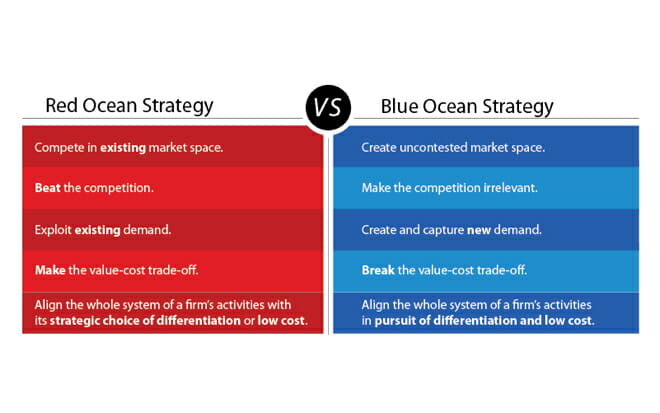
Hello from Blue Ocean Strategy! We recently listened to the podcast “Masters in Business: Michael Covel” on Barry Ritholtz’s Big Picture (January 13, 2016). We really appreciate when people take the time to mention blue ocean strategy and as a thank you, we share the best content with our growing global audience via our website, social media accounts and email newsletter. We thought our audience would enjoy this piece and so we have already mentioned and posted a link to it in our eLibrary – here.
We would love to have you as part of our Blue Ocean Community. We have an exciting newsletter with original content that we’d love for you to sign up for. Also, if you haven’t already, check out our Facebook, Twitter or LinkedIn accounts where we share other latest developments on blue ocean strategy.
To blue oceans ahead!
With appreciation,
xxx from the BOS Team
Thanks! I hope to have Professor Kim on my podcast soon. Let’s make that happen.
A listener passed this along. An interesting post from Finance Trends (source):
Valeant Pharmaceuticals (VRX) is now big headline news, as the stock’s downward slide continues to punish investors, big and small.
Hedge fund manager, Bill Ackman of Pershing Square was reported to have lost $1 billion in a single day due to VRX’s latest plunge. Institutional ownership of Valeant’s stock was very widespread. As mentioned in our last post, a huge number of hedge funds and mutual funds owned big positions in VRX. Smaller investors may also be feeling the hit in their personal investment accounts or in their pension funds’ returns.
Let’s not focus too much on the investors who were unfortunate enough to get burned in this stock crash. The media and the investing world are already having a field day with this debacle. Instead, let’s take a fresh look at the chart to better understand why so many savvy investors were hurt in this decline.
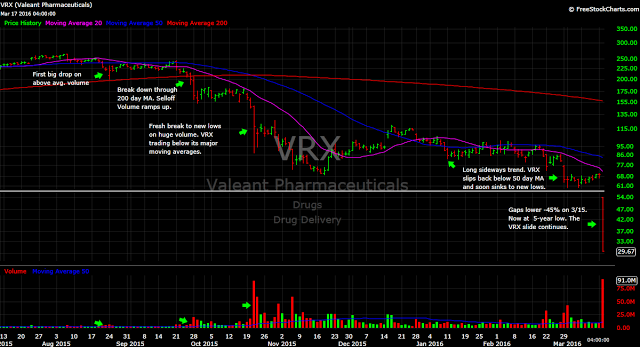
As you can see in this updated daily chart (see below), VRX had been showing signs of distribution (professional selling) for weeks heading into the fall of 2015.
After breaking down through its 200 day moving average (the red line), the stock moved sideways for a time before plunging through the $150 level. Here’s where the decline really accelerated and volume ramped up.
Towards the end of 2015, we saw a nice rebound in VRX and a bit of chatter about how “everything would be fine” and “here is a smart place for big investors to average down and buy more”, etc. Well, as recent events have shown us, that is not exactly how things played out for the investors who stubbornly held on to their bullish “thesis” for VRX.
At the start of this week, VRX was trading near $68. By Tuesday, the stock had plunged by over 50% to close at $33.49. As of today’s close, VRX is trading at $29.65, 60% lower from our previous Valeant (VRX) update at the end of February.
If you didn’t read my last post on VRX, go back and check out the closing section, “How to avoid disastrous stock declines”. If you know someone who is stubbornly holding on to major losses in their portfolio or trading account, share the article with them. While nothing is foolproof in investing, these simple ideas may help you pare or avoid the disastrous losses that can ruin any investor, big or small.
“The most important rule of trading is to play great defense, not great offense. Every day I assume every position I have is wrong. I know where my stop risk points are going to be. If they are going against me, then I have a game plan for getting out.” – Paul Tudor Jones, via Darvas Trader.
My guest today is Catherine Stott, the author of, “Hypnotrading: A practical guide to using hypnosis and NLP to improve your trading performance: Self-hypnosis and psychotherapeutic techniques for traders.” Catherine believes that hypnotherapy and neuro-lingustic programing can help traders defeat inner challenges and become more successful. She got started working with traders after helping a friend, who happened to be a trader. He helped her understand the world of trading a bit more throughout their sessions and this ignited her interest deeper. She has been helping traders for years but didn’t start HypnoTrading until 2014.
The topic is her book Hypnotrading: A Practical Guide to Using Hypnosis and NLP to Improve Your Trading Performance.
In this episode of Trend Following Radio:
Stress vs. anxiety
Meditation vs. hypnosis
Being in a relaxed state
Negative self talk
Fear of success
Modeling
P-A-C-E-R
Luck and expectation
Defining goal setting
“It’s about your experience rather than your academic ability, and your drive and thrive for learning and achieving.” Catherine Stott