Subscribe now and watch my free trend following VIDEO.

Ep. 193: Gerd Gigerenzer Interview with Michael Covel on Trend Following Radio

Gerd Gigerenzer
Gerd Gigerenzer

Subscribe to Trend Following Radio on iTunes

My guest today is Gerd Gigerenzer, the director of the Max Planck Institute for Human Development in Berlin, and a former professor of psychology at the University at Chicago. Gerd is also the director of the Harding Center for Risk Literacy (read David Harding the head of trend following firm Winton Capital).

The topic is heuristics.

In this episode of Trend Following Radio we discuss:

  • Uncertainty
  • Comparing decisions to baseball (gaze heuristic)
  • Complex problems and simple solutions
  • Using price action as a decision making cue
  • Unconscious heuristics
  • The art of knowing what one doesn’t have to know
  • The less is more effect
  • The miracle on the Hudson River a few years ago as a case in point illustrating heuristics
  • The idea of an adaptive toolbox
  • The element of surprise in Gigerenzer’s work
  • The distinction between risk and uncertainty
  • Intuition vs. rationality

In this episode of Trend Following Radio:

  • Why uncertainly and risk are not the same thing
  • How we use heuristics to make decisions
  • Why complex problems don’t always require complex solutions
  • Why heuristics and conscious reasoning are both important
  • “Less is more” – the art of knowing what you don’t need to know
  • How these methods are applicable in investing, management, law, and many other areas
  • What defensive decision making is and why you need to know

Mentions & Resources:

Listen to this episode:

Jump in!

[toggle Title=”View Full Transcript”]MICHAEL: Today on the show, I have Gerd Gigerenzer. Gerd is the director at the Max Planck Institute for Human Development in Berlin, and he’s a former professor of psychology at the University of Chicago. Gerd is also the director of the Harding Center for Risk Literacy. That would be the David Harding Center for Risk Literacy.

Our conversation today is about heuristics, and for those of you that trade, for those of you that invest, and for those of you that just want to navigate risk and uncertainty in your life, my conversation with Gerd is intriguing. Frankly, I find it fascinating. I find the topics that he goes into fascinating. His work is the foundation, the philosophical foundation, of trend following success, even if he did not set out for that to be the case. I hope you enjoy this conversation.

Hi Gerd, this is Mike Covel. How are you?

GERD: Yeah, I’m fine, so far. There’s no snow yet.

MICHAEL: Where are you today?

GERD: I’m in Berlin, at the Institute. And you?

MICHAEL: I am right outside Washington, D.C. right now.

GERD: Okay.

MICHAEL: Let me jump right in, Professor. I think your work and what you’re doing – in my world, in my trading world, much of your work is the foundational spine, so to speak, on good trading and the good philosophy behind good trading. I think where I’m going with that is, for example, the big question: how do we all make inferences about the world that we live in with limited time and knowledge? I mean, that gets right at where you start in with your work, doesn’t it?

GERD: Yes, totally right. But it’s not what most economists are talking about, and where the uncertainty is confused with risk, with known risks, and where one tries to model people’s behavior as if they could calculate all the risks. What I’m doing is to try to develop an alternative, or to find tools that actually can deal with uncertainty, and heuristics are some of these tools.

MICHAEL: One of the heuristics that I know you’ve used quite a bit in explaining this to all different types of audiences is the gaze heuristic, and specifically in sports, and specifically I’ve heard you use it in baseball. As a guy who once played baseball for a long time – and I was a baseball catcher – why don’t you explain that, though, from your perspective, and why that’s such a great way to lead into this subject?

GERD: The question is how does an outfielder catch a ball? If you look into explanations of that, you will find that many people think if the problem is complex, we need a complex solution. What would it be? Obviously, that the outfielder somehow calculates the trajectory of the ball and runs to the point where it’s going to go. You can find people like Richard Dawkins, in his Selfish Gene, writing exactly that. He puts the “as if” in there. This is an economics term. So behave as if one would be able to compute and know everything.

I’m interested in how actual people make decisions, here outfielders, and a number of experiments show that they don’t compute trajectories and don’t run to the point that has been computed, but rely on a simple heuristic that actually can do the job in the limited time, and also in a situation where one has not the information to estimate all the parameters you would need to determine the right trajectory, such as the initial distance, the initial velocity, the air resistance and the direction of the wind and spin and so on.

One of the simplest heuristics, among a number of heuristics that outfielders use, is the gaze heuristic. It works if the ball is already high up in the air, and it’s very simple. It consists of three building blocks. First, fixate your eye on the ball; second, start running; and third, adjust your running speed so that the angle of gaze remains constant. And then you will end up at the point where the ball ends up.

So here is a very different philosophy. There is a complex problem, and what’s needed is a simple solution, and when we look hard enough, we often can find it.

MICHAEL: In my world, and in some of the books that I’ve written on trading, one of the simple heuristics that people use is they say “How do I make a good investing decision? There’s so much information out there, there’s so many different variables; who do I make a good investing decision?” And many traders have figured out, why don’t we just focus on one piece of information?

For example, the price itself. So literally, if the price is going up, I want to be long with that instrument; if the price is going down, I want to be short with that instrument. So a lot of traders have really come at – whether they did it knowing about your work, or your work is the great foundation for why they’ve been successful – but this simple heuristic of using price action as a decision-making cue has worked extremely well.

GERD: Yeah. In trading, we have the same two philosophies: it’s a complex and difficult problem, and many are looking for complex solutions. You notice that it ranges from the traditional finance model, from Markowitz optimizing, to all kinds of computer-based and high, sophisticated calculation procedures. The other alternative is realizing this is not a problem of known risk. Trading is not trading in a casino. You trade in an uncertain world, and in an uncertain world, the optimization models will not necessarily work.

So we need something that’s robust, something simple, and the heuristic you described is a member of a class of heuristics that are called one reason decision-making. You try to figure out what’s the single most important reason, and then you ignore all the rest. It looks as if that would be irrational, but only if you believe that everything could be calculated. Many studies in social psychology, behavioral economics have tried to show that people just rely on one reason and ignore the rest, and they concluded that this is irrational.

But these studies overlook the important distinction between a world of risk and a world of uncertainty. In a world of risk, maignoring relevant information is irrational, or at least it’s a sign of it’s not so important, this problem. But not in a world of uncertainty – here, and what can be showed it mathematically, good decisions require to ignore part of the information, and if you try to make a complete pro/con list, then you will likely fail.

MICHAEL: As you bring up the world “fail,” I can think of an example that I’ve seen in your work that did not have much time for decision-making, and the pilot had to use various heuristics to make his decisions to save many lives, and that would’ve been the miracle on the Hudson River a few years ago. Why don’t you describe, through your work lens, why that’s such a great example to teach with?

GERD: The heuristics are often used unconsciously, like the gaze heuristic. If you interview a baseball outfielder, you will find out that most of them cannot say how they do what they do so well. So there’s more in our mind than we can describe. The frame heuristics can be used deliberately, and the miracle of the Hudson River is a case in point. As you will recall, the plane started to go from LaGuardia Airport, and within a few minutes, something totally unexpected happened: a flock of Canadian geese collided with the plane.

Now, the modern engines are built in a way to be able to digest birds, but not Canadian geese; they are too fat. The unlikely event happened that they flew in both machines, and it got very quiet in the plane, and the pilots turned around and had to make an important decision: will we make it to LaGuardia Airport, or will we hit the ground before it? That’s a decision about life and death. How did they do this?

One might conclude it’s a complex problem, so we need to compute the trajectory of this plane. But they didn’t. They used the same heuristic as the baseball outfielder uses, the gaze heuristic, now in a different situation. It means you look through the windshield, in the cockpit, and fixate the tower. And if the tower goes up in your windshield, you will not make it; you will hit the ground before. So here is an example of the same heuristic that many people use unconsciously now being used consciously, and it is more accurate than calculations, and in any case, much faster. So the pilots had time to do other important things.

It’s also a lesson that one can use this study of the heuristics people intuitively use in order to inform experts how to make better decisions. And it’s also an illustration that the common opposition between heuristics and conscious reasoning is wrong. So if you look in a famous book by Daniel Kahneman, you will hear a message about two systems. In one, they are heuristics and they are unconscious and they are error-prone. It’s not true. Every heuristic we have studied is used both unconsciously and consciously.

MICHAEL: It’s terribly fascinating. But your work – and I don’t think you have any problem with the controversy of this – you’re coming at these subjects of risk and uncertainty in a way that the establishment is not comfortable with. Many careers have been built off going a different direction than where you’re going. I relate very strongly to your direction, hence the reason I wanted to have you on my program.

GERD: That’s true. My work has caused many controversies. But that’s nothing bad. The science is there to discuss, to debate, to change, to improve. And the distinction between risk and uncertainty that is very fundamental to my research is not one that I came up with. You can find it in the work of the economist Knight in the 1920s; you can find it later. But it has not been taken seriously.

Moreover, most of intellectual effort has been put into building some ways and some methods that reduce uncertainty to known risks. Then we can use our probability measurements that we do. Probability is a wonderful instrument, and I rely on it, but it has its place. It’s not the only tool in our toolbox. And thinking that probability theory or Bayesian theory or any other tool is the only tool that can solve all problems would be like mistaking a hammer with an entire toolbox, and then thinking that everything in the world is a nail. It isn’t. There are screws, and you need different tools, like screwdrivers.

So the entire idea of an adaptive toolbox, of different strategies that the mind uses, is, I know, something that not many people are – or at least some people are not comfortable with, but it’s the same way our body is built. It has not one super organ, but it has many, and there’s a reason for that, because they work better.

MICHAEL: Let me slide into gut feelings. Because if I was to ask you, are you intuitive or rational, I think I know where you’re going to go, but how do you answer that when someone says “Gerd, are you an intuitive man or a rational man?”

GERD: It’s not an “or.” That’s a an error. It’s not an opposition, although you can read this again and again. We need both. We need our brains, we need our guts. More precisely, we need deliberate thinking, but also sometimes we need to trust our intuition. The only question is when. It’s not a question whether intuition is superior to deliberate thinking, or if deliberate thinking is superior to intuition, as many of my dear colleagues believe. No, that’s not the point.

You can show that good expertise is almost impossible without good intuitions. A composer needs intuition to compose. He or she cannot calculate the piece. A chicken sexer needs intuition – do you know what chicken sexing is? Chicken sexing is the art of finding out whether a one-day-old chicken is male or female. If you ask a chicken sexer how they do what they do, they cannot tell. It’s intuitive. But nevertheless, they can do this. And then there are other problems where it’s better to calculate, to do explicit pro and con lists.

And the unlucky attitude in much of social science is to put the one against the other one and look down at one of these. The intuition is based, according to my own research, often on simple heuristics. Why? Because intuition mostly has to do with real world problems that are characterized by uncertainty, not by known risk. If you play in the casino, roulette, you can calculate how much you will lose in the long run. You don’t need any intuition. But if you want to find out whom to trust, whom to marry, what job to take, what to do with the rest of your life, you can‘t calculate that.

Only parts can be calculated. There is a risk, and this is what we usually call experience. But it’s an experience that is not in language, that we cannot express, and this is why many people are suspicious of it.

MICHAEL: One of the things that I think is really interesting about your work is that you are tackling, at least in a way that people can understand and it can be useful then when it happens, is the element of surprise. And of course, you can’t necessarily prepare for a surprise; it’s a surprise. But why don’t you talk about surprise in your work and how you feel about it, what you’ve learned, and what’s useful for the audience to think about.

GERD: The moment one tries to reduce all forms of uncertainty to known risk, surprise is out of the question, because nothing can happen. Nothing new, at least. For instance, the financial crisis we recently had is an example why using standard models for estimating risk have overlooked every crisis and prevented none, and we’re surprised that things could happen that should not as easily happen. So dealing with uncertainty and devising and testing tools for uncertainty is also dealing with surprise. Also, the world needs flexible methods and flexible heuristics in order to adapt to new situations that are quite unexpected.

MICHAEL: When I was preparing for our conversation today, I was thinking one of the great lines that I’ve seen in your work is “the art of knowing what one doesn’t have to know.” Now, that’s slightly going back and talking about some of the issues we talked about in the beginning of this conversation, but the idea of knowing what one doesn’t have to know, the “less is more,” it’s a fairly – I think if most people think about it, it’s simple, it’s intuitive, this makes sense. It’s maybe common sense.

But as a society, we seem in many, many elements of our society – not just my world, for example, trading, but many elements of society, we have got to this point where complexity and more and more data has become overwhelming. I think people – for example, we have all these devices. We have the cell phones, we have the computers. The information overload never stops. And I really think a large number of the population think that all this extra information is helping, but if you just stop for a second and pause, you’ve kind of got to see yourself, “how does this help? It’s just distracting me.”

GERD: Yeah. This is part of the belief that we also talked about, that complex problems need complex solutions. It’s also a version of big data to hope that you can find your needle in the haystack just by having more. Not by knowing anything, but just having more computation. In an uncertain world, this is not correct, because you need to have sufficiently simple solutions in order to make better decisions.

Here is a very simple illustration of this, what we call “less is more” effect. A “less is more” effect is a situation where if you know more than a certain amount, your performance deteriorates, at least for some point. Dan Goldstein and I have studied how people answer simple trivia questions, such as “Which city has more inhabitants, Milwaukee or San Diego?” No, Milwaukee and Detroit, make it simple. About 60% of Americans that we have tested got the right answer, Detroit.

If you ask Germans, what we found is that 90% of the Germans got the answer right, not because they knew more, but because they knew less. Most of the Germans had not even heard of Milwaukee, only of Detroit, and they relied on a simple heuristic that we call the recognition heuristic. You’ve heard of Detroit, not of Milwaukee, so it’s probably Detroit. The Americans could not rely on this heuristic; they have heard of both, and they need to rely on the facts, on recall.

Here is a situation where less is more, where we can show and prove that a sufficient degree of ignorance can actually help. The art of knowing what you don’t need to know can be a conscious version of these type of heuristics that are used, usually unconscious, and realizing that in an uncertain world, the attempt to calculate everything is an illusion of certainty, and it will probably lead to failure.

Good decision-making in an uncertain world needs to find a balance between ignoring and knowing something, and this balance can be mathematically described by the so-called bias-variance dilemma, which I’m not going into it, and which shows us that when we need to make estimations, we should not try to fit every data point, but we have to ignore something and try to just be a little bit biased in order to make better decisions.

So in our work, bias has a positive meaning, and not the meaning that it has in much of work in social psychology, where every deviation from a so-called normative model is called a bias, and people are blamed for it. Intuition is probably more intelligent than this kind of argument by some social psychologists.

MICHAEL: Gerd, you brought up something here a second ago which I thought could lead to another example. I have two quick questions, and then we’ll wrap up. But the idea of recognition, and I think in your work – I can’t remember if it’s an experiment that you did or something that you covered, but the idea of people selecting stocks for investing purposes and the recognition. Why don’t you go into that example? I think that was really interesting.

GERD: That’s actually a study I did with some of my colleagues a long time ago. You’ll find it in the Simple Heuristics Make Us Smart book. We wanted to test how good a very simple heuristic is that can only be used by semi-ignorant people when picking stocks. In order to use this recognition heuristic, you need semi-ignorant people, so we went in downtown Chicago, asking pedestrians which of a long list of stocks they recognized by name, nothing more. Then we did the same thing in downtown Munich.

Then we had pedestrians and we had business students, and then we built portfolios of say the 10 most recognized stocks, and as a control portfolio, the least recognized. Then we waited a half a year; that was the criteria. Then we looked how much money did they make compared to randomly picked stocks, to a certain number of well-known blue chip firms, and some experts and all kinds of criteria.

The study showed that the recognition heuristic portfolios, based on the semi-ignorance of pedestrians, made most money. We replicated the study a few times in contests that have been defined by stock journals and others, and found similar results. Now, that will not always replicate, but I would venture that this simple heuristic does at least as good as well-known people, professional stock pickers, the Dow Jones or other indexes.

That’s an illustration that you can, in a highly complex and uncertain world, you can actually do quite well by simple heuristics – in this case, interestingly, heuristics that need semi-ignorant people. Not totally ignorant, because they need to recognize some half of the – so it should not be read that the less you know, the better. No. A “less is more” effect is defined in a different way. There’s usually some time where more knowledge helps, but then there will be a tipping point, where more knowledge will lead you astray.

MICHAEL: I think there’s something – it’s almost a pejorative in some ways, from my perspective, when I hear the word “simple” associated with your work, because for you to come to the position and draw some of the inferences and conclusions in your work with your associates, you’ve had to explore all of the other theories and whatnot that’s come before, and then come out on the other side with a viable perspective that makes sense.

I want to lead, as a last example, a last question: a few years ago, I had the chance to spend the afternoon with Harry Markowitz, who is obviously, for most people in the finance world and in their college textbooks, the name is quite familiar. But why don’t you go ahead just briefly and maybe describe for the audience Markowitz’s findings, and then maybe why don’t you add some critique from your perspective on perhaps ways that he might’ve got it wrong?

GERD: First, Markowitz didn’t get it wrong. He developed an optimization model called the mean-variance portfolio that works if the assumptions of his model are in place. But the claim that the Markowitz model would work in the real world of finance is a different one. If someone makes this claim, then it’s likely that the person gets it wrong.

Interestingly, when Harry Markowitz made his own investments for the time for his retirement, he used his Nobel Prize winning optimization method, so we might think? No, he did not. He relied on a simple heuristic: divide your money equally. So if you have two options, 50/50. If you have three, a third, a third, and so on, 1/N. There is not much computation involved.

The question now is, how good is 1/N, a simple heuristic, no computation, no free parameters, relative to the Markowitz optimization model? There are a number of studies. What most of the studies show is that in the real world of investment, 1/N typically leads to better returns than Markowitz optimization. Typically means. And the real question is, can we identify these situations where the simple heuristic does better, and the situation where the Markowitz model would do better?

To the best knowledge today, these situations are the higher the uncertainty, the better for the heuristic. Second, the larger the number of “N,” so the assets that you have, the better for the heuristic. If a small number, that is where the Markowitz model is profiting because it doesn’t have to estimate so many parameters. And finally, third, the larger the sample size, the better for the Markowitz model.

So then you can ask, given the answer of the stock market, and if N = 50 assets, for instance, how many years of stock data would you need in order so that you can likely argue that the Markowitz model finally does better? There are some simulations out there that have tried to answer this question, and the answer is roughly 500 years. So that means in the year 2500, we can start to distrust our intuitions, like 1/N, and do the computations, provided the same stocks are still around in the stock market in the first place.

MICHAEL: Gerd, once you got into this subject area, looking at risk, looking at uncertainty, doing the experiments, doing the research, this has just become a lifelong project for you. I mean, you are 100% passionate. You just love this, don’t you? I love it; I think it’s awesome. But I mean, you’ve got to just love it.

GERD: I do. And also, I learn so much about the world. For instance, this basic research about how to deal with uncertainty is relevant for so different fields that it not only includes finance, but it includes management. It also includes the law. I have taught about 50 or so American federal judges in decision-making. It includes healthcare. I have personally taught about 1,000 German doctors in order to understand risks. So I probably learn as much as these experts learn from my own work about how the world is functioning.

And there are situations where you need to teach people how to understand known risks, so risk communication, which doctors still don’t learn in their medical education. And then there are other situations where you need to teach them how to use heuristics, and also the difference between risk and uncertainty. And at the end, also teach them there is not just one method out there, but we have to deal with the world; we have to have a toolbox, which we call the adaptive toolbox, in order to make better decisions.

It’s true; it has been always much fun in my life, and I continue to learn new things about different areas in my environment, including the psychological factors of decision-making, such as defensive decision-making. If you go to your doctor’s and you believe that your doctor gives you the best advice, you may be the lucky outlier.

But most doctors in the U.S. practice defensive decision-making; that is, they suggest to you something that’s the second or third best for you, but which protects themselves from being sued by you. So that’s called defensive decision-making. You treat your clients different from, say, your relatives. In one study, 93% of all American doctors said, “Yes, I do defensive decision-making. That is, I do not advise the best thing for my client.”

MICHAEL: That’s frightening, isn’t it?

GERD: That’s frightening, but it’s important for everyone to know. And you cannot blame your doctor for doing that, because you are the one who is suing. But you have to understand the system. And there are some simple heuristics, then, that may help you.

For instance, when my mother got blind on one eye, and there was an experimental therapy, so I called up the person who has done most of these experimental therapies and explained the case and asked him, “What do you think? What would you recommend for my mother?” He said, “Just try the therapy.” Then I realized I asked the wrong question, because he will be in a defensive position. I could sue him.

So I asked him again, I said, “Look, I have only one mother. If it would be yours, what would you do?” He said, “I wouldn’t do anything.” His mother wouldn’t sue him, so he’s cautious. This kind of heuristic, don’t ask your doctor what you should do, but ask him or her…

MICHAEL: There’s a classic chapter in Stephen J. Gould’s book, Full House, where he talks about surviving cancer, and how he put aside doctor advice and looked at the bell curve, so to speak, for his own situation. I think that’s what you’re saying here, is take the power into your hands and don’t just trust.

GERD: Yeah, and also realize that the doctor is in a defensive position, so ask the doctor not what he would recommend, but what he would himself do, or what he would recommend to his own mother, in this case.

So there are a number of psychological factors that are also very important in order to understand decision-making and risk. There will be a book that’s coming out in April next year, so April 2014, called Risk Savvy, where much of this, what I’m just saying, is contained and elaborated. So if you’ve nothing better to do, then just get a copy and have a nice evening.

MICHAEL: Listen, I know people might be saying “Mike, you’ve got a professor of risk and uncertainty on the show,” but I’m going to go find it: I hear there is an interesting video of you on YouTube somewhere, and I believe it’s a commercial, and I believe music is involved. So I’m going to go find it. This is true, right?

GERD: Yes, this is from an earlier career. You asked about my life; my life has not been just about studying risk and uncertainty. I had another career. I was a musician in the entertainment business, and the video you are referring to was the first TV spot for the VW Rabbit, called at this time. And it’s actually an American spot. I had a band at this time, and we won the contest for the TV spot, and I’m on the steering wheel with the banjo, in case you don’t recognize me. That’s a long time ago.

MICHAEL: Well, I’m going to go find it. Hey Gerd, the best place for people to reach out and check into your work, if they want to reach out to you – I believe it’s the Max Planck Institute at Berlin. Is that the best place for people to go?

GERD: On the internet, you mean? Or the website, yes?

MICHAEL: Yeah.

GERD: But also it depends on what you are doing. The Risk Savvy book is my third trade book. There’s another one called Gut Feelings and there’s another one called Calculated Risk before. But there are also many academic books which you can easily find just typing in my name, “Gigerenzer,” and then you will find lots of things. Lots of interesting things to read and think and challenge you.

What I hope is, at the end, to make the theme of decision-making and risk something that is less abstract and less remote from what real experts and people in daily life that’s deemed as classic decision-making theory, which is about calculating probabilities and utilities. In most cases, we cannot calculate the probabilities, nor do we know the utilities, so we need something else. I hope there is a viable alternative that brings the academic science in more contact with the professions that really have to deal with uncertainty.

MICHAEL: I appreciate your time today, and hopefully when that new book comes out in the spring, I can have you on and we can discuss it.

GERD: Okay, we’ll do this.

MICHAEL: Thank you very much. Have a good day today, Gerd.

GERD: Yeah, it was a great pleasure to talk to you, Mike. Bye bye.

MICHAEL: Thank you. Take care.
[/toggle]

Rate and Review Trend Following Radio on iTunes

Join over 12,000 others on the Trend Following mailing list.

Have a question or comment about this episode? Post it below.
Andrew Carnegie: the Keys to Success in Business

Below is an address to the Students of the Curry Commercial College June 23, 1885 given by Andrew Carnegie:

1.It is well that young men should begin at the beginning and occupy the most subordinate positions. Many of the leading business men of Pittsburg had a serious responsibility thrust upon them at the very threshold of their career. They were introduced to the broom, and spent the first hours of their business lives sweeping out the office. I notice we have janitors and janitresses now in offices, and our young men unfortunately miss that salutary branch of a business education. But if by chance the professional sweeper is absent any morning the boy who has the genius of the future partner in him will not hesitate to try his hand at the broom. The other day a fond fashionable mother in Michigan asked a young man whether he had ever seen a young lady sweep in a room so grandly as her Priscilla. He said no, he never had, and the mother was gratified beyond measure, but then said he, after a pause, “What I should like to see her do is sweep out a room.” It does not hurt the newest comer to sweep out the office if necessary. I was one of those sweepers myself, and who do you suppose were my fellow sweepers? David McCargo, now superintendent of the Alleghany Valley Railroad; Robert Pitcairn, Superintendent of the Pennsylvania Railroad, and Mr. Moreland, City Attorney. We all took turns, two each morning did the sweeping; and now I remember Davie was so proud of his clean white shirt bosom that he used to spread over it an old silk bandana handkerchief which he kept for the purpose, and we other boys thought he was putting on airs. So he was. None of us had a silk handkerchief.

2. Assuming that you have all obtained employment and are fairly started, my advice to you is “aim high.” I would not give a fig for the young man who does not already see himself the partner or the head of an important firm. Do not rest content for a moment in your thoughts as head clerk, or foreman, or general manager in any concern, no matter how extensive. Say each to yourself. “My place is at the top.” Be king in your dreams. Make your vow that you will reach that position, with untarnished reputation, and make no other vow to distract your attention, except the very commendable one that when you are a member of the firm or before that, if you have been promoted two or three times, you will form another partnership with the loveliest of her sex–a partnership to which our new partnership act has no application. The liability there is never limited.

3. Let me indicate two or three conditions essential to success. Do not be afraid that I am going to moralize, or inflict a homily upon you. I speak upon the subject only from the view of a man of the world, desirous of aiding you to become successful business men. You all know that there is no genuine, praiseworthy success in life if you are not honest, truthful, fair-dealing. I assume you are and will remain all these, and also that you are determined to live pure, respectable lives, free from pernicious or equivocal associations with one sex or the other. There is no creditable future for you else. Otherwise your learning and your advantages not only go for naught, but serve to accentuate your failure and your disgrace. I hope you will not take it amiss if I warn you against three of the gravest dangers which will beset you in your upward path.

4. The first and most seductive, and the destroyer of most young men, is the drinking of liquor. I am no temperance lecturer in disguise, but a man who knows and tells you what observation has proved to him, and I say to you that you are more likely to fail in your career from acquiring the habit of drinking liquor than from any, or all, the other temptations likely to assail you. You may yield to almost any other temptation and reform–may brace up, and if not recover lost ground, at least remain in the race and secure and maintain a respectable position. But from the insane thirst for liquor escape is almost impossible. I have known but few exceptions to this rule. First, then, you must not drink liquor to excess. Better if you do not touch it at all–much better; but if this be too hard a rule for you then take your stand firmly here. Resolve never to touch it except at meals. A glass at dinner will not hinder your advance in life or lower your tone; but I implore you hold it inconsistent with the dignity and self-respect of gentlemen, with what is due from yourselves to yourselves, being the men you are, and especially the men you are determined to become, to drink a glass of liquor at a bar. Be far too much of the gentleman ever to enter a barroom. You do not pursue your careers in safety unless you stand firmly upon this ground. Adhere to it and you have escaped danger from the deadliest of your foes.

5. The next greatest danger to a young business man in this community I believe to be that of speculation. When I was a telegraph operator here we had no Exchanges in the City, but the men or firms who speculated upon the Eastern Exchanges were necessarily known to the operators. They could be counted on the fingers of one hand. These men were not our citizens of first repute: they were regarded with suspicion. I have lived to see all of these speculators irreparably ruined men, bankrupt in money and bankrupt in character. There is scarcely an instance of a man who has made a fortune by speculation and kept it. Gamesters die poor, and there is certainly not an instance of a speculator who has lived a life creditable to himself, or advantageous to the community. The man who grasps the morning paper to see first how his speculative ventures upon the Exchanges are likely to result, unfits himself for the calm consideration and proper solution of business problems, with which he has to deal later in the day, and saps the sources of that persistent and concentrated energy upon which depend the permanent success, and often the very safety, of his main business.

keys to success in business
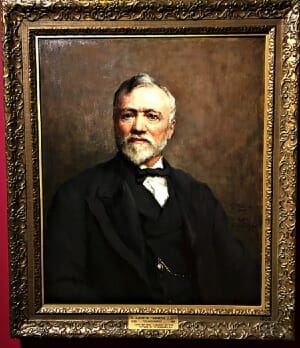
Painting of Andrew Carnegie, Photograph by Scotland 307, CC.

6. The speculator and the business man tread diverging lines. The former depends upon the sudden turn of fortune’s wheel; he is a millionnaire to-day, a bankrupt to-morrow. But the man of business knows that only by years of patient, unremitting attention to affairs can he earn his reward, which is the result, not of chance, but of well-devised means for the attainment of ends. During all these years his is the cheering thought that, by no possibility can he benefit himself without carrying prosperity to others. The speculator on the other hand had better never have lived so far as the good of others or the good of the community is concerned. Hundreds of young men were tempted in this city not long since to gamble in oil, and many were ruined; all were injured whether they lost or won. You may be, nay, you are certain to be similarly tempted; but when so tempted I hope you will remember this advice. Say to the tempter who asks you to risk your small savings, that if ever you decide to speculate you are determined to go to a regular and well-conducted house where they cheat fair. You can get fair play and about an equal chance upon the red and black in such a place; upon the Exchange you have neither. You might as well try your luck with the three-card-monte man. There is another point involved in speculation. Nothing is more essential to young business men than untarnished credit, credit begotten of confidence in their prudence, principles and stability of character. Well, believe me, nothing kills credit sooner in any Bank Board than the knowledge that either firms or men engage in speculation. It matters not a whit whether gains or losses be the temporary result of these operations. The moment a man is known to speculate, his credit is impaired, and soon thereafter it is gone. How can a man be credited whose resources may be swept away in one hour by a panic among gamesters? Who can tell how he stands among them? except that this is certain: he has given due notice that he may stand to lose all, so that those who credit him have themselves to blame. Resolve to be business men, but speculators never.

7. The third and last danger against which I shall warn you is one which has wrecked many a fair craft which started well and gave promise of a prosperous voyage. It is the perilous habit of indorsing–all the more dangerous, inasmuch as it assails one generally in the garb of friendship. It appeals to your generous instincts, and you say, “How can I refuse to lend my name only, to assist a friend?” It is because there is so much that is true and commendable in that view that the practice is so dangerous. Let me endeavor to put you upon safe honourable grounds in regard to it. I would say to you to make it a rule now, never indorse: but this is too much like never taste wine, or never smoke, or any other of the “nevers.” They generally result in exceptions. You will as business men now and then probably become security for friends. Now, here is the line at which regard for the success of friends should cease and regard for your own honour begins.

8. If you owe anything, all your capital and all your effects are a solemn trust in your hands to be held inviolate for the security of those who have trusted you. Nothing can be done by you with honour which jeopardizes these first claims upon you. When a man in debt indorses for another, it is not his own credit or his own capital he risks, it is that of his own creditors. He violates a trust. Mark you then, never indorse until you have cash means not required for your own debts, and never indorse beyond those means. Before you indorse at all, consider indorsements as gifts, and ask yourselves whether you wish to make the gift to your friend and whether the money is really yours to give and not a trust for your creditors.

9. You are not safe, gentlemen, unless you stand firmly upon this as the only ground which an honest business man can occupy.

10. I beseech you avoid liquor, speculation and indorsement. Do not fail in either, for liquor and speculation are the Scylla and Charybdis of the young man’s business sea, and indorsement his rock ahead.

11. Assuming you are safe in regard to these your gravest dangers, the question now is how to rise from the subordinate position we have imagined you in, through the successive grades to the position for which you are, in my opinion, and, I trust, in your own, evidently intended. I can give you the secret. It lies mainly in this. Instead of the question, “What must I do for my employer?” substitute “What can I do?” Faithful and conscientious discharge of the duties assigned you is all very well, but the verdict in such cases generally is that you perform your present duties so well that you had better continue performing them. Now, young gentlemen, this will not do. It will not do for the coming partners. There must be something beyond this. We make Clerks, Bookkeepers, Treasurers, Bank Tellers of this class, and there they remain to the end of the chapter. The rising man must do something exceptional, and beyond the range of his special department. HE MUST ATTRACT ATTENTION. A shipping clerk, he may do so by discovering in an invoice an error with which he has nothing to do, and which has escaped the attention of the proper party. If a weighing clerk, he may save for the firm by doubting the adjustment of the scales and having them corrected, even if this be the province of the master mechanic. If a messenger boy, even he can lay the seed of promotion by going beyond the letter of his instructions in order to secure the desired reply. There is no service so low and simple, neither any so high, in which the young man of ability and willing disposition cannot readily and almost daily prove himself capable of greater trust and usefulness, and, what is equally important, show his invincible determination to rise.

12. Some day, in your own department, you will be directed to do or say something which you know will prove disadvantageous to the interest of the firm. Here is your chance. Stand up like a man and say so. Say it boldly, and give your reasons, and thus prove to your employer that, while his thoughts have been engaged upon other matters, you have been studying during hours when perhaps he thought you asleep, how to advance his interests. You may be right or you may be wrong, but in either case you have gained the first condition of success. You have attracted attention. Your employer has found that he has not a mere hireling in his service, but a man; not one who is content to give so many hours of work for so many dollars in return, but one who devotes his spare hours and constant thoughts to the business. Such an employee must perforce be thought of, and thought of kindly and well. It will not be long before his advice is asked in his special branch, and if the advice given be sound, it will soon be asked and taken upon questions of broader bearing. This means partnership; if not with present employers then with others. Your foot, in such a case, is upon the ladder; the amount of climbing done depends entirely upon yourself.

13. One false axiom you will often hear, which I wish to guard you against: “Obey orders if you break owners.” Don’t you do it. This is no rule for you to follow. Always break orders to save owners. There never was a great character who did not sometimes smash the routine regulations and make new ones for himself. The rule is only suitable for such as have no aspirations, and you have not forgotten that you are destined to be owners and to make orders and break orders. Do not hesitate to do it whenever you are sure the interests of your employer will be thereby promoted and when you are so sure of the result that you are willing to take the responsibility. You will never be a partner unless you know the business of your department far better than the owners possibly can. When called to account for your independent action, show him the result of your genius, and tell him that you knew that it would be so; show him how mistaken the orders were. Boss your boss just as soon as you can; try it on early. There is nothing he will like so well if he is the right kind of boss; if he is not, he is not the man for you to remain with–leave him whenever you can, even at a present sacrifice, and find one capable of discerning genius. Our young partners in the Carnegie firm have won their spurs by showing that we did not know half as well what was wanted as they did. Some of them have acted upon occasion with me as if they owned the firm and I was but some airy New Yorker presuming to advise upon what I knew very little about. Well, they are not interfered with much now. They were the true bosses–the very men we were looking for.

14. There is one sure mark of the coming partner, the future millionnaire; his revenues always exceed his expenditures. He begins to save early, almost as soon as he begins to earn. No matter how little it may be possible to save, save that little. Invest it securely, not necessarily in bonds, but in anything which you have good reason to believe will be profitable, but no gambling with it, remember. A rare chance will soon present itself for investment. The little you have saved will prove the basis for an amount of credit utterly surprising to you. Capitalists trust the saving young man. For every hundred dollars you can produce as the result of hard-won savings, Midas, in search of a partner, will lend or credit a thousand; for every thousand, fifty thousand. It is not capital that your seniors require, it is the man who has proved that he has the business success habits which create capital, and to create it in the best of all possible ways, as far as self-discipline is concerned, is, by adjusting his habits to his means. Gentlemen, it is the first hundred dollars saved which tells. Begin at once to lay up something. The bee predominates in the future millionnaire.

15. Of course there are better, higher aims than saving. As an end, the acquisition of wealth is ignoble in the extreme; I assume that you save and long for wealth only as a means of enabling you the better to do some good in your day and generation. Make a note of this essential rule: Expenditure always within income.

16. You may grow impatient, or become discouraged when year by year you float on in subordinate positions. There is no doubt that it is becoming harder and harder as business gravitates more and more to immense concerns, for a young man without capital to get a start for himself, and in this city especially, where large capital is essential, it is unusually difficult. Still, let me tell you for your encouragement, that there is no country in the world, where able and energetic young men can so readily rise as this, nor any city where there is more room at the top. It has been impossible to meet the demand for capable, first-class bookkeepers (mark the adjectives) the supply has never been equal to the demand. Young men give all kinds of reasons why in their cases failure was clearly attributable to exceptional circumstances which render success impossible. Some never had a chance, according to their own story. This is simply nonsense. No young man ever lived who had not a chance, and a splendid chance, too, if he ever was employed at all. He is assayed in the mind of his immediate superior, from the day he begins work, and, after a time, if he has merit, he is assayed in the council chamber of the firm. His ability, honesty, habits, associations, temper, disposition, all these are weighed and analysed. The young man who never had a chance is the same young man who has been canvassed over and over again by his superiors, and found destitute of necessary qualifications, or is deemed unworthy of closer relations with the firm, owing to some objectionable act, habit, or association, of which he thought his employers ignorant.

17. Another class of young men attribute their failure to employers having relations or favourites whom they advanced unfairly. They also insist that their employers disliked brighter intelligences than their own, and were disposed to discourage aspiring genius, and delighted in keeping young men down. There is nothing in this. On the contrary, there is no one suffering so much for lack of the right man in the right place, nor so anxious to find him as the owner. There is not a firm in Pittsburg to-day which is not in the constant search for business ability, and every one of them will tell you that there is no article in the market at all times so scarce. There is always a boom in brains, cultivate that crop, for if you grow any amount of that commodity, here is your best market and you cannot overstock it, and the more brains you have to sell, the higher price you can exact. They are not quite so sure a crop as wild oats, which never fail to produce a bountiful harvest, but they have the advantage over these in always finding a market. Do not hesitate to engage in any legitimate business, for there is no business in America, I do not care what, which will not yield a fair profit if it receive the unremitting, exclusive attention, and all the capital of capable and industrious men. Every business will have its season of depression–years always come during which the manufacturers and merchants of the city are severely tried–years when mills must be run, not for profit, but at a loss, that the organization and men may be kept together and employed, and the concern may keep its products in the market. But on the other hand, every legitimate business producing or dealing in an article which man requires is bound in time to be fairly profitable, if properly conducted.

18. And here is the prime condition of success, the great secret: concentrate your energy, thought, and capital exclusively upon the business in which you are engaged. Having begun in one line, resolve to fight it out on that line, to lead in it; adopt every improvement, have the best machinery, and know the most about it.

19. The concerns which fail are those which have scattered their capital, which means that they have scattered their brains also. They have investments in this, or that, or the other, here, there and everywhere. “Don’t put all your eggs in one basket” is all wrong. I tell you “put all your eggs in one basket, and then watch that basket.” Look round you and take notice; men who do that do not often fail. It is easy to watch and carry the one basket. It is trying to carry too many baskets that breaks most eggs in this country. He who carries three baskets must put one on his head, which is apt to tumble and trip him up. One fault of the American business man is lack of concentration.

20. To summarize what I have said: Aim for the highest; never enter a bar-room; do not touch liquor, or if at all only at meals; never speculate; never indorse beyond your surplus cash fund; make the firm’s interest yours; break orders always to save owners; concentrate; put all your eggs in one basket, and watch that basket; expenditure always within revenue; lastly, be not impatient, for, as Emerson says, “no one can cheat you out of ultimate success but yourselves.” I congratulate poor young men upon being born to that ancient and honourable degree which renders it necessary that they should devote themselves to hard work. A basketful of bonds is the heaviest basket a young man ever had to carry. He generally gets to staggering under it. We have in this city creditable instances of such young men, who have pressed to the front rank of our best and most useful citizens. These deserve great credit. But the vast majority of the sons of rich men are unable to resist the temptations to which wealth subjects them, and sink to unworthy lives. I would almost as soon leave a young man a curse, as burden him with the almighty dollar. It is not from this class you have rivalry to fear. The partner’s sons will not trouble you much, but look out that some boys poorer, much poorer than yourselves, whose parents cannot afford to give them the advantages of a course in this institute, advantages which should give you a decided lead in the race–look out that such boys do not challenge you at the post and pass you at the grand stand. Look out for the boy who has to plunge into work direct from the common school and who begins by sweeping out the office. He is the probable dark horse that you had better watch.

Shout out to Dan/Ian at tropicalmba.com for this find on the critical business skills for success address by Andrew Carnegie. My advice on the importance of reading when you are Starting out and having an Edge in your Trading.


How can you move forward immediately to Trend Following profits? My books and my Flagship Course and Systems are trusted options by clients in 70+ countries.

Also jump in:

Trend Following Podcast Guests
Frequently Asked Questions
Performance
Research
Markets to Trade
Crisis Times
Trading Technology
About Us

Trend Following is for beginners, students and pros in all countries. This is not day trading 5-minute bars, prediction or analyzing fundamentals–it’s Trend Following.

Ep. 187: Charles Faulkner Interview with Michael Covel on Trend Following Radio

Charles Faulkner
Charles Faulkner

My guest today is Charles Faulkner, an author, trader, and international expert on modeling the knowledge and performance of exceptional individuals. He was originally featured in “The New Market Wizards” by Jack Schwager.

The topic is trading psychology.

In this episode of Trend Following Radio we discuss:

  • Behavior, emotions, decision-making, and intuition in the world of money–and what money does to us on a biological level
  • Neurolinguistic Programming
  • How money in the mind influences money in the world
  • The schizophrenic-seeming handout to the two recent Nobel Prize winners
  • “System one” and “system two”
  • How “one” is running all the time, how “two” takes effort–and where Faulkner hopes to take this research
  • How experience can teach “system one”
  • New lightbulb moments in current research
  • How the “afraid to lose” (or in Singapore, Kiasu) concept could be terribly dangerous when applied to money
  • Why the less you know about something, the clearer the image–and the more certain you are that it’s real and true
  • The need for certainty
  • Money as a living metaphor; sunk costs
  • The Myers-Briggs instrument
  • Rituals and money

Listen to this episode:

Jump in!

Harvard Yoga Scientists Find Proof of Meditation Benefit; Trend Following Benefit Too

Trading can be taxing on emotions. Hard on health. Anxiety can arrive. The good news? There is a proactive health process you should consider right along with your position sizing algorithm:

Scientists are getting close to proving what yogis have held to be true for centuries — yoga and meditation can ward off stress and disease.
John Denninger, a psychiatrist at Harvard Medical School, is leading a five-year study on how the ancient practices affect genes and brain activity in the chronically stressed. His latest work follows a study he and others published earlier this year showing how so-called mind-body techniques can switch on and off some genes linked to stress and immune function.

While hundreds of studies have been conducted on the mental health benefits of yoga and meditation, they have tended to rely on blunt tools like participant questionnaires, as well as heart rate and blood pressure monitoring. Only recently have neuro-imaging and genomics technology used in Denninger’s latest studies allowed scientists to measure physiological changes in greater detail.

“There is a true biological effect,” said Denninger, director of research at the Benson-Henry Institute for Mind Body Medicine at Massachusetts General Hospital, one of Harvard Medical School’s teaching hospitals. “The kinds of things that happen when you meditate do have effects throughout the body, not just in the brain.”

The government-funded study may persuade more doctors to try an alternative route for tackling the source of a myriad of modern ailments. Stress-induced conditions can include everything from hypertension and infertility to depression and even the aging process. They account for 60 to 90 percent of doctor’s visits in the U.S., according to the Benson-Henry Institute. The World Health Organization estimates stress costs U.S. companies at least $300 billion a year through absenteeism, turn-over and low productivity.

Seinfeld, Murdoch

The science is advancing alongside a budding “mindfulness” movement, which includes meditation devotees such as Bill George, board member of Goldman Sachs Group and Exxon Mobil Corp., and comedian Jerry Seinfeld. News Corp. Chairman Rupert Murdoch recently revealed on Twitter that he is giving meditation a try.

As a psychiatrist specializing in depression, Denninger said he was attracted to mind-body medicine, pioneered in the late 1960s by Harvard professor Herbert Benson, as a possible way to prevent the onset of depression through stress reduction. While treatment with pharmaceuticals is still essential, he sees yoga and meditation as useful additions to his medical arsenal.

Exchange Program

It’s an interest that dates back to an exchange program he attended in China the summer before entering Harvard as an undergraduate student. At Hangzhou University he trained with a tai chi master every morning for three weeks.

“By the end of my time there, I had gotten through my thick teenage skull that there was something very important about the breath and about inhabiting the present moment,” he said. “I’ve carried that with me since then.”

His current study, to conclude in 2015 with about $3.3 million in funding from the National Institutes of Health, tracks 210 healthy subjects with high levels of reported chronic stress for six months. They are divided in three groups.

One group with 70 participants perform a form of yoga known as Kundalini, another 70 meditate and the rest listen to stress education audiobooks, all for 20 minutes a day at home. Kundalini is a form of yoga that incorporates meditation, breathing exercises and the singing of mantras in addition to postures. Denninger said it was chosen for the study because of its strong meditation component.

Participants come into the lab for weekly instruction for two months, followed by three sessions where they answer questionnaires, give blood samples used for genomic analysis and undergo neuro-imaging tests.

‘Immortality Enzyme’

Unlike earlier studies, this one is the first to focus on participants with high levels of stress. The study published in May in the medical journal PloS One showed that one session of relaxation-response practice was enough to enhance the expression of genes involved in energy metabolism and insulin secretion and reduce expression of genes linked to inflammatory response and stress. There was an effect even among novices who had never practiced before.

Harvard isn’t the only place where scientists have started examining the biology behind yoga.

In a study published last year, scientists at the University of California at Los Angeles and Nobel Prize winner Elizabeth Blackburn found that 12 minutes of daily yoga meditation for eight weeks increased telomerase activity by 43 percent, suggesting an improvement in stress-induced aging. Blackburn of the University of California, San Francisco, shared the Nobel medicine prize in 2009 with Carol Greider and Jack Szostak for research on the telomerase “immortality enzyme,” which slows the cellular aging process.

Build Resilience

Not all patients will be able to stick to a daily regimen of exercise and relaxation. Nor should they have to, according to Denninger and others. Simply knowing breath-management techniques and having a better understanding of stress can help build resilience.

“A certain amount of stress can be helpful,” said Sophia Dunn, a clinical psychotherapist who trained at King’s College London. “Yoga and meditation are tools for enabling us to swim in difficult waters.”

Thanks to Gary Percy for the find. My yoga? See pics on FB.

Similar Posts

Flow State

Dan Ariely Interview

Podcast with Charles Poliquin

Andy Puddicombe

Feedback Email Q and A


How can you move forward immediately to Trend Following profits? My books and my Flagship Course and Systems are trusted options by clients in 70+ countries.

Also jump in:

Trend Following Podcast Guests
Frequently Asked Questions
Performance
Research
Markets to Trade
Crisis Times
Trading Technology
About Us

Trend Following is for beginners, students and pros in all countries. This is not day trading 5-minute bars, prediction or analyzing fundamentals–it’s Trend Following.

Ep. 184: Cal Newport Interview with Michael Covel on Trend Following Radio

Cal Newport
Cal Newport

My guest today is Cal Newport, an American non-fiction author and associate professor of computer science at Georgetown University.

The topic is passion.

In this episode of Trend Following Radio we discuss:

  • Alan Watts
  • Why following your passion isn’t such a great idea from Newport’s perspective
  • The notion of deliberate practice and the 10000 hour rule, falling back on simplistic strategies that fail
  • Passion following success as the true gauge
  • Misconceptions about passion
  • Thinking of passion as a side-effect of running your career in the right way
  • Overcoming difficulty as a necessary step in the process
  • The work and analysis Newport has done looking at top chess players
  • The systematic aspect of gaining skill and its ties to passion
  • Anxiety and failure

Listen to this episode:

Jump in!

Magazine Covers at Turning Points?

Thomas Vician provides some interesting research about magazine covers: read (PDF). Shout to Tom for reaching out with an interesting perspective.


How can you move forward immediately to Trend Following profits? My books and my Flagship Course and Systems are trusted options by clients in 70+ countries.

Also jump in:

Trend Following Podcast Guests
Frequently Asked Questions
Performance
Research
Markets to Trade
Crisis Times
Trading Technology
About Us

Trend Following is for beginners, students and pros in all countries. This is not day trading 5-minute bars, prediction or analyzing fundamentals–it’s Trend Following.

Right and Wrong Doesn’t Help the Process

Ed Seykota recently offered on his site:

Labeling trades as right and wrong, depending on the outcome, indicates some or another emotional attachment to individual events. From the perspective of a stream of trades that generate from a trading method, you might notice that you get some winners and some losers and that your long-term results aggregate the individual events.

Spot on.


How can you move forward immediately to Trend Following profits? My books and my Flagship Course and Systems are trusted options by clients in 70+ countries.

Also jump in:

Trend Following Podcast Guests
Frequently Asked Questions
Performance
Research
Markets to Trade
Crisis Times
Trading Technology
About Us

Trend Following is for beginners, students and pros in all countries. This is not day trading 5-minute bars, prediction or analyzing fundamentals–it’s Trend Following.