Subscribe now and watch my free trend following VIDEO.

Interview with Dan Ariely: The Upside Of Irrationality

Feedback in:

Michael, I heard on the podcast you are visiting my adopted city of Beijing where I have lived for the past 8 years. If you need anything while there, places to go eat, see, my friend has great Israeli restaurant there etc. Whatever you need let me know. My local China mobile number is below. We are out of town so can not meet but can help. Glad you enjoy Asia. I moved there from Wall Street about 8 years ago. Life never been the same ever since. Also, you will love this interview. Full link below. Best of luck with CLSA.

Miguel: Continuing from this definition of decision making you write about the Lancelot story where he’s a fighter and claims that the key to fighting well is not worrying about the outcome but rather focusing on having perfect concentration (minimal stress). How can you relate this story to decision making?

Dan: What is interesting about this story is that by not valuing his life Lancelot became much more rational in a standard way. Basically, the way we think about it is that emotion makes people irrational. Not bad necessarily, but irrational, and if you can disassociate yourself from your emotions you can make more rational decisions. That is exactly what Lancelot was able to do-So during a sword-fight where you want to fight to the best of your ability you don’t want any stress, and to do so you don’t want to think about anything besides the immediate fight. By detaching yourself from emotions you are able to do that.

Thanks for the nice words and words of wisdom!


How can you move forward immediately to Trend Following profits? My books and my Flagship Course and Systems are trusted options by clients in 70+ countries.

Also jump in:

Trend Following Podcast Guests
Frequently Asked Questions
Performance
Research
Markets to Trade
Crisis Times
Trading Technology
About Us

Trend Following is for beginners, students and pros in all countries. This is not day trading 5-minute bars, prediction or analyzing fundamentals–it’s Trend Following.

Ep. 116: Jerry Parker Interview with Michael Covel on Trend Following Radio

Jerry Parker
Jerry Parker

My guest today is Jerry Parker. In 1983, Parker was accepted into the Turtle Program, a select investment training program developed by successful Chicago portfolio manager Richard Dennis. He appears in Covel’s “The Complete TurtleTrader” and has been the most successful TurtleTrader. Parker founded Chesapeake Capital Corporation, a global investment manager headquartered in Richmond, Virginia, in 1988.

The topic is Trend Following. 

In this episode of Trend Following Radio we discuss:

  • Mistake of combining different strategies with trend following, and the importance of having a concentrated strategy that you can rely on
  • How discretionary moves can get in the way of your system, and “systematized discretion”
  • The psychological effect of following a trend following strategy for decades
  • The idea of going for positive expected value over what’s least risky
  • Why Parker doesn’t like to use the term “managed futures”, and why it doesn’t really tell the story of trend followers
  • Trend followers performing well at different points in time compared to long-only
  • Using trend following as another strategy for investors who only invest through a long-only value-based system
  • The importance of not letting your views on politics and society influence your trading, and maintaining a systematic and disciplined approach
  • The growth of news media since 1984, information overflow, limiting your variables, and using price as your primary indicator
  • How Parker has learned over the years to deal with drawdowns, loving your losses, and the importance the Turtle program played in his education on drawdowns
  • Why governments are the ultimate counter-trend traders
  • Why buy and hold is not a good place to be even if people are saying it’s turned around
  • Parker’s stock-only trend following program, and why the diversified program will do better than the stock-only system
  • Leverage as a tool

Listen to this episode:

Jump in!

Don’t Offend Day Trading!

Feedback in:

Hi Mike, Just listened to your last podcast. Thanks for doing the podcasts while you are on the road! Trading is a solitary activity, I have not found any other trend following traders locally. I find people just want to discuss fundamentals and sentiment and predictions. No good for the business of non-discretionary trading. So I find listening to your interviews balances that, almost like having access to mentors. I’m always looking forward to the next interview. The monologue episodes are sometimes puzzling however, particularly your negative comments aimed at various groups. This time it was daytraders. I am not a daytrader and don’t want to be, its not my style, but I do know people who earn good profits daytrading. But why should you or I care if they have their eyes glued to the screen, its their own choice and it doesn’t effect us. I’m assuming your long term aim is marketing your stuff (an honorable objective, all credit to you for that), but is talking down to potential customers really effective? Also something confused me with your logic today, you make the assumption that any historic data correlated with trend following, must therefore also be derived from trend following. But could daytrading profits also be correlated? eg. Oct 2008 trend following was profitable, but surely daytraders would also be short as markets were consistently directional downwards, so they would also be profitable from the high volatility. My logic might be wrong, let me know. By the way I’m a big fan of your books, and recommend them at every opportunity. Most of my foundation concepts came from reading “Trend Following” about 3 years ago, but I also liked “Trend Commandments” for clarifying the whole TF mentality.

Regards,
Mike B.

In my books are performance track records of trend following traders. Audits. Where are the day trading records like that? My passion is to take what I know and pass it along. Clearly, I am not the only one who shares that day trading view. You are aware of Ed Seykota? Why would potential customers be offended by my comments? Confused. Also, clarify your point about correlations? Not following that logic.

Hi Mike, Thanks for your reply. Why could they be offended? “They have personal issues they try to resolve by daytrading…” Did you mean that in a complimentary way? But I don’t disagree with your Ed Seykota quote about daytraders. My point about marketing is that getting a negative gut reaction from potential customers doesn’t usually result in them reaching for their wallets. Its not offensive to me, I’m not in that group. Personally I prefer to only make decisions once a day, and play more golf! This is how I see the relationship between trend following and daytrading. I view all market activity (all time frames) as driven by two character types, either momentum/TF or reversion-to-mean (RTM). The RTM guys include value investors, most analysts, and most media commentators. Any healthy market needs both TFs and RTMs, but each individual person can’t be both. In sideways markets you can’t tell the difference, but when prices are moving into new territory thats when the two types polarize. When price is making new highs/lows TFs want to be in the trend direction, and RTMs want to be opposite, and the trend stops only when RTMs overwhelm the TFs. But those same two drivers come into play when medium-term traders look at a daily chart, or when daytraders look at a 5-min chart. A daytrader can have a TF style (buying new highs, etc). The difference is the speed, the intensity, and higher probability of being knocked out by market noise. Anyway, you’ve been doing this much longer than me, I could be wrong. So thanks for letting me voice an opinion. Enjoy the rest of the weekend!

Cheers,
Mike
Calgary, Alberta

Thanks Mike for the thoughtful note, but let me be even more stark:

1. Day trading track records don’t appear to exist.
2. If a strategy is faulty, or doesn’t work, or there is no proof, why would you keep hoping for it to work or imagining it to work? Yes, that would lead to Ed Seykota’s conclusion about “issues” that they need to work on.


How can you move forward immediately to Trend Following profits? My books and my Flagship Course and Systems are trusted options by clients in 70+ countries.

Also jump in:

Trend Following Podcast Guests
Frequently Asked Questions
Performance
Research
Markets to Trade
Crisis Times
Trading Technology
About Us

Trend Following is for beginners, students and pros in all countries. This is not day trading 5-minute bars, prediction or analyzing fundamentals–it’s Trend Following.

Day Trading Podcast Feedback

Feedback in:

Michael, Hope you are enjoying your journey. I really enjoy the great guests you have on your podcasts. Let me provide some constructive feedback.

1.) You could enhance your podcast by listening to a master interviewer like [name] who really gets the most out of his guest with well prepared and carefully thought out questions.

2.) Given diversified trend trading systems have similar performance it adds value to run many different types of systems with non-correlated returns. Sharing your research on what does not work would be more constructive than your current comments about day trading systems. A great place to start researching other systems is attain and striker which provide hundreds of systems with both backtested and actual track records since go-live. It would be great material for another book to focus on summarizing the 100 most popular trading systems across all strategies with a correlation matrix between them.

3.) It would also be great to have a futures broker as a guest to get their perspective about the pros and cons about having the system executed exactly as specified. If you are aware of another program that has this please pass it along.

4.) Your material is geared toward validating one approach which a good start for the novice. However for those already doing this it would add value to discuss complementary systems/approaches with system developers.

Thanks,
Steven

Thanks for the feedback on interviewee questions. Agreed improvement always possible!

As for other issues:

1. Brokers don’t do much for me. That is for someone else.
2. My recent day trading criticism originated with trend trader Ed Seykota. It was spot on.
3. If my business was all hard core systems types–there would be no business.

As for other complimentary systems what do you mean exactly?

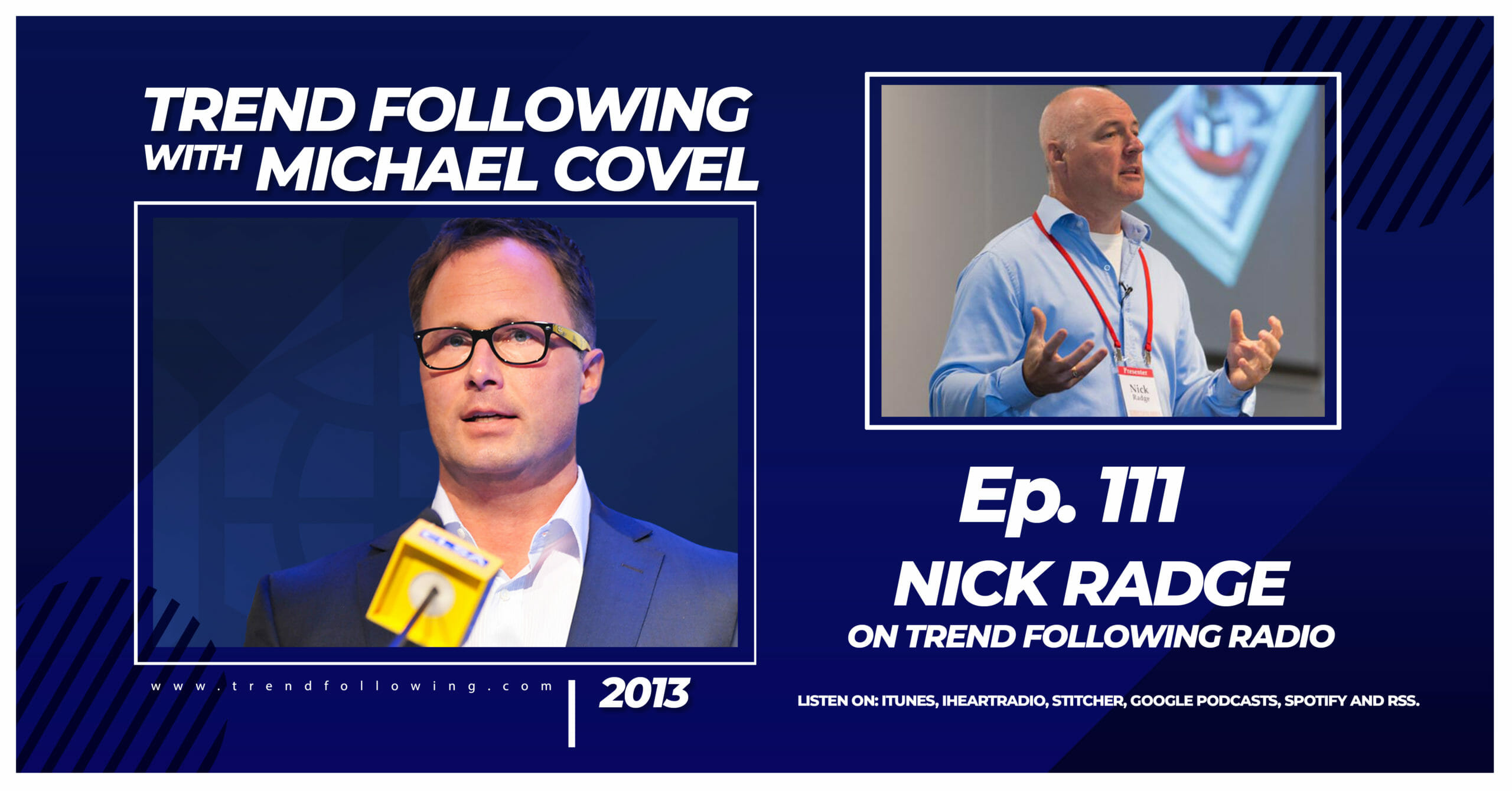
Ep. 111: Nick Radge Interview with Michael Covel on Trend Following Radio

Nick Radge
Nick Radge

My guest today is Nick Radge. Radge operates The Chartist (www.thechartist.com.au). He began trading in 1985. During a stint working for an investment bank in Singapore Nick dedicated his evenings testing trading strategies; 2 hours a day for 18 months, a total of at least 750 hours. Nick’s first book, Every-Day Traders (John Wiley & Sons Australia Ltd, 2003), was written to identify the traits of successful traders.

The topic is his book Unholy Grails – A New Road to Wealth.

In this episode of Trend Following Radio we discuss:

  • How the trend following world is foreign to many people
  • The importance of drawing distinctions between traditional value investing and alternative systems like trend following
  • How the name of the game for many fund managers is not necessarily performance but funds under management
  • Playing the game of mathematics vs. playing the game of picking the right stocks
  • Why the US stock market has gone straight up despite all the fear going on elsewhere in the world, and why you shouldn’t “fight the tape”
  • Closet trend followers
  • Why price can’t be faked
  • Trade restrictions, cultural attitudes, and the importance of being able to step out of the crowd
  • Why individuals have an advantage over fund managers
  • The value of understanding trend following even when you don’t actually use it as a strategy
  • Spotting ‘trends’, how you can’t spot a trend until it’s started or until it’s over, and using hitchhiking as an analogy for trading
  • How trend following is useful when outlier events and black swans appear
  • Using rules and strategies to fight fear
  • The difficulty of using Warren Buffett as an example, and the problems that arise when managing larger amounts of money
  • Radge’s thoughts on being an entrepreneur

Listen to this episode:

Jump in!

Ep. 109: Richard Russell and Dow Theory with Michael Covel on Trend Following Radio

Richard Russell and Dow Theory with Michael Covel on Trend Following Radio

My guest today is Richard Russell, an American writer on finance. He began publishing a newsletter called the Dow Theory Letters in 1958. The Letters covered his views on the stock market and the precious metal markets.

The topic is Dow Theory.

In this episode of Trend Following Radio we discuss:

  • Views about the economy and the Fed
  • Gentleman’s blogpost in further detail, and notes how taking hold of data such as trading volume and confirming the Dow and transports together are almost fundamental-like in their approach
  • Local Malaysian food, Yoga, getting the tar beat out of him in a Thai massage, General Patton, and invites listeners to write in with questions about predictive vs. reactive technical analysis
  • Clip from famed basketball coach John Wooden at UCLA

Listen to this episode:

Jump in!

Ep. 107: Be Water My Friend with Michael Covel on Trend Following Radio

Be Water My Friend with Michael Covel on Trend Following Radio

Please enjoy my monologue Be Water My Friend with Michael Covel on Trend Following Radio. This episode may also include great outside guests from my archive.

Listen to this episode:

Want to learn more Trend Following? Watch my video here.