Subscribe now and watch my free trend following VIDEO.

Ep. 291: Steven Kotler Interview with Michael Covel on Trend Following Radio


Steven Kotler
Steven Kotler

My guest today is Steven Kotler, an American bestselling author, journalist, and entrepreneur. His articles have appeared in over 70 publications, including The New York Times Magazine, LA Times, Wired, GQ, Discover, Popular Science, Outside, Men’s Journal, Details and National Geographic Adventure. He is best known for his non-fiction books, including the New York Times bestseller Abundance, A Small Furry Prayer, and West of Jesus.

The topic is his book The Rise of Superman: Decoding the Science of Ultimate Human Performance.

In this episode of Trend Following Radio we discuss:

  • Synonyms for flow
  • Flow in basketball and other sports
  • Group flow
  • Pattern recognition
  • The neurological explanation for flow
  • The four stages of flow
  • Why flow is not just a binary state
  • Spiritual experiences compared to flow states
  • Brain activity during flow states; the “deep now”
  • Getting to the flow state with drugs
  • The flow state and the act of being on stage
  • Why you need to take risks to get into flow
  • Social fear, risk, and pain vs. physical fear, risk, and pain
  • Method acting, screen presence, and flow
  • The military and flow research
  • Risk and comfort
  • The balance between challenges and skills
  • Getting comfortable with being uncomfortable
  • The fight or flight mindset
  • Future research into flow

Listen to this episode:

Jump in!

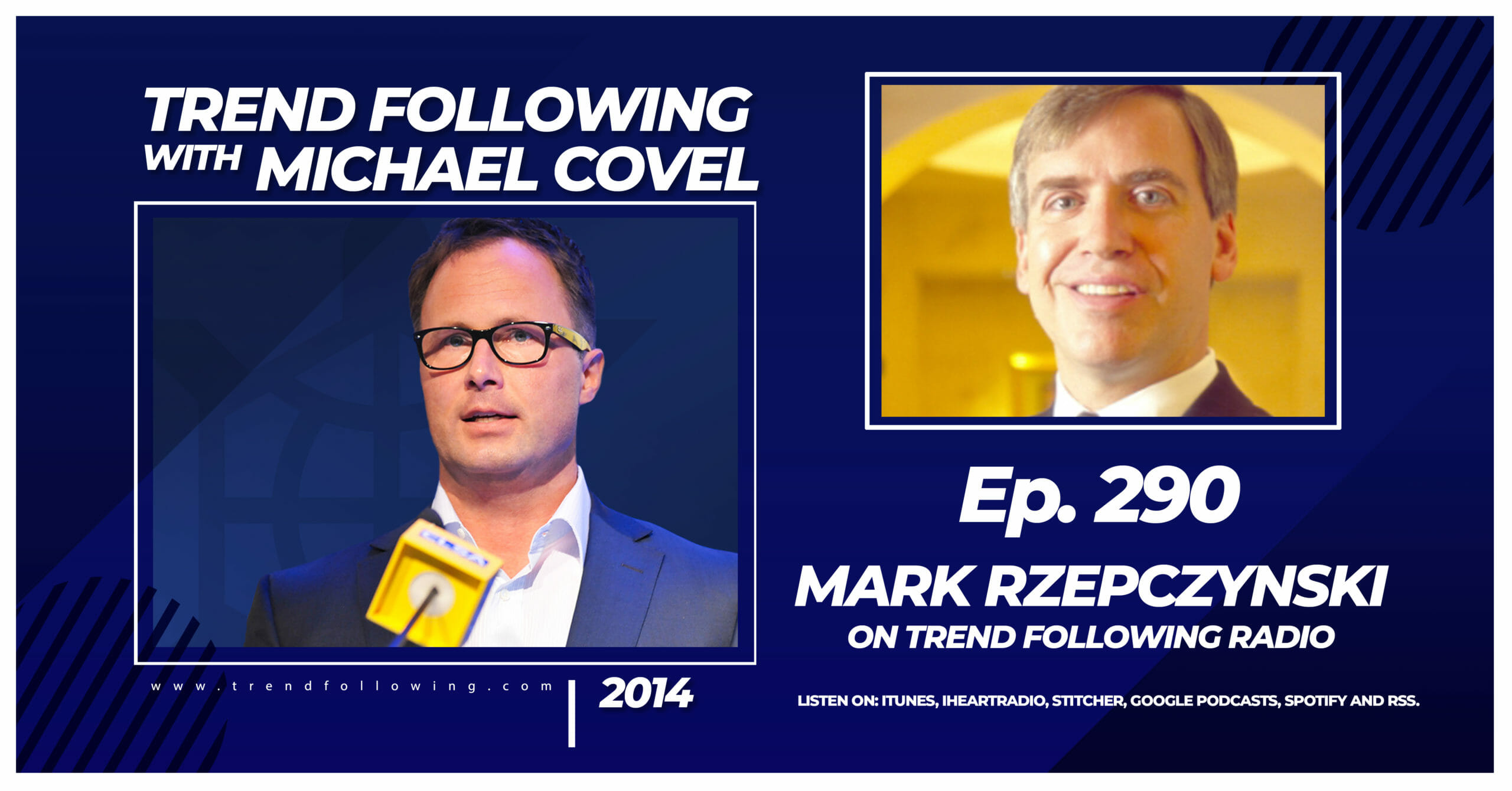
Ep. 290: Mark Rzepczynski Interview with Michael Covel on Trend Following Radio

Mark Rzepczynski
Mark Rzepczynski

My guest today is Mark Rzepczynski, a Founder and Chief Investment Officer at AMPHI Capital Management. Prior to co-founding AMPHI Capital Management, he was the CEO of the Fund Group at FourWinds Capital Management, where he oversaw alternative investments. Rzepczynski was also President and Chief Investment Officer at John W. Henry & Co., an iconic Commodity Trading Advisor. He is on the Advisory Board of the Chartered Alternative Investment Analyst Association (CAIA), the Associate Editor of the Journal of Alternative Investments, and a former board member of the FIA Futures Industry Association.

The topic is Trend Following.

In this episode of Trend Following Radio we discuss:

  • Advantages of podcasting as a format over traditional media outlets
  • Why prices are “primal”
  • Prices as a heuristic
  • Rzepczynski’s ah-ha moment that brought him to the heuristic of price
  • Why a complex education doesn’t necessarily mean you should use a complex system
  • Why knowing the transductive reasoning behind price movement is unnecessary
  • VUCA: volatile, uncertain, complex, and ambiguous
  • VUCA in the context of portfolio management
  • The zen of trading and portfolio management; the importance of passion in investing
  • The notion of over-diversification
  • Dynamic allocation
  • Convergent vs. divergent
  • The improbability principle
  • Tail events and preparing for the unexpected
  • The notion of systematic vs. discretionary
  • How trend following is represented in the mainstream media
  • Complexity
  • Risk and return
  • Volatility and complacency

Listen to this episode:

Jump in!

Ep. 289: Alex Tabarrok & David Nott Interviews with Michael Covel on Trend Following Radio

Alex Tabarrok & David Nott

My guests today are Alex Tabarrok and David Nott.

Tabarrok is the co-author of the Marginal Revolution website. He’s an economist at Covel’s alma mater, George Mason University.

Nott is the president of The Reason Foundation–an organization that is all about free minds and free markets.

The topic is libertarianism.

In this episode of Trend Following Radio we discuss:

  • Covel and Tabarrok discuss China and the importance of teaching Chinese to American children; the greatest anti-poverty program in the world; the difficulty of improving the infrastructure of the United States; regulation and innovation; interest groups; benevolent dictators; the need for a democracy in an information age; innovation in the current American education system; why the American education system is focused on getting you to work for the man; women in the American education system; innovation, intellectual property and patents; the cumulative properties of innovation; grounds for optimism in the United States when it comes to innovation; how George Mason University became a libertarian economist hotspot; if Europe is following the path of Japan; why the European monetary union was a mistake; and why travel can create optimism.
  • Covel and Nott discuss The Reason Foundation and what it means to be a libertarian today; how Nott explains being a libertarian to people; how the actor and comedian Drew Carey came to be involved with The Reason Foundation; finding the optimism to stay focused on swaying people to the founding principles of our country; politics in China; the 2008 financial crisis, state control, and Reason’s response to the bailouts; common sense notions; pension reform; drug policy reform; the cultural policies surrounding prohibition; expanding the idea of liberty to younger people; Vernon Smith and Walter Williams.

Listen to this episode:

Jump in!

Ep. 288: Frank Curzio & Robin Griffiths Interviews with Michael Covel on Trend Following Radio

Frank Curzio & Robin Griffiths

My guests today are Frank Curzio of Stansberry & Associates and Robin Griffiths, the Chief Technical Strategist at ECU and formerly at HSBC.

The topic is markets.

In this episode of Trend Following Radio we discuss:

  • Covel and Curzio discuss how the fundamental guys justify all time highs in the equity market; the Shiller PE ratio; the importance of analyzing interest rates; Warren Buffett recent investments; what the Fed would do if we went down 30% today; why having a low interest rate environment creates a good situation for stocks; being prepared from a risk management perspective; Zero Interest Rate Policy, its effect on equities and bonds, and tail risk; comparing the environment today to the 1987 crash; hypothetical situations surrounding the S&P 500; exit strategies; and the 24-hour news cycle.
  • Covel and Griffiths discuss how to use fundamentals in an age when interest rates are artificially controlled; Griffiths’ history as a mechanical engineer and how he found his way into trading and technical analysis; regression analysis; Elliott Wave and cycles; the idea of whipsaws; geopolitical risks; China, India, and the rise of Asia; not trading off of geopolitical fundamental information; how Griffiths came to the conclusion that the efficient market hypothesis and much of what the mutual fund industry depends on doesn’t hold water; spikes and why people in 2014 think that all spikes are gone; Extraordinary Popular Delusions and the Madness of Crowds by Charles Mackay and the cyclical nature of booms and busts; and virtual currencies.

Listen to this episode:

Jump in!

You Are Right… The World Could End

Feedback in:

I am looking forward to a future show with more details from Dunn Capital. If I’m not mistaken, they would have a practical opinion on the usefulness of both Bayesian Inference and Efron’s bootstrap method. Efron, of course, is the author of the Bayes critique cited above.

Per the Kaminski piece, there is no guarantee that 800 years of evidence won’t be undone by a perpetual and implacable tyranny of central bank price discovery suppression. This research looks suspiciously like new marketing materials from Greyserman/Hite etal. In today’s world It is absolutely invalid to say that stop orders which lost money on concentrated bets in the US stock index will be a justifiable risk control cost when the market gaps down 50% over a weekend because the Fed finally sh*ts the bed. How can any credible trend follower say they don’t care to know anything about unprecedented and precarious risks to the monetary system in their analysis?

Dunn seems to have taken more into account than ISAM. An educated guess about Dunn’s risk throttle is that one of the inputs is proportional to the difference between the overnight rate and the CPI.

Further to reducing risk in a low payoff environment (throttling), one of your other guests, Peter Schiff, (who you must interview again) has a decent theory that CPI and the overnight rate will never again cross paths or at least not until Keynesian central banking is dead and buried.

BTW, if something goes wrong with the monetary system, have you considered the possibility that agricultural markets and other markets with lock limits could suddenly and simultaneously be both lock limit up and lock limit down?

I’m guessing, in your mind, you have this idea that it is impossible for all positions to simultaneously lose because there is both a long and short side. One side has to win by definition, right? Well, maybe not…

Think about the situation where the monetary system is pushed to the breaking point. Where in the CME rule book does it say a market can’t be locked both up and down? Trend following strongly depends on the assumption of knowing prices or at least a sensible price ranges. What happens when this is suddenly a bad assumption?

DUNN CEO already appeared on my podcast. TFs don’t use Fed analysis in their trading. Of course, as you note, the world could end. In that case far more issues than trading will be relevant.


How can you move forward immediately to Trend Following profits? My books and my Flagship Course and Systems are trusted options by clients in 70+ countries.

Also jump in:

Trend Following Podcast Guests
Frequently Asked Questions
Performance
Research
Markets to Trade
Crisis Times
Trading Technology
About Us

Trend Following is for beginners, students and pros in all countries. This is not day trading 5-minute bars, prediction or analyzing fundamentals–it’s Trend Following.

Ep. 287: Toby Crabel Interview with Michael Covel on Trend Following Radio

Toby Crabel
Toby Crabel

My guest today is Toby Crabel, a tennis player who is now a commodities trader. In 2005, the Financial Times called Crabel “the most well-known trader on the counter-trend side”.

The topic is commodity trading.

In this episode of Trend Following Radio we discuss:

  • Crabel’s history as a pro tennis player
  • Longevity and consistency in tennis and trading
  • Where Crabel stands with the total number of systems he employs
  • The source of Crabel’s profits and the philosophy behind it
  • Price action
  • Winning and losing volatility
  • Why Crabel needs price movement and volume
  • The idea of price shocks and the importance of being aware of them
  • The process of moving from high drawdowns to a much lower drawdown
  • The importance of diversity
  • Early lightbulb moments that informed Crabel’s trading style
  • Crabel’s experience with Victor Niederhoffer
  • How the philosophy of Objectivism has informed Crabel’s life
  • The liquidity of futures markets
  • The importance of persistence

Go listen. You may also enjoy this post on Toby Crabel.

Buy & Sell

Listen to this episode:

Jump in!

Anthony Todd: “Great Podcast!”

Feedback in:

Hi Michael, Great podcast with Anthony Todd. Just a comment: Please tell him I’m insane and I’ll try to succeed without 500,000,000 bucks capital!

Ciao,
[Name]

Thanks for the feedback. He was indeed a great guest.

Find out more about what does a commodity trader do?


How can you move forward immediately to Trend Following profits? My books and my Flagship Course and Systems are trusted options by clients in 70+ countries.

Also jump in:

Trend Following Podcast Guests
Frequently Asked Questions
Performance
Research
Markets to Trade
Crisis Times
Trading Technology
About Us

Trend Following is for beginners, students and pros in all countries. This is not day trading 5-minute bars, prediction or analyzing fundamentals–it’s Trend Following.