My guest today is Thomas Gilovich, an American psychologist who is the Irene Blecker Rosenfeld Professor of Psychology at Cornell University. He has conducted research in social psychology, decision making, behavioral economics, and has written popular books on these subjects.
In this episode of Trend Following Radio we discuss:
How his world dovetailed into money and markets
Basketball, streak shooting, and the “hot hand”
Randomness and the clustering illusion
The missing Malaysian Airlines flight and probability
The reluctance to accept a probabilistic view of the world
Politics, predictions, and probabilities
People who see the world in black and white
Drawing conclusions from incomplete and unrepresentative evidence, and how to avoid that folly
The position of the devil’s advocate, and the importance of that role
Gilovich’s response to the media’s talking heads, and their often black and white opinions
Behavioral economics vs. traditional economics
When people do the wrong thing because the public demands it
Bill James and the closer
Instinct vs. considered judgment and test taking
Irrationality in financial markets and bubbles
Loss aversion
Why you don’t need to be better than the market
Listen to this episode:
Listen to this podcast on iTunes. (Please leave a rating!)
At some point you have to cook 10,000 meals. Or play a million hands of poker. Or 1000s of games of chess. Or start 20 businesses.
Very few are successful right away. That would require too much luck and luck favors the prepared and the persistent.
In those 1000s of whatever you will encounter much failure. We all know that the best baseball players in the world are enormous successes if they strike out “only” 70% of the time.
When my dad died I went to his house and logged onto this chess account. I saw that he played about 30,000 games. He never got any better.
A lot of people can play the 10,000 hands of poker and never get better. Or bake 1000 cakes and never get better.
You have to remember your experiences, study your failures, try to note what you did right and what you did wrong, and remember them for future experiences.
Will future experiences be exactly like the old experiences? Almost never.
But you have to have the ability to say “Hmm, this is like the time four years ago when X, Y, and Z happened.”
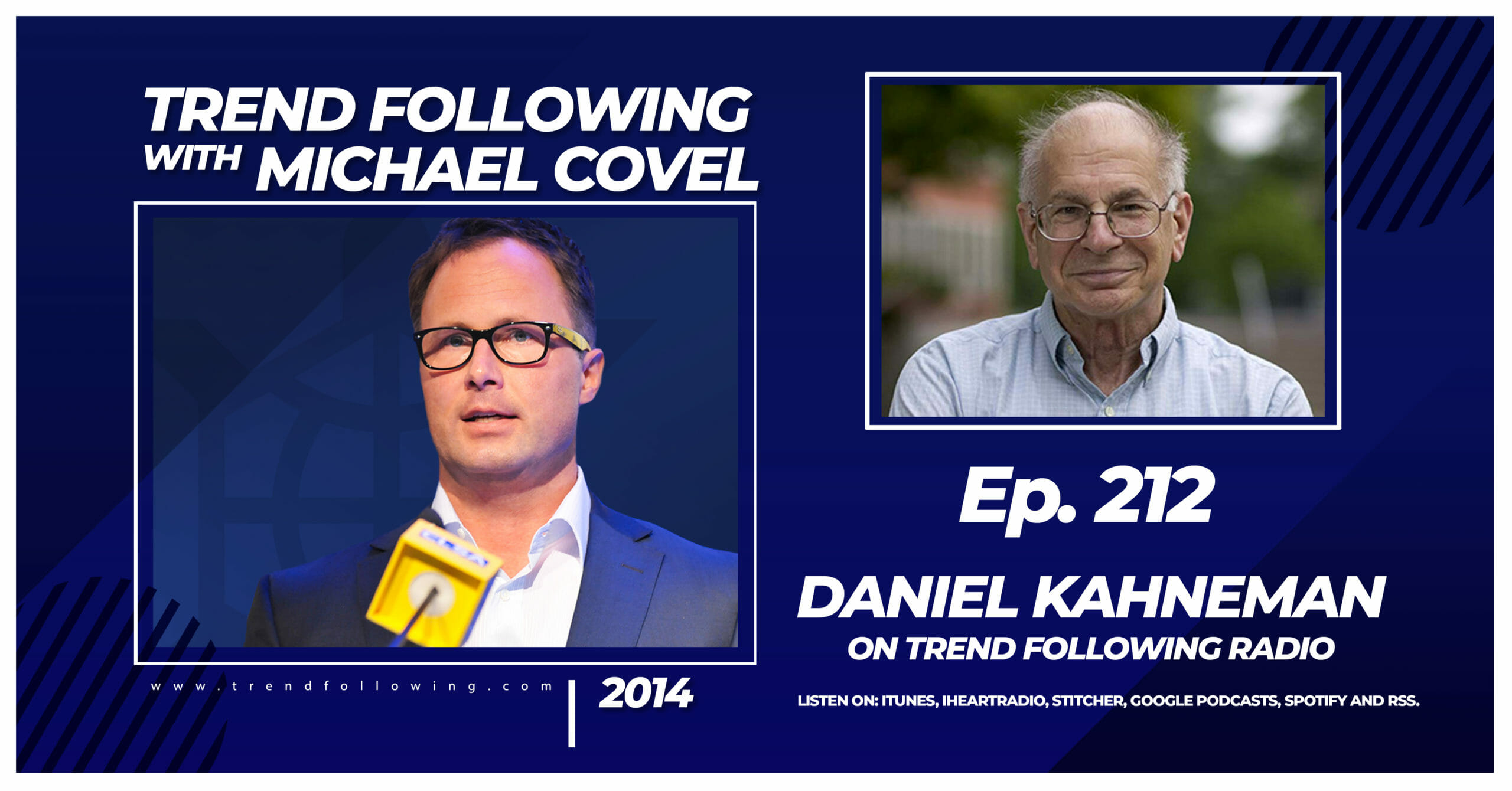
My guest today is Daniel Kahneman, the second Nobel Prize winner to appear on this podcast. Kahneman is an Israeli-American psychologist and economist notable for his work on the psychology of judgment and decision-making, as well as behavioral economics, for which he was awarded the 2002 Nobel Memorial Prize in Economic Sciences.
The topic is behavioral psychology.
In this episode of Trend Following Radio we discuss:
Kahneman’s beginnings, and how he came to realize he was looking at the world from a different vantage point than most
How Kahneman’s work is foundational to trading
Questioning the dogma of rationality
Happiness, and the distinction between the remembering self and the experiencing self
The consumption of memories
The danger of not making peace with a loss
Bubbles and crowd behavior
Happiness research and public policy
Emotion, possibility, and probability
Hope and fear
Why optimism is the engine of capitalism
The influence of prospect theory
In this episode of Trend Following Radio:
The difference between the “remembering self” and the “experiencing self” and its impact on happiness
How the measures of happiness are being implemented into public policy
How the failure to accept one’s losses can lead to risk-taking in trading
How crowd behavior relates to economic bubbles
Why capitalism is largely driven by optimism
How behavioral economics have affected the trading world
The Amos Tversky and Daniel Hahneman Working Relationship
“Not making peace with a loss – this is the downfall of so many investors” – Tweet this Daniel Kahneman quote.
MICHAEL: My guest today has been called the most important psychologist alive today. His name is Daniel Kahneman. He is the winner of the 2002 Nobel Memorial Prize in Economic Sciences. Prospect theory, for those of you in the trend following world. Behavioral economics, behavioral finance. He is the guy. He started it all, along with his partner, many years ago. I welcome him to my podcast. I hope you enjoy.
MICHAEL: I was looking at your career, looking at all the research and findings, everything behind what you’ve done, and obviously we’re not going to fill it in on this conversation, but at what point in your life did you start to realize that you were comfortable looking at the world, people, behavior, from outside the norm? When did you first realize that you were looking at things from a different vantage point?
DANIEL: That’s an extremely difficult question.
MICHAEL: I like to give the hard ones right out of the gate.
DANIEL: When one does science, of course, you publish things because you think that they’re new. What we didn’t see was how far our research would be taken. So we studied, Amos Tversky and I began our work by studying judgment under uncertainty. Limited sort of problems of judgment. We worked on that five years, and we wrote an article at the end of those five years, in 1974, which was published in Science.
That article had a lot more impact and resonance than we had anticipated, and it was really in seeing that reaction that we realized that we had done something that was unusual, because people were reacting to it as if it were unusual. So it was somewhere between 1974 and 1980, we became aware that people were taking it as new, or were taking it as newer than we had taken it.
MICHAEL: Interesting. For me, in my world, the world of money and markets, your work is right there – for me, at least, from where I come from – is right there at the foundation. If people were to say to me, “Hey Mike, what’s the best way to learn about making money in the markets or being successful in the markets?” I would point them towards your work. I think it’s one foundational element that if people don’t wrap themselves around the internal themselves, they’re just not going to do very well, and I think you really – I don’t think you intended, perhaps, to have so many people on Wall Street be thinking fondly of your work, but it so happened that way.
DANIEL: Yeah. This all really came as a surprise. We had not expected it. I mean, there was going to be some reaction to the assumption that rationality into the dominance, the rationality assumption in finance and economics, it happened that we provided an instrument that people inside the discipline could use to question the dogma of rationality. It’s actually quite – it’s an interesting anecdote how this happened, and the reason our work had an impact, because it’s actually accidental, why our work had impact.
It had impact because of the way that we present our ideas, and we present our ideas by examples in the text of questions that people tend to get wrong. So the readers, who are not psychologists, readers outside the discipline, they read this and they face the demonstrationsthat work on them. And it’s when something works on you that you’re inclined to change your views about human nature. Merely getting data about undergraduates or some other people responding to questions does very little to people.
MICHAEL: Yeah, reading about others is one thing, but when you see the change internally on your own self, that’s when the magic can happen.
DANIEL: When you see yourself making mistakes or tempted to make mistakes, then the idea that people generally, people who are as smart as you are, are tempted to make mistakes, that’s a discovery. It makes it much harder for people to distance themselves from the findings, and I think that it’s this accident of format that caused our work to have the impact it did.
MICHAEL: I want to shift away from your early work to something that’s been near and dear to you recently, and that’s the subject of happiness. I mean, I’m sure it’s always been near and dear to you, but I would love for you to get into something that I think can help people regardless of what they’re interested in in their life, and it’s the idea of the remembering self and the experiencing self. That, out of the gate, might sound very academic to just a regular audience listening, but I think it’s a very important distinction that you’ve drawn. Why don’t you just talk about the experiencing self and the remembering self out of the gate?
DANIEL: Sure. There are two types of questions which you can ask people about how happy they are. We can ask them “How do you feel right now? What is your mood right now?” The self that answers this question, I call the experiencing self, because it talks about what’s happening right now. But when you ask people “How was your vacation? How happy were you during your vacation?” or “How happy have you been over the last year?” or “How satisfied are you with your life?”, when you’re asking those general questions, you’re asking for something entirely different. You are asking persons “how do you feel about your life?” Now that you’re thinking about your life, how do you think about your life? How that makes you feel.
So how you feel as you are living and how you feel when you’re thinking about your life are two very different questions, and it turns out that you can measure subjective wellbeing in both ways by asking people to report on their experiences or by asking people to think about their life and evaluate it, and different factors turn out to be important for experience and for life evaluation.
MICHAEL: But there’s quite a bit of confusion between the two. For example, I think you had a story about taking photographs on a vacation.
DANIEL: Yes. We seem to be planning our vacations; in many cases, we plan our vacations as constructing memories for use in later consumptions, and photographs are symbolic of that. But in fact, my argument has been that if you look at it in terms of how much time people spend consuming their memories, then that is a negligible amount of time compared to the amount of time that they spend having experiences. And yet we put a disproportionate amount of weight on the consumption of memories.
MICHAEL: Well, I’m sure you’ve observed this; you watch young people today, everyone’s got a smart phone, and it’s a constant taking of pictures of themselves, called “selfies.” It seems like instead of living and experiencing the moment, everyone is trying to capture an artificial moment and capture a memory, but the experiencing is not there. I don’t know – you’ve probably noticed this yourself.
DANIEL: I don’t do that, but that’s certainly – the ability to record so many things as they are happening to you must be changing the experience of life, because you are evaluating your experiences as future memories. And in a way, when you’re taking pictures of what you see, you’re adopting a different stance on the experience itself. Certainly, this is having an effect; what effect it has, at least, I don’t know. I haven’t analyzed it.
MICHAEL: Yeah, I don’t know what’s happening there. It doesn’t seem like it’s necessarily good or bad. It’s all relative. But I’ve only got you for a short amount of time, and I want to jump to a couple different areas that I think are really important to my audience, and some very strong thoughts that sound very straightforward, but I think – for example, a quote of yours that I’ve seen: “A person who has not made peace with his losses is likely to accept gambles that would be unacceptable to him otherwise.”
Now, that can have meaning in far different fields, but in my world of trading, of finance and money and Wall Street, not making peace with a loss – this is the downfall of so many investors. And here you’re coming at it – I don’t imagine you were thinking through some of that work with investing and trading in mind, but it’s foundational. I mean, every great trader knows what you just said, that’s like written on the wall in some form or another.
DANIEL: Of course, we weren’t thinking specifically of investors, but it turns out there is research that demonstrates this. We know about traders, how they trade in the course of a day, and if they’ve been losing, they take more risks later in the afternoon. So that seems to be – the idea if you haven’t made peace with your losses, that means that you are trying to make up those losses. That tends to make you risk seeking, and we do see a lot of evidence for that.
And it probably is costly to traders. In the extreme cases, traders who trade so much that they can’t make peace with their losses; some of them get caught up in cycles of fraud and they become rogue traders. But those are the exceptions. But traders who are not rogue traders do tend to vary in risk seeking depending on the history of what’s happened to them during the day or during the year.
MICHAEL: Let me shift slight gears on you and talk about bubbles and crowd behavior. Generally, it seems – I know your research goes there, but that when people get together in crowds, the decision-making changes.
DANIEL: Well, yes. What we see is – and that is probably, ultimately, it’s biological. It’s following other people. When you see a lot of people running in one direction, we are by and large wired to run in the same direction. Now, a few very clever people will run in another direction, but the majority of us, when we see the herd moving one way, we move with it. That has large consequences, of course, on market behavior.
By and large, what it causes, it causes people individually to do far less well than the markets than they should, because they tend to come in too late when the market is rising. People’s timing is way off, and as a result of trying to follow the herd, they do much less well than they would do if they were basically adopting a policy and sticking to it.
MICHAEL: Is there anything else you’d rather be doing in your life than this? I look through your work and the findings, and I just imagine you’re terribly passionate about what you do.
DANIEL: Yes. And I do other things. I’ve retired from my academic career, and I now do consulting, which I enjoy just as much as I enjoyed science. It’s been a fun career, and the topic has been fun. When I started out this line of research like 45 years ago with Amos Tversky, this was sheer fun, because he was a very funny person with a lovely sense of humor, and we were laughing all the time. We laughed for about 12 years doing our research.
What made it funny was that we were studying our own biases and our own mistakes. Our point was not that people are stupid, because we never thought that people are stupid, and we never thought that we were stupid. But it’s our own mistakes and intuitions we were studying, and that must’ve been the best fun I’ve had in my life, those years of working on that topic.
MICHAEL: Yeah, because I assume the two of you were just, to some degree, off on your own island and just doing your thing, and the rest of the world was there, but you were engaged 100% in your endeavors. I’m sure that feeling must’ve been great.
DANIEL: Yes, it was. You know, we were friends, and for more than 10 years, I think, we spent about half a day just together talking, which was very unusual in scientific collaborations. So we were extremely fortunate. We liked each other’s company, and our topic was fun. Our topic was one that could be studied while having a fun conversation. That is, you examine your own intuitions, you raise puzzles, you see how the other responds, you develop theories and puzzles and intuitions at the same time. It was great to do.
MICHAEL: I watch leaders, often leaders making public policy, and near and dear to you is the topic of happiness that we just mentioned a second ago. But talk about happiness research in public policy. It seems like – I’ll give you the example of you and your partner at that time, and happy to go through this process, and you’re learning and you’re finding all these new things out. But it seems like today, it seems like so many leaders, when it comes to public policy, you don’t ever hear anyone talk about happiness. It’s just left out of the equation.
DANIEL: I think that’s not quite right, actually. The study of happiness is an official task within the UK government, and the UK government, the current coalition government, put in subjective wellbeing as one of the objectives of policy and one of the measures of policy. So trying to keep a happy population is rapidly becoming an accepted objective of policy. There have been major international commissions. This is a measurement of happiness, a formal measurement of happiness, is now routine and part of policy in the UK, in Canada, in many European countries. In Australia, things are beginning to move in this direction. And even in this country, there is serious talk of implementing measurements of wellbeing.
There are questions about how this is to be done, and whether we are ready for the measurements, and whether the measurement and our understanding of happiness is mature enough to base policy on it. So there’s room for debate about that. But that there is increasing recognition of the role of wellbeing in policy I think is beyond doubt.
MICHAEL: Let me go to a few more topics with you. Emotion. So much emotion in individuals driven by possibility and not probability. I think that’s probably intuitive, but it’s not necessarily, when it comes to decision-making, being driven by possibility versus probability. Leave us with some not great results, often, doesn’t it?
DANIEL: I suppose that what you’re talking about is hope and fear. When you’re looking at entrepreneurial activity, it is, we have argued, largely driven by optimism, so that when people take risks – at least, that’s my main understanding of risk, is that much of the time, when people take risk, it’s because they don’t know the odds that they’re facing. They’re actually deluding themselves. In my view of risk takers, they’re on the one hand loss-averse. They hate to lose. But on the other hand, they’re optimistic, quite often to a delusional degree, so that they don’t really know the true probability that they face of losing. That’s a combination that produces risk and risk-taking. But it’s mainly driven by optimism.
You can see that in entrepreneurs, you can see that in people with discoveries and are trying to bring them to market, you can see that in people who start small businesses. The average small business in the United States, there is 35% survival after five years, as I recall. But most people who start a new business assign themselves a probability of 80% or higher to be successful. So it’s that delusion that keeps them going. I’ve called optimism the engine of capitalism, because it is in that sense very beneficial to society. But many people would not be taking the risks they take if they knew the risk they are taking.
MICHAEL: Obviously, you’ve had a major dent in thought and people investigating the issues that you’ve laid out, understanding, believing, knowing it’s true. How much of a dent, though, I’m curious, do you think that something like prospect theory – how much of a dent has it really made in the sense – I mean, obviously, you’ve made a dent, but the acceptance? Because I look at, for example, you could look at the current U.S. equity market right now. I have no idea if it’s fairly valued or not fairly valued, but we can all observe, in the last 15 years, some quite fantastic bubbles and some quite fantastic busts.
DANIEL: I don’t really think that the advances in behavioral economics and behavioral finance – and I’m a customer and not a producer of that, and I’m really not an expert, but my impression is that very bright people are working on this, very bright people are trying to develop theory, but it’s early days of behavioral economics and behavioral finance.
When you say has it made a dent, well, the answer is clearly yes, because some of the major economics departments and finance departments in the land have behavioral economics and behavioral finance as a central part of their curriculum. The Harvard Economics Department, one of the best in the country, some of the major stars there are behavioral economists, and the best students are going there. Many of the best students are going there. So that you know that it has made a dent, because what graduate students are doing is telling you something both about the recent past and about the near future. The near future, there’s going to be a lot of behavioral economics going, because many very bright scholars are going into the field.
MICHAEL: I should probably clarify myself. I obviously was not trying to say it hasn’t made a dent, but I guess I was thinking more about the more established field of economics, the more rational side of the coin, where you’re coming at it from a different perspective. There’s always going to be that conflict between the two.
DANIEL: There is. There’s something almost funny about the last Nobel Prizes that were given, because the Nobel Prize in Economics was given to two people, both of them students of finance, with radically different ideas, so that you have Eugene Fama, who was a traditionalist and believes in the rational agent model, believes quite passionately about it and in the rationality of markets, and on the other hand you’ve got Bob Shiller, who speaks about irrational exuberance and doesn’t believe in the rationality of markets. So both of these currents are alive and well within finance. My sense is that there is a lot – that the younger people may be drifting in the direction of behavioral finance, but I’m not sure. This is an impression that I get.
MICHAEL: Can I get you to go back to your really early years for a moment – we’ve only got a few minutes left, but I would love for you to go back to as a young man, because I think when people listen to people that have had some achievement in their life and they’ve gone down certain paths, it’s always nice to look back and say “Can I relate to that person?” It’s very difficult to relate to somebody that maybe receives a Nobel Prize, but can you relate to that man as a young man?
I’m wondering if you might talk about maybe some of your early experiences, and I think there’s one experience that I believe was in France, and I believe it was with a German soldier, and you walked away from that changed.
DANIEL: Yeah, I can tell the experience. It was during the War. I was seven years old, 1941, in occupied France. France occupied by the Germans. They were beginning the measures against Jews. It wasn’t extermination yet, but they were getting ready. So the Jews were supposed to wear a star of David, the yellow star of David, and there was a curfew for Jews. I was a first grader or a second grader, probably, and I was staying with a friend, and I went past the curfew. So I put my sweater inside out and walked home.
Then near home, in a place I still remember – this was in Paris – there was a German soldier facing me and walking towards me, and he was wearing a black uniform, which I knew, though I was only seven years old, was a bad one because it was the SS that were wearing the black uniforms. He approached me, and I must’ve been shaking; I don’t remember every detail. But what I do remember is he stopped me, he called me, and he picked me up and he hugged me. I remember being terrified that he would see the yellow star inside my sweater as he was hugging me. And then he put me down and he opened his wallet and took out the picture of a little boy and showed it to me, and then he gave me some money and I went home.
It was the complexity of that experience – he was a man who was clearly ready and perhaps eager to kill people like me, but there he was, he has a son, he loved his son; I reminded him of his son. So it was the kind of experience of the complexity of human beings that has guided me. It has inspired, I think, a lot of my work. I’ve been curious about people all my life.
MICHAEL: Yeah, I think a lot of people might be envious when they – and I highly recommend them to take a look at some of your books – but it’s such a fun topic to be an observer of the human condition, just to watch people, to observe, and then to find things out that maybe you didn’t expect to see. That’s such a fun process.
DANIEL: Oh yes, that’s what I was saying. It has been a fun career.
MICHAEL: Well listen, I don’t want to keep you. You were kind enough to take some time out today. I will go ahead and point people to any place you might want – it might just be Amazon – to check out one of your books. I know you’re not trying to sell anything or promote anything. People can go check out Thinking Fast and Slow, is one book. I know there’s quite a few.
DANIEL: It really is the only one that was written for the public, and it’s still there. It’s actually on the bestsellers list. It has been since it was published, I think. So it’s easy to get. It’s $2.99 on Kindle. I don’t know why Amazon sells it like that, but that’s how they sell it. Anyway, that’s the book in which I told the whole story of my research and related research with other people. It’s not an autobiographical book. It’s a book about thinking and decision-making.
MICHAEL: Well, I love it. I love the topic. I think it’s so foundational to my audience, and I still think there’s probably some people out there that they say, “Mike, you’ve gone off the deep end. Why does this gentleman at Princeton – what is the relevance here?” I think some people just don’t get it, but there’s quite a few that do, and I think they’re appreciative to be turned onto new ways of thought and thinking. I appreciate all your work, and I appreciate you taking the time today.
DANIEL: Thank you very much for having me.
MICHAEL: Take care.
If you want to learn how to be a trend-following trader, the first place to go is trendfollowing.com. My firm can help you with educational, research, and systems trading packages to get you started immediately. Take advantage of my 15 years of experience. Take advantage of all the insights that I’ve accumulated and put into one research and educational package. These are systems that you can use immediately to start making money. Once again, go to trendfollowing.com.
My guest today is Ed Seykota, a commodities trader, who earned S.B. degrees in Electrical Engineering from MIT and Management from the MIT Sloan School of Management, both in 1969. In 1970 he pioneered Systems trading by using early punched card computers to test ideas on trading the markets.
The topic is his book Govopoly in the 39th Day.
In this episode of Trend Following Radio we discuss:\
Trend Following
Seykota’s concerns about our economy
The assimilation model and how Seykota sees assimilation happening today
The definition of “govopoly”
How Seykota’s mentor’s work plays into Seykota’s work today
Thinking about systems
What we can do to “fix” the economy, or to at least prepare yourself
The exponential curve that assimilation takes
Noticing things before they’re important
Why Seykota doesn’t provide a “solution” to the problem and instead advocates for the system to correct itself
What we can do as people in response to the system
Detroit as a microcosm of the US
Ways to make money during the assimilation
In this episode of Trend Following Radio:
What “govopoly” means to Seykota
The concept of assimilation in economics and how it affects us
Why noticing and understanding exponential growth can be difficult
Why sometimes the best course of action is to leave the system to play itself out
Detroit as a microcosm of the United States
What the US government has in common with the duckweed
Making money despite government assimilation and bubbles
“You have to view a system as a whole as opposed to the cause and effect mentality prevalent today” – Ed Seykota – Tweet this
MICHAEL: Today on the show I have Ed Seykota. Ed was famously first featured in the original “Market Wizards” book. He was also featured in my book, “Trend Following.” I consider Ed a friend and a mentor. He has educated me greatly over the years. I always welcome his wisdom. Today comes something a little different, though: Ed has a new book out called “Govopoly.” It’s worth checking out. Our conversation today gets into a tiny bit of trend following, but it’s mostly about his new book. And like anything Ed does, it’s coming at it from a different perspective. I hope you enjoy.
MICHAEL: You’re pretty well known for being a very successful trader, and you’ve now gone ahead and put a book together called Govopoly that I think is going to surprise people. It’s a little bit different. So what inspired you? What were you feeling that you decided to put this book together?
ED: It doesn’t exactly flow from my work in the markets, or trend following. My market work is all about trend following. I have some deep concerns about our economy, and I wanted to share those. As I say in the introduction to my book, I’ve had those concerns for most of my life. I spent the last probably four years now trying to clarify what it was that was going on in our economy and see if I could make some sense of it. As it started coming together, I found myself writing this book, and then the book becomes an obsession, and then – now it’s done, and I feel good about having it behind me.
But originally, the motivation was I had a feeling. I had a feeling something wasn’t right about the economy. Something just wasn’t moving the right way, and I couldn’t quite put my finger on what it was, and so I said “Well, I need to think about this for awhile.” I came up with a theory, and it seems to make sense, and I built computer models of it, and the computer models verify at least that the theory makes sense. It explains the symptoms. So that’s the origin of the book. It doesn’t exactly flow from the premise of why would someone who plays the markets want to write a book. I see them as fairly separate things.
MICHAEL: Let me jump into – I’m holding your book right now, and there’s a very somber-looking Ed Seykota on the front cover, and there’s a lot of – if someone just picks it up, there’s probably a lot of things when you’re looking at the cover, thinking “What are the meanings here? Where is Ed standing?” And then on the back, the first word you see is the word “assimilation,” which is a very powerful word. Why don’t you talk about the idea of assimilation and how you see that word in our society today. What’s going on? What’s being assimilated?
ED: The premise of the book, and the model, which I call the assimilation model, has to do with the assimilation or takeover or absorption of the free competition sector of our economy by what I call the govopoly system. Govopoly means monopoly by government sanction. As the economy matures, the government becomes more powerful and forms alliances with the various groups to award them monopoly status, and this prevents free competition, and eventually it stifles the economy. This overall cycle is the main cycle that I’m talking about, how that happens and how that comes about and the evolution of it. Assimilation means takeover or absorption, and if you look at the assimilation of the free competition sector by the govopoly system, that assimilation explains most of the things that are going on in our economy.
MICHAEL: Let me take a step back just for people that are new to this. I think what’s so interesting about your book is that you’re not coming from a left perspective or a right perspective in terms of partisan politics. You’re really just trying to explain what you’re observing in the economy. But essentially, you’re laying out a scenario that you see, eventually, at some stage of the game, the assimilation of our economy by government, meaning government essentially runs, controls, owns everything, to some degree? Is that really the thinking process?
ED: It’s not the government. Again, it’s not the government. It’s the alliance between the government and its ability to award monopolies. So you have people on both sides of the political spectrum gain, in the short run, and receive benefits from the government, either protection from competition or outright awards, and there is no limit to a particular political party that can receive these kinds of benefits.
I don’t have a political bias. This phenomena transcends politics and it transcends the, as you call it, left and right politics. It doesn’t have to do with politics, it doesn’t have to do with who’s to blame or anything like that. It has to do with the overall evolution, basically since the mid-1800s till where we are today, and it shows what’s happening and what’s likely to happen from here. It doesn’t have anything to do with partisan politics.
MICHAEL: Let me take a step back to something that you said initially, that you’ve been having this feeling for a long time that there was something wrong. I share that with you, and I was quite happy to see where you went with your book, because I knew something was coming. I knew your new work was coming, but I didn’t know where it was going. So when I saw it, for me it was frankly an “aha” moment. It was like, “Oh, this is a way that I can understand this system that feels so uncomfortable and so wrong for me.” But when did you first start having that deep in your gut feeling? Was this 5 years ago, 10 years ago, going back decades? When did you first start to know that this govopoly system was unfolding?
ED: I had a sense there was something that wasn’t exactly right – oh, when I first graduated from college, I started thinking about it. That’s many, many decades ago. It wasn’t until I started viewing it and saying “Yeah, I don’t like it, and it doesn’t feel right, but the system itself has a logic of its own. The system is doing what it needs to do,” and I stopped trying to make the system wrong and stopped trying to blame people and said, “What’s really going on? How does the thing work?” When I started thinking that way, then the thing started getting clearer to me. The whole notion that there was somebody to blame and it isn’t doing what it’s supposed to do, all those notions were interfering with my thinking. Once I got around to “Here’s what it’s doing; let me try to understand what it’s doing instead of not liking it. Let’s try to understand it.”
MICHAEL: Growing up as a young man, you were heavily influenced by a professor at MIT, a Jay Forrester. I’m curious; how did Jay Forrester’s work, his systems dynamics work, how did that influence you and how has that played in a role in, for you, understanding this system that you’ve been observing?
ED: Forrester I think is just an amazing person in many ways. He’s also responsible for putting together one of the first working computers and had tremendous work and positioning servodynamics and also holds some basic patents on core memory, back when they used to wind them out of magnets and so forth. He’s a tremendously inventive guy, and he had this notion of looking at things in terms of a system of interacting elements. This is a point of view which is easy to talk about in a couple words.
To fully get an idea of how to analyze systems, I wish there was a way – and so does Forrester – I wish there was a way to convey that in a couple words. The people that seem to really understand it are the people that have come up through engineering and deal with circuit designs, servodesigns, and see that if one thing changes, it changes everything else, and everything regulates and changes everything else. So you have to view a system as a whole as opposed to what’s popular and prevalent today, which is viewing things as trigger models. I call them trigger models because you say “What’s the cause?” There’s this cause and effect mentality, and that guides our governmental policymaking and it guides our thinking. Trigger models just don’t work. You identify the cause, you think that’s the cause, and it’s not really the cause; it’s just one of the events that sets it in motion.
In the book, I use an example of a pendulum, where you ask someone how does a pendulum work, they say “You have to give it a good swing and it’ll just keep going.” So they’re talking about the event that sets it off, but the whole dynamics of how do you account for it going back and forth, and how do you account for the particular period it has, or the frequency of its oscillation, and what happens when you shorten the string or when you increase the mass of the bob on the end – you have to understand the dynamics of how it works to come to terms with those issues.
Forrester had this notion that you could apply system thinking from engineering to solving business problems and look at social systems the same way, and that was his enormous contribution. I was fortunate enough to be at MIT at the time he was active in teaching these things, and it changed my thinking enormously, as it has countless other people. He’s made an enormous contribution to thinking in general.
MICHAEL: Just to interject, it was the systems dynamics thinking, this also led – I’m not going to go there right now, but this was part of your thinking as well for your trading career, too. His foundation, a lot of the things you learned with him, was foundation for your whole life.
ED: Oh yeah, enormously. Yeah, the work I do in the Trading Tribe and the role thing and the psychology, how we approach how you adjust attitudes and so forth, we look at that in terms of a system. Everything I do is in terms of system thinking and putting together some of my trading systems the same way. At the time that I started doing that, there weren’t a whole lot of people doing it. I was one of the first that started it, mostly because digital computation appeared just about that time, and I said “Oh, let’s use computers to look at the markets and let’s build systems and see how they work.”
So yeah, I’ve been very active and interested in how systems operate, and I’ve done some work on looking at fluid dynamics and how a lift works and airplane wings and found that there were some – if you look at the system dynamics of lift, you find a lot of things in textbooks now that are, I believe, questionable. I have been interested in looking at that, and the Bernoulli principle as well. Yeah, everything I do, every thinking process is based on systems.
MICHAEL: Let me go to I think the big issue that many people might have with your book. I know you, I’ve known you for a long time. You’re a good-natured guy. You’re straightforward, you’re honest, you’re direct, though, and I think sometimes that straightforward, direct, honest, people might say – for example, if you’re talking about assimilation model, the govopoly system, and you’re essentially saying that resisting this through elections and that kind of stuff really can’t work, people could step back and say “That’s kind of somber. That’s very negative,” perhaps. I look at it the other way. I say hold on, this is actually enlightening. This actually makes me feel better, because I can wrap my arms around how this system works.
I think many people, though, in America that are used to the 24/7 news circuit are going to say to themselves, “This is great. Ed Seykota has written a book that says it can’t be stopped, the assimilation can’t be stopped, and he’s got a model to show that.” But I think most people in America just think “The next election can solve it. Can’t we stop assimilation?” Why can’t we stop assimilation, Ed?
ED: You raise a good issue there, and I do expect a wide variety of responses, and I think that’s certainly a response I expect, is people saying “Why can’t we do something about it?” I draw an analogy, if someone learns they have terminal cancer, in which cancer cells assimilate healthy tissue in the body, and they say “Why can’t we stop it?” It’s sad, and eventually they have to come to terms with it, and eventually it’s all self-correcting anyway. It finally corrects itself.
But my thesis in the book is that this moves forward. At this point, it has to move forward, and it’s in the process of delivering its own cure. The whole political process is part of the way it works. I’m sure a lot of people would rather hear “Oh yeah, here’s the fix,” and if you examine the bookshelves, all the books that are on the economy – and there’s no end of books on the mess we have in the economy – and most of them advocate a political solution. We ought to do this or we ought to do that. They’ve been saying that right along, and we know that doesn’t work. You certainly can get books that tell you if you vote for this guy or you pass this law or you un-pass the other law, it’ll fix everything or set it back the way it was, but there’s no foundation for that thinking. I think this is how the system works.
I’m glad to have people disagree; I’m okay if people don’t like it. I think hopefully, this can serve as a point around which people can debate this issue. I think that’ll be of some service; if some people want to debate it, I’d certainly like to promote that, some discussion of these ideas. If someone comes up with a model that’s better than mine, I’d like to know about it. I’d like to fix my model to reflect the better information. I did the best job I could on this. I expect someone will come along with a better idea sometime; in the meanwhile, I invite all kinds of opinion and reaction, and I have a website where people can write in their opinion, publish what they have to say. Whether or not they agree with me, I think it’s important to provide a forum for people to express their feelings and thinking about it.
MICHAEL: What I think is so interesting – and I’ve had quite a few guests on my podcast that share an overall similar view about the economy and the issues that we have, but I notice – and you point this out as well – I notice that most everyone ends with this – they lay out this somber scenario, they say “This doesn’t look well; the system is broken”, so to speak, and at the very end they go, “But we can all rally together and fix it.” It almost feels like a dark comedy to me, where all these very bright people lay out a very strong scenario of why things are not going right in the economy, and then “We can all rally around and fix it.” I keep thinking to myself, “When does that happen?” And that was why, when I saw your book, I was like, ah, okay. This gives people a place to hang a hook on, to think about this topic from a different vantage point. I think that’s terribly important.
ED: Yeah, I’m glad to have you pick up on that. Yeah, there are things you can do. Personally, there are things you can do to prepare yourself financially and psychologically, emotionally. There are things you can do to prepare yourself locally. I don’t know of anything anyone can do politically. All the political things tend to make the system go more towards assimilation. Everything political moves towards more assimilation until finally the thing self-corrects. So what you can do is come up with a plan to deal with what I believe is inevitable and stop wasting time trying to figure out which political move makes more sense.
I had a friend, a very bright guy, and he ran one of the most successful medical drug firms in the world, and he had a brain tumor. He got all the king’s horses and all the king’s men, and he could afford anything, any amount of medical care, and he knew all of the brightest doctors in the world. I mean, if anybody could get medical care, he could get it. And there was nothing they could do to solve this tumor. It was assimilating his brain.
Sometimes, there’s no way to set it back. It just goes forward. Time goes forward, and things, sometimes they assimilate and they take over, and that’s the way they work. I understand people don’t like it, and it’s probably a lot easier to sell books if you promise some medication, if you say “Well, let’s do this and vote for this guy or that guy or pass this law or un-pass that law and things will get better,” and you promise them salvation. I call those books medicinal. They medicate your feelings, and they maybe make you feel better, but they’re not really laying it out how it is.
What I try to do is say “Here’s what’s going on. Here’s a model that really explains it.” This model explains the situation we’re in, explains how we happen to be in this situation, and it shows that there’s nothing in the system, the system that generates the situation, there’s nothing in the system that can move it backwards, move it the other way. There is nothing there. If there were something in the system to move it back, it would be moving it back, but there’s nothing there.
And there’s people complaining about it, and there’s certainly an increase in popularity of media outlets, radio, TV, and internet and magazines that complain about it and come up with all kinds of ideas for fixing it, and they’re ineffective, but there’s more and more of them because as we head into more and more pain, there’s more and more need for this medication. More and more people want to say “What can we do about it?”
My claim is that it’s doing what it’s supposed to do. The system is already working. It already works. People don’t like what it does, but this is how it works. So that’s the message of the book. Here’s how it works. It doesn’t pretend that it works differently than it does, and it doesn’t pretend that if you go out and complain about it, anything’s going to change. I think the model there is – there’s lots of examples in nature of assimilation, and a predatory behavior – in the animal kingdom, all kinds of animals invade other animals and consume them. It’s a very natural process.
In childbirth, you have an organism living inside of its mother, and it’s basically consuming its mother. Now, in that case, the child actually emerges and then stops consuming the mother’s body, and maybe consumes her in other ways. But that’s a different kind of a parasite; that’s one where, by design, it discharges and separates itself from the host.
What we have here, in the assimilation model of the economy, we don’t have that kind of assimilation. The government does not by design intend to separate itself from the host and let the host alone. It just doesn’t work that way. This is more like cancer that metastasizes in the body, it appears everywhere, and there’s no way to get rid of it, and there’s no clinic. There’s no clinic you can go to to remove it. If you look at the overall system, this is what it’s supposed to do. This is how it works. If you look at it as a system, this is what the system does, this is how it’s supposed to operate, this is how it operates, and that’s that. And then you can have your feelings about it.
I suppose, my guess is, the reaction to my book, I expect about 90% of people expressing feelings about it – I’ve had a lot of that – and a few people actually address the issue, like what you’re doing. You seem to be open to addressing the issues. So I’m delighted to have someone interested in what the book actually says. I also expect it’s likely to excite a lot of feelings, because there’s something about it that brings up all of the feelings about what they don’t like. For that purpose, too, I tried to stay very apolitical about it and not further go down the line of polarizing people.
I’m just looking at the system, and I’m not wanting to polarize this in terms of who’s right and who’s wrong and whose policies – if you look at the evolution, every administration, every group of people, they all start out idealistic, and then they wind up being absorbed and assimilated into the system, too. So that’s not how you have – you have this and this champion, and they say “We’re going to fix the system,” and then they get into the actual how does the system work, and they can’t get their agenda to work, and some of them move over to the other side, and that’s how the system works.
MICHAEL: Ed, you bring up another issue; as we move towards assimilation, as you describe in your book, you attach a wrinkle as we move towards assimilation, and the wrinkle, as I see it – and it’s clearly evidenced with a unique picture on the front cover of your book – is the exponential growth, the exponential curve that assimilation takes. Because I think if people dig into your work and they start to follow this, they might think in the typical way maybe that human beings like to think, which is kind of a linear progression.
But the way that you see this, the way you see the assimilation model unfolding, is that at some stage of the game, there’s going to be an exponential growth rate in the assimilation model as it moves towards the takeover, so to speak. Why don’t you explain that? Maybe even talk about duckweed and how you made the analogy to explain this exponential process. I think this is very difficult for people to maybe accept and even understand.
ED: Yeah, thank you for bringing up that issue. That’s probably the other major point of the book, is that this process of assimilation has an exponential characteristic. It’s exponential. That means it has a doubling time, and things that double, they tend to – when they’re small – and that’s why I use duckweed. I chose duckweed because that’s one of the fastest growing plants, that some species can double in a day or two. If there’s only a few duckweed in your pond, you don’t care, but when it gets to the point when you notice it, it’s already too late to do anything about it.
It’s the same way with any process. The same thing with cancer. There’s certainly a lot of wisdom behind the idea of check often and get it early. If you wait until you notice it and it starts to cause symptoms, it’s too late to deal with it. This is the nature of exponential growth. It’s probably one of the least well understood mathematical principles, and the most important one, how exponentials work. They work so that you don’t notice them until they become important, and when they become important, then it’s too late to do anything about it.
In your language, in phrases, you say “Things are getting exponential now.” Well, it’s not exactly accurate. It’s been exponential all along; they’re just getting noticeable now. Something that’s really small – if you have a penny, and it doubles, well, great, you’ve got two pennies. That’s probably not going to do much to your net worth. And then you have four, and then you have eight, and sixteen and so forth. You don’t notice it, but to the point where maybe you have a million dollars, and then you have two million and whatever, you start to notice it. By the time you notice it, it becomes important.
In this case, it’s important to notice that this is now to the point we have the last phases, where the govopoly system is now assimilating the free competition sector at a rate which is enormous, and we have now the lowest percentage of people with jobs. That is the number of people in jobs divided by the number of people, without the advantage of all of the mathematics about who’s available and so forth. But the actual employment, number of people in jobs divided by the total number of people, that’s at an all-time low for the last 30 or 40 years. Manufacturing is down. You’ve got personal freedom down.
You’ve got all of these symptoms showing up now, and we’re now noticing them. At the point we’re noticing them, it’s way too late to do anything about them, because the process itself has now grown to the point where it’s important, inexorable, and it can’t be stopped. It has to stop itself. So eventually, I think we’re going to get increasingly volatile markets, bubbles. We have a long-term trend towards lower standard of living. That’ll show up as higher debt, and eventually inflation. Huge dependency on government. We have more class warfare, a lot of waste, loss of personal freedom.
All of these symptoms, and people want to address the symptoms, are part of a system which is larger and explains all of these factors. The system has been growing along for a hundred years exponentially. It’s been growing, but now we start to notice it, because now someone you know lost their job, someone you know had to close his business or went out of business. So it’s getting personal, and it’s getting close to people. It’s been going on, but it’s been small.
But as it grows and it grows exponentially – on the cover of my book, I have myself standing in a pond of duckweed. That’s one of my main metaphors, is how does duckweed grow, and there I am, playing my banjo in duckweed, and part of my conclusion is you might as well do what you like to do and just accept the fact that the duckweed is here. It’s here to stay, and it’s going to be here to stay until it kills everything else in the pond – that’s what duckweed does; it eventually smothers everything else in the pond, and that releases additional nitrogen that the duckweed likes. But I have a picture of me playing my banjo in the duckweed, and I just accept it. You don’t see me doing anything to try to eliminate the duckweed. I’m just out there doing what I need to do, which is playing my banjo.
MICHAEL: I think this is where you point of view will probably cause some people some discomfort, because you’re saying that the typical ways that many people in society want to address these problems that you see, you’re pointing out, “Hey, this hasn’t worked. It’s moving towards assimilation,” and that’s going to cause many people who have entire lives and careers built around providing this medicine – either political medicine or actual medicine, whatever – but many people are going to feel threatened by a model that says “Hey, the model is in place. It’s moving forward. We can’t stop it, we can’t control it. It’s going to do what this particular model wants to do,” and that’s going to be alarming for some people. This is not a message – and you know this, Ed – this is not a message that is out there in other books. It’s not in mainstream media at all.
ED: No, it’s not. Yeah, I had trouble getting mainstream media interested in this project, which I wasn’t surprised. I think you’re correct. It’s going to alarm and irritate people, and I see that as a benefit. If people can develop a sense of unease and irritation that something isn’t right and there’s nothing they can do to fix the system, then they can divert their attention to something meaningful and worthwhile, which is to align themselves so that they’re going with assimilation instead of against it.
And yeah, I project a lot of people may find themselves in a deteriorating situation, their quality of life, without work or suddenly without work, and if they can get irritated to think about this before it happens, maybe they can prepare themselves a little bit for what’s happening or what’s on the way. It would be, I suppose, fantasy to think “Okay, everybody’s going to get the book, everybody’s going to read it, everybody’s going to see how the system doesn’t work, and everybody’s going to get together and change the system.” But I don’t think that’s realistic either. I think a few people may catch on and see “This is how it works,” and maybe they’ll agree with me. Maybe they won’t. But I don’t think that changes the system.
So I think yeah, you’re right. People are going to look at this, and this is not a medicinal book. This doesn’t leave you feeling like there’s a policy we can change to fix it, and it doesn’t do the distraction thing. “You’ve got to get on the right side or the left side or the blue side or the green side or the red side and let’s take up the banner of our group and let’s march into battle and set things straight.” I think that’s medicinal, too. It gives people a distraction. You get them on a team to fight something that they can’t win anyway.
But I don’t do that. I don’t exhort people to fight or do anything. I say “Here’s what’s going on; here’s what I think you can expect to happen. If you agree with this, the thing you can do personally to prepare yourself…” I think part of that process, part of that dynamic, would be an awareness that “Whoa, this is major, and it’s imminent.” I think that’s likely an uncomfortable feeling, so I think one of the ways the book can serve people is by making them uncomfortable. I’m not going the other way. I know you can sell more books by promising some salvation and making them feel good, but that’s not what I’m doing here. I have no idea how the book is going to run. Some people like it, some people don’t. But it’s not medicinal. I’m not promising a solution, and purposely so. I think the very thing you point out, it’s likely to irritate people, well, great. Then I’ve accomplished my mission.
MICHAEL: I think that’s selling yourself a little short. I think your mission is bigger than that. For someone like myself, and there’s many other people like me, I read it, and I actually walked away feeling good. I walked away feeling like “Oh, wow, I’ve got a place, I’ve got a way in my mind to look at society and look at what I’m in the middle of, growing up, my formative years in the ’90s and the 2000s here, and I can kind of make sense of this all.”
What’s so nice – and I think maybe we can shift there, because I don’t want people to think this is all somber – is that you say to people, “Hey, go enjoy life. Do something fun. Paint a picture, learn the banjo, trade. Enjoy life. But just don’t spend an infinite amount of time glued to the cable news shows or debating politics or this or that, because the system is going to do what it’s going to do.” So for me, I love that message, because then it’s just like “Hey, you’re right. We’ve got limited time on this planet. Let’s go enjoy ourselves.” I’m barking up the right tree, aren’t I, Ed?
ED: Yeah, I’m glad you got to that point with it. You got through the irritation and you went through to the personal resolution and “here’s what I can do as a person to cope with it.” That’s the ideal, is to go with what you feel in your heart, and you’re happy anyway. That’s what makes people happy, is when they find something they can do and they share it with other people. That’s about as good as it gets. I think you always want to do that, but especially now.
If people can just find that whatever it is inside them that they want to express and find a way to express it, that’s how the new society is going to have to form anyway. You might as well start practicing. People that make it through whatever’s going to happen, however this thing is going to fall apart and reform, it will reform around people who are doing something they like doing that’s of service to others, and eventually we wind up with a solution. Because the system has to fall apart. There’s no way you can basically replace work with printing money. You can’t do that, although we’re running that experiment again to prove it.
So yeah, I think if you can get to that point, where just find something you like to do – personally, I’m spending much more time now playing banjo. I’m starting a band, and I’m out playing maybe three, four times a week. I just decided that’s one of the things I like to do. As you say, it’s more fun doing that than watching the news.
MICHAEL: Absolutely, absolutely.
ED: My solution to it is right on the cover of the book. You don’t really have to read the book; you can just look at the cover. There’s duckweed everywhere, it’s smothering the pond, so do what you want to do. In my case…
MICHAEL: I just would’ve voted for Ed smiling on the cover instead. Ed in the duckweed, smiling, playing the banjo. Right?
ED: Well, yeah. There was a lot of discussion about that, and I was looking for the smiley thing too. I thought that would work. But I have experts. The photographer was just over – I had a panel of people who were helping me pick the picture, and we had some that were smiley, and they said it’s not the best look. I said okay. Of course, I authorized the picture. It was my choice. I listened to people and they thought that the smiley –
MICHAEL: Well, they’ll hear your smile on the podcast interview.
ED: Yeah, they have to. There’s plenty of pictures inside to hopefully elicit smiles.
MICHAEL: Yeah, you’re good-natured about it. Very much so. Hey, I’ve got a couple more things I want to address with you, but one thing I think people could – some critics would probably say “Ed, this is very alarmist” or “This is well off into the future.” Of course, you address that by discussing exponential. But I saw a show recently on CNN, and it was Anthony Bourdain’s new travel show on CNN, and he was in Detroit. The entire episode was basically going through the ruins of Detroit, this entire failed city. Now, the critics could say “That’s just Detroit,” but it’s also very alarming that a major American city has become a ghost town, a fallen Rome. People can say “Hey, this is alarmist,” but then if you look at the facts, the facts say here’s a great example. Look at Detroit.
ED: That’s the experience of the whole country. Detroit’s a little ahead of the curve. The same policies there, the same policies that account for the demise of Detroit are the same policies we’re using around the country. So that’s a really good precursor. If we assimilate all the assets of the free competition sector, you find Detroit, where we had manufacturing, manufacturing in Detroit – now where is all the assets? Well, if you want to find all those assets, go look in the suburbs of Washington, D.C. There you’ll see the house prices are going up and they’re hiring people and people are driving expensive cars, and you could have a dealership that sells really high end cars. I mean $300,000 and up. You can’t keep them in stock. So if you want an example, where did Detroit go? Well, go look at Washington, D.C. suburbs, and you’ll find it. That’s assimilation.
MICHAEL: Well, if you look at my situation right now, I own property in Fairfax County, Virginia. I grew up in this county, and it used to be kind of – I almost want to say a little bit of a redneck-ish county growing up. Today, in 25 years, it has shifted gears, and if you tell most Americans, “Hey, the highest median income in the country is in Fairfax County, Virginia,” they look at you like you’re crazy. “Hold on, you mean it’s not Greenwich, Connecticut? It’s not Los Angeles? It’s not Manhattan?” No, it’s Fairfax County, Virginia.
ED: I think if this podcast thing doesn’t work out for you, you can always go into real estate advising. I think your perspicacity is most impressive. One other thing I want to round out – when we were talking about trend following, once you get to the point where you see the thing is basically going chaotic, we’ve got bubble markets and so forth, then it comes right back full circle. The only way to really deal with this, you have to go with the trends, because they’re going to be enormous trends. You might get a deflation based on credit implosion, and then you might get an inflation based on printing more money. You might get them at the same time.
Right now, they’re kind of in balance, and they have been for the last several years, so you haven’t had a whole lot of trends because those two forces have been in balance, and both of them are getting larger. But eventually, it’s going to resolve one way or another, and the deflation may win in the short run, and then inflation in the long run. But whenever, it’s very difficult to predict these things, so you have to go with the trends. Once you get to the point where you say “I don’t know what’s going to happen except the economy is assimilating,” then at that point, you have to say “then I have to just go with whatever trend is going.”
In your case, real estate in Virginia. Smart investment. You turned out to be one of the – I guess you’re qualified now as a real estate guru, because you happen to have real estate in the very – and how you happen to have that and so forth, that’s the trend, and the trend has been going up for quite awhile. And the trend, if you look at your house, over the last 20 years, or 30, and you look at a similar house at the start in Detroit, you’d see the Detroit house has gone down –
MICHAEL: To zero.
ED: To a fraction, a small fraction of what it was worth, and your house has probably gone up five or ten times.
MICHAEL: Look, it’s great for my personal situation, but I freely admit that it’s a terrible situation. It really is, that cities – and look, even cities like Las Vegas, you’re seeing 80% of homes underwater, many towns and cities in Arizona, southern California. I mean, real estate has just not recovered. But then you look at this area that I’m in right now, and you see standard issue suburban-style homes selling for $1.5 to $1.8 million? I mean, Ed there’s nothing here. There’s no water, there’s no beaches, there’s no mountains. There’s asphalt.
ED: You’ve got it in a nutshell there. You’ve summed up the whole last part of my book, which is you basically have some mixed feelings about the economy going down, and you happen to be on the right side of it. You’re aligning yourself with assimilation, and you don’t like it personally, and you’re making money at it. So I think that’s what, basically, you’re already doing. You’re already doing what I recommend people do, is figure out a way to align with it. You’ve seen the example of the economy is assimilating, and you figure out a way to make money on it. There’s always opportunity. You’re under a good trend there. I don’t know how long it’s going to last, but you’re certainly under a good trend, and selling Detroit real estate and buying Virginia real estate, that’s a good real estate spread.
MICHAEL: Let me get you to talk a little bit more about – because we’ve talked about some somber issues, or at least some people might perceive them as somber; to me, I perceive them as like “Hey, I can wrap my arms around something.” But you do very clearly at the end – and we’ve already talked about this some – but you say “Hey, look. It’s going to be chaotic. Enjoy the ride. Have a good time.” And you do lay out a way to make money. You do point out that a trend-following trading perspective – you point this out in Govopoly – will be your – I don’t necessarily want to use the word “best”; it might not be the word you would use, but one of your best opportunities to profit from all this unknown chaos that is sure to happen, as you say, as the assimilation model moves forward.
ED: Yeah, there’s ways to do that. It’s like you’re doing with your real estate. You go with the trend, and as things become increasingly chaotic and volatile, and as the system gets to the point where there’s very little left to assimilate, then you get into enormous trends, and if you find out a way to align with those, you can probably do better than you can staying stuck in one asset class or trying to figure it out. I don’t think there’s any way of understanding anything in chaos. When things get chaotic, there is by nature no way to understand it.
So if you have an investing system based on trying to understand things, particularly if you have – I point this out as well – particularly if your system says when you’re wrong, the market says you’re wrong on your idea, and some people double up on it, you only have to be wrong once to be wiped out on that. So you have to find some way of following trends. I point out some ways in my book to do that.
I want to make it very clear, I don’t publish any particular system in the book, and I don’t promise anybody it’s going to make any money. This isn’t, by any means, this isn’t a book that promises some system to get rich on. I don’t have a system in the book. I claim that you have to do your work and you have to find a system that fits yourself and so forth. I don’t have a magic way to get rich in there. Nothing to do with that. There’s plenty of that out there, and I’m not doing that. But I am saying that of all the strategies that you can employ to protect yourself and perhaps prosper during these times, you have to have some degree of ability to detect trends and act on them, and do so with appropriate risk control.
MICHAEL: Ed, we didn’t talk about it in this interview, but you do talk about a lot of very specific issues in the book. You talk about the pros and cons of bailouts, you talk about whether or not American debts can be paid off. You get into the very, very basics of good economics, stuff like tool-making. You get into issues talking about the government, essentially, is there to take care of the govopoly system. It’s really just you break these issues down.
But let me ask as a final question: is there anything that I did not address today, or is there something important on your mind that you really want to leave listeners with? Maybe it’s even summing up what we’ve been talking about. Is there something that I missed that’s near and dear to you?
ED: I’m happy that we couldn’t exhaust the topics in the book in an interview. There’s more to the book than we talked about, so that maybe motivates people to take a look at it. I think I’d like to mention the link. If they want to learn more about the book, go to www.govopoly.com. Govopoly, like government monopoly. Look on govopoly.com, and you can get a sample of the writing, if people are interested in it. So yeah, I would hope that maybe our interview would motivate some people to take a little closer look at it, maybe want to read it. We could go on for a long time.
MICHAEL: For hours, yeah.
ED: I spent four years thinking about this.
MICHAEL: I’m a very hopeful guy for myself. I’m not hopeful for the system that you describe in your book. That system, as you describe so eloquently, will do what it wants to do and do what it’s supposed to do. But I’m very hopeful for my personal situation, for my friends, my family, and I think that’s the positive message that you lay out.
ED: I also want to mention there’s about 360 pages, and I have a picture on every page. So at 1,000 words per picture, that’s 360,000 words that you can get. I think one of the last pictures in the book sums it up, and I think that the point of the book is, bottom line, the point of the book is share the love. If you remember that, you’ll do okay.
MICHAEL: Yeah, I think that’s your – yeah, I’m looking at that picture right now. I’m not going to tell people what it is. They’ll have to go check it out. But I think you’re right on with that, and I always enjoy talking to you. I always learn something. That’s my definition of a good friend, is someone that always teaches me something, every time I talk to them. So I appreciate your time today, Ed.
ED: I learned a lot, too, visiting with you, and I appreciate the fact that you prepared yourself, you read it, and you asked questions that were pertinent to the content. I always enjoy talking to you, and particularly enjoyed this interview.
MICHAEL: Thank you, Ed. Appreciate it.
ED: Thank you.
MICHAEL: As a little extra today, I want you to go check out YouTube and see Ed’s video on the whipsaw song. Here’s a little of the music going out.
Song lyrics:
You get a whip and I get a saw, honey
You get a whip and I get a saw, babe
You get a whip and I get a saw
One good trend pays for ’em all
Honey, trader, baby mine
Now what do we do when we catch a trend, honey
What do we do when we catch a trend, babe
What do we do when we catch a trend
We ride that trend right to the end
Honey, trader, baby mine
So you get a whip and I get a saw, honey
You get a whip and I get a saw, babe
You get a whip and I get a saw
One good trend pays for ’em all
Honey, trader, baby mine
If you want to learn how to be a trend-following trader, the first place to go is trendfollowing.com. My firm can help you with educational, research, and systems trading packages to get you started immediately. Take advantage of my 15 years of experience. Take advantage of all the insights that I’ve accumulated and put into one research and educational package. These are systems that you can use immediately to start making money. Once again, go to www.trendfollowing.com.
My guest today is Gerd Gigerenzer, the director of the Max Planck Institute for Human Development in Berlin, and a former professor of psychology at the University at Chicago. Gerd is also the director of the Harding Center for Risk Literacy (read David Harding the head of trend following firm Winton Capital).
The topic is heuristics.
In this episode of Trend Following Radio we discuss:
Uncertainty
Comparing decisions to baseball (gaze heuristic)
Complex problems and simple solutions
Using price action as a decision making cue
Unconscious heuristics
The art of knowing what one doesn’t have to know
The less is more effect
The miracle on the Hudson River a few years ago as a case in point illustrating heuristics
[toggle Title=”View Full Transcript”]MICHAEL: Today on the show, I have Gerd Gigerenzer. Gerd is the director at the Max Planck Institute for Human Development in Berlin, and he’s a former professor of psychology at the University of Chicago. Gerd is also the director of the Harding Center for Risk Literacy. That would be the David Harding Center for Risk Literacy.
Our conversation today is about heuristics, and for those of you that trade, for those of you that invest, and for those of you that just want to navigate risk and uncertainty in your life, my conversation with Gerd is intriguing. Frankly, I find it fascinating. I find the topics that he goes into fascinating. His work is the foundation, the philosophical foundation, of trend following success, even if he did not set out for that to be the case. I hope you enjoy this conversation.
Hi Gerd, this is Mike Covel. How are you?
GERD: Yeah, I’m fine, so far. There’s no snow yet.
MICHAEL: Where are you today?
GERD: I’m in Berlin, at the Institute. And you?
MICHAEL: I am right outside Washington, D.C. right now.
GERD: Okay.
MICHAEL: Let me jump right in, Professor. I think your work and what you’re doing – in my world, in my trading world, much of your work is the foundational spine, so to speak, on good trading and the good philosophy behind good trading. I think where I’m going with that is, for example, the big question: how do we all make inferences about the world that we live in with limited time and knowledge? I mean, that gets right at where you start in with your work, doesn’t it?
GERD: Yes, totally right. But it’s not what most economists are talking about, and where the uncertainty is confused with risk, with known risks, and where one tries to model people’s behavior as if they could calculate all the risks. What I’m doing is to try to develop an alternative, or to find tools that actually can deal with uncertainty, and heuristics are some of these tools.
MICHAEL: One of the heuristics that I know you’ve used quite a bit in explaining this to all different types of audiences is the gaze heuristic, and specifically in sports, and specifically I’ve heard you use it in baseball. As a guy who once played baseball for a long time – and I was a baseball catcher – why don’t you explain that, though, from your perspective, and why that’s such a great way to lead into this subject?
GERD: The question is how does an outfielder catch a ball? If you look into explanations of that, you will find that many people think if the problem is complex, we need a complex solution. What would it be? Obviously, that the outfielder somehow calculates the trajectory of the ball and runs to the point where it’s going to go. You can find people like Richard Dawkins, in his Selfish Gene, writing exactly that. He puts the “as if” in there. This is an economics term. So behave as if one would be able to compute and know everything.
I’m interested in how actual people make decisions, here outfielders, and a number of experiments show that they don’t compute trajectories and don’t run to the point that has been computed, but rely on a simple heuristic that actually can do the job in the limited time, and also in a situation where one has not the information to estimate all the parameters you would need to determine the right trajectory, such as the initial distance, the initial velocity, the air resistance and the direction of the wind and spin and so on.
One of the simplest heuristics, among a number of heuristics that outfielders use, is the gaze heuristic. It works if the ball is already high up in the air, and it’s very simple. It consists of three building blocks. First, fixate your eye on the ball; second, start running; and third, adjust your running speed so that the angle of gaze remains constant. And then you will end up at the point where the ball ends up.
So here is a very different philosophy. There is a complex problem, and what’s needed is a simple solution, and when we look hard enough, we often can find it.
MICHAEL: In my world, and in some of the books that I’ve written on trading, one of the simple heuristics that people use is they say “How do I make a good investing decision? There’s so much information out there, there’s so many different variables; who do I make a good investing decision?” And many traders have figured out, why don’t we just focus on one piece of information?
For example, the price itself. So literally, if the price is going up, I want to be long with that instrument; if the price is going down, I want to be short with that instrument. So a lot of traders have really come at – whether they did it knowing about your work, or your work is the great foundation for why they’ve been successful – but this simple heuristic of using price action as a decision-making cue has worked extremely well.
GERD: Yeah. In trading, we have the same two philosophies: it’s a complex and difficult problem, and many are looking for complex solutions. You notice that it ranges from the traditional finance model, from Markowitz optimizing, to all kinds of computer-based and high, sophisticated calculation procedures. The other alternative is realizing this is not a problem of known risk. Trading is not trading in a casino. You trade in an uncertain world, and in an uncertain world, the optimization models will not necessarily work.
So we need something that’s robust, something simple, and the heuristic you described is a member of a class of heuristics that are called one reason decision-making. You try to figure out what’s the single most important reason, and then you ignore all the rest. It looks as if that would be irrational, but only if you believe that everything could be calculated. Many studies in social psychology, behavioral economics have tried to show that people just rely on one reason and ignore the rest, and they concluded that this is irrational.
But these studies overlook the important distinction between a world of risk and a world of uncertainty. In a world of risk, maignoring relevant information is irrational, or at least it’s a sign of it’s not so important, this problem. But not in a world of uncertainty – here, and what can be showed it mathematically, good decisions require to ignore part of the information, and if you try to make a complete pro/con list, then you will likely fail.
MICHAEL: As you bring up the world “fail,” I can think of an example that I’ve seen in your work that did not have much time for decision-making, and the pilot had to use various heuristics to make his decisions to save many lives, and that would’ve been the miracle on the Hudson River a few years ago. Why don’t you describe, through your work lens, why that’s such a great example to teach with?
GERD: The heuristics are often used unconsciously, like the gaze heuristic. If you interview a baseball outfielder, you will find out that most of them cannot say how they do what they do so well. So there’s more in our mind than we can describe. The frame heuristics can be used deliberately, and the miracle of the Hudson River is a case in point. As you will recall, the plane started to go from LaGuardia Airport, and within a few minutes, something totally unexpected happened: a flock of Canadian geese collided with the plane.
Now, the modern engines are built in a way to be able to digest birds, but not Canadian geese; they are too fat. The unlikely event happened that they flew in both machines, and it got very quiet in the plane, and the pilots turned around and had to make an important decision: will we make it to LaGuardia Airport, or will we hit the ground before it? That’s a decision about life and death. How did they do this?
One might conclude it’s a complex problem, so we need to compute the trajectory of this plane. But they didn’t. They used the same heuristic as the baseball outfielder uses, the gaze heuristic, now in a different situation. It means you look through the windshield, in the cockpit, and fixate the tower. And if the tower goes up in your windshield, you will not make it; you will hit the ground before. So here is an example of the same heuristic that many people use unconsciously now being used consciously, and it is more accurate than calculations, and in any case, much faster. So the pilots had time to do other important things.
It’s also a lesson that one can use this study of the heuristics people intuitively use in order to inform experts how to make better decisions. And it’s also an illustration that the common opposition between heuristics and conscious reasoning is wrong. So if you look in a famous book by Daniel Kahneman, you will hear a message about two systems. In one, they are heuristics and they are unconscious and they are error-prone. It’s not true. Every heuristic we have studied is used both unconsciously and consciously.
MICHAEL: It’s terribly fascinating. But your work – and I don’t think you have any problem with the controversy of this – you’re coming at these subjects of risk and uncertainty in a way that the establishment is not comfortable with. Many careers have been built off going a different direction than where you’re going. I relate very strongly to your direction, hence the reason I wanted to have you on my program.
GERD: That’s true. My work has caused many controversies. But that’s nothing bad. The science is there to discuss, to debate, to change, to improve. And the distinction between risk and uncertainty that is very fundamental to my research is not one that I came up with. You can find it in the work of the economist Knight in the 1920s; you can find it later. But it has not been taken seriously.
Moreover, most of intellectual effort has been put into building some ways and some methods that reduce uncertainty to known risks. Then we can use our probability measurements that we do. Probability is a wonderful instrument, and I rely on it, but it has its place. It’s not the only tool in our toolbox. And thinking that probability theory or Bayesian theory or any other tool is the only tool that can solve all problems would be like mistaking a hammer with an entire toolbox, and then thinking that everything in the world is a nail. It isn’t. There are screws, and you need different tools, like screwdrivers.
So the entire idea of an adaptive toolbox, of different strategies that the mind uses, is, I know, something that not many people are – or at least some people are not comfortable with, but it’s the same way our body is built. It has not one super organ, but it has many, and there’s a reason for that, because they work better.
MICHAEL: Let me slide into gut feelings. Because if I was to ask you, are you intuitive or rational, I think I know where you’re going to go, but how do you answer that when someone says “Gerd, are you an intuitive man or a rational man?”
GERD: It’s not an “or.” That’s a an error. It’s not an opposition, although you can read this again and again. We need both. We need our brains, we need our guts. More precisely, we need deliberate thinking, but also sometimes we need to trust our intuition. The only question is when. It’s not a question whether intuition is superior to deliberate thinking, or if deliberate thinking is superior to intuition, as many of my dear colleagues believe. No, that’s not the point.
You can show that good expertise is almost impossible without good intuitions. A composer needs intuition to compose. He or she cannot calculate the piece. A chicken sexer needs intuition – do you know what chicken sexing is? Chicken sexing is the art of finding out whether a one-day-old chicken is male or female. If you ask a chicken sexer how they do what they do, they cannot tell. It’s intuitive. But nevertheless, they can do this. And then there are other problems where it’s better to calculate, to do explicit pro and con lists.
And the unlucky attitude in much of social science is to put the one against the other one and look down at one of these. The intuition is based, according to my own research, often on simple heuristics. Why? Because intuition mostly has to do with real world problems that are characterized by uncertainty, not by known risk. If you play in the casino, roulette, you can calculate how much you will lose in the long run. You don’t need any intuition. But if you want to find out whom to trust, whom to marry, what job to take, what to do with the rest of your life, you can‘t calculate that.
Only parts can be calculated. There is a risk, and this is what we usually call experience. But it’s an experience that is not in language, that we cannot express, and this is why many people are suspicious of it.
MICHAEL: One of the things that I think is really interesting about your work is that you are tackling, at least in a way that people can understand and it can be useful then when it happens, is the element of surprise. And of course, you can’t necessarily prepare for a surprise; it’s a surprise. But why don’t you talk about surprise in your work and how you feel about it, what you’ve learned, and what’s useful for the audience to think about.
GERD: The moment one tries to reduce all forms of uncertainty to known risk, surprise is out of the question, because nothing can happen. Nothing new, at least. For instance, the financial crisis we recently had is an example why using standard models for estimating risk have overlooked every crisis and prevented none, and we’re surprised that things could happen that should not as easily happen. So dealing with uncertainty and devising and testing tools for uncertainty is also dealing with surprise. Also, the world needs flexible methods and flexible heuristics in order to adapt to new situations that are quite unexpected.
MICHAEL: When I was preparing for our conversation today, I was thinking one of the great lines that I’ve seen in your work is “the art of knowing what one doesn’t have to know.” Now, that’s slightly going back and talking about some of the issues we talked about in the beginning of this conversation, but the idea of knowing what one doesn’t have to know, the “less is more,” it’s a fairly – I think if most people think about it, it’s simple, it’s intuitive, this makes sense. It’s maybe common sense.
But as a society, we seem in many, many elements of our society – not just my world, for example, trading, but many elements of society, we have got to this point where complexity and more and more data has become overwhelming. I think people – for example, we have all these devices. We have the cell phones, we have the computers. The information overload never stops. And I really think a large number of the population think that all this extra information is helping, but if you just stop for a second and pause, you’ve kind of got to see yourself, “how does this help? It’s just distracting me.”
GERD: Yeah. This is part of the belief that we also talked about, that complex problems need complex solutions. It’s also a version of big data to hope that you can find your needle in the haystack just by having more. Not by knowing anything, but just having more computation. In an uncertain world, this is not correct, because you need to have sufficiently simple solutions in order to make better decisions.
Here is a very simple illustration of this, what we call “less is more” effect. A “less is more” effect is a situation where if you know more than a certain amount, your performance deteriorates, at least for some point. Dan Goldstein and I have studied how people answer simple trivia questions, such as “Which city has more inhabitants, Milwaukee or San Diego?” No, Milwaukee and Detroit, make it simple. About 60% of Americans that we have tested got the right answer, Detroit.
If you ask Germans, what we found is that 90% of the Germans got the answer right, not because they knew more, but because they knew less. Most of the Germans had not even heard of Milwaukee, only of Detroit, and they relied on a simple heuristic that we call the recognition heuristic. You’ve heard of Detroit, not of Milwaukee, so it’s probably Detroit. The Americans could not rely on this heuristic; they have heard of both, and they need to rely on the facts, on recall.
Here is a situation where less is more, where we can show and prove that a sufficient degree of ignorance can actually help. The art of knowing what you don’t need to know can be a conscious version of these type of heuristics that are used, usually unconscious, and realizing that in an uncertain world, the attempt to calculate everything is an illusion of certainty, and it will probably lead to failure.
Good decision-making in an uncertain world needs to find a balance between ignoring and knowing something, and this balance can be mathematically described by the so-called bias-variance dilemma, which I’m not going into it, and which shows us that when we need to make estimations, we should not try to fit every data point, but we have to ignore something and try to just be a little bit biased in order to make better decisions.
So in our work, bias has a positive meaning, and not the meaning that it has in much of work in social psychology, where every deviation from a so-called normative model is called a bias, and people are blamed for it. Intuition is probably more intelligent than this kind of argument by some social psychologists.
MICHAEL: Gerd, you brought up something here a second ago which I thought could lead to another example. I have two quick questions, and then we’ll wrap up. But the idea of recognition, and I think in your work – I can’t remember if it’s an experiment that you did or something that you covered, but the idea of people selecting stocks for investing purposes and the recognition. Why don’t you go into that example? I think that was really interesting.
GERD: That’s actually a study I did with some of my colleagues a long time ago. You’ll find it in the Simple Heuristics Make Us Smart book. We wanted to test how good a very simple heuristic is that can only be used by semi-ignorant people when picking stocks. In order to use this recognition heuristic, you need semi-ignorant people, so we went in downtown Chicago, asking pedestrians which of a long list of stocks they recognized by name, nothing more. Then we did the same thing in downtown Munich.
Then we had pedestrians and we had business students, and then we built portfolios of say the 10 most recognized stocks, and as a control portfolio, the least recognized. Then we waited a half a year; that was the criteria. Then we looked how much money did they make compared to randomly picked stocks, to a certain number of well-known blue chip firms, and some experts and all kinds of criteria.
The study showed that the recognition heuristic portfolios, based on the semi-ignorance of pedestrians, made most money. We replicated the study a few times in contests that have been defined by stock journals and others, and found similar results. Now, that will not always replicate, but I would venture that this simple heuristic does at least as good as well-known people, professional stock pickers, the Dow Jones or other indexes.
That’s an illustration that you can, in a highly complex and uncertain world, you can actually do quite well by simple heuristics – in this case, interestingly, heuristics that need semi-ignorant people. Not totally ignorant, because they need to recognize some half of the – so it should not be read that the less you know, the better. No. A “less is more” effect is defined in a different way. There’s usually some time where more knowledge helps, but then there will be a tipping point, where more knowledge will lead you astray.
MICHAEL: I think there’s something – it’s almost a pejorative in some ways, from my perspective, when I hear the word “simple” associated with your work, because for you to come to the position and draw some of the inferences and conclusions in your work with your associates, you’ve had to explore all of the other theories and whatnot that’s come before, and then come out on the other side with a viable perspective that makes sense.
I want to lead, as a last example, a last question: a few years ago, I had the chance to spend the afternoon with Harry Markowitz, who is obviously, for most people in the finance world and in their college textbooks, the name is quite familiar. But why don’t you go ahead just briefly and maybe describe for the audience Markowitz’s findings, and then maybe why don’t you add some critique from your perspective on perhaps ways that he might’ve got it wrong?
GERD: First, Markowitz didn’t get it wrong. He developed an optimization model called the mean-variance portfolio that works if the assumptions of his model are in place. But the claim that the Markowitz model would work in the real world of finance is a different one. If someone makes this claim, then it’s likely that the person gets it wrong.
Interestingly, when Harry Markowitz made his own investments for the time for his retirement, he used his Nobel Prize winning optimization method, so we might think? No, he did not. He relied on a simple heuristic: divide your money equally. So if you have two options, 50/50. If you have three, a third, a third, and so on, 1/N. There is not much computation involved.
The question now is, how good is 1/N, a simple heuristic, no computation, no free parameters, relative to the Markowitz optimization model? There are a number of studies. What most of the studies show is that in the real world of investment, 1/N typically leads to better returns than Markowitz optimization. Typically means. And the real question is, can we identify these situations where the simple heuristic does better, and the situation where the Markowitz model would do better?
To the best knowledge today, these situations are the higher the uncertainty, the better for the heuristic. Second, the larger the number of “N,” so the assets that you have, the better for the heuristic. If a small number, that is where the Markowitz model is profiting because it doesn’t have to estimate so many parameters. And finally, third, the larger the sample size, the better for the Markowitz model.
So then you can ask, given the answer of the stock market, and if N = 50 assets, for instance, how many years of stock data would you need in order so that you can likely argue that the Markowitz model finally does better? There are some simulations out there that have tried to answer this question, and the answer is roughly 500 years. So that means in the year 2500, we can start to distrust our intuitions, like 1/N, and do the computations, provided the same stocks are still around in the stock market in the first place.
MICHAEL: Gerd, once you got into this subject area, looking at risk, looking at uncertainty, doing the experiments, doing the research, this has just become a lifelong project for you. I mean, you are 100% passionate. You just love this, don’t you? I love it; I think it’s awesome. But I mean, you’ve got to just love it.
GERD: I do. And also, I learn so much about the world. For instance, this basic research about how to deal with uncertainty is relevant for so different fields that it not only includes finance, but it includes management. It also includes the law. I have taught about 50 or so American federal judges in decision-making. It includes healthcare. I have personally taught about 1,000 German doctors in order to understand risks. So I probably learn as much as these experts learn from my own work about how the world is functioning.
And there are situations where you need to teach people how to understand known risks, so risk communication, which doctors still don’t learn in their medical education. And then there are other situations where you need to teach them how to use heuristics, and also the difference between risk and uncertainty. And at the end, also teach them there is not just one method out there, but we have to deal with the world; we have to have a toolbox, which we call the adaptive toolbox, in order to make better decisions.
It’s true; it has been always much fun in my life, and I continue to learn new things about different areas in my environment, including the psychological factors of decision-making, such as defensive decision-making. If you go to your doctor’s and you believe that your doctor gives you the best advice, you may be the lucky outlier.
But most doctors in the U.S. practice defensive decision-making; that is, they suggest to you something that’s the second or third best for you, but which protects themselves from being sued by you. So that’s called defensive decision-making. You treat your clients different from, say, your relatives. In one study, 93% of all American doctors said, “Yes, I do defensive decision-making. That is, I do not advise the best thing for my client.”
MICHAEL: That’s frightening, isn’t it?
GERD: That’s frightening, but it’s important for everyone to know. And you cannot blame your doctor for doing that, because you are the one who is suing. But you have to understand the system. And there are some simple heuristics, then, that may help you.
For instance, when my mother got blind on one eye, and there was an experimental therapy, so I called up the person who has done most of these experimental therapies and explained the case and asked him, “What do you think? What would you recommend for my mother?” He said, “Just try the therapy.” Then I realized I asked the wrong question, because he will be in a defensive position. I could sue him.
So I asked him again, I said, “Look, I have only one mother. If it would be yours, what would you do?” He said, “I wouldn’t do anything.” His mother wouldn’t sue him, so he’s cautious. This kind of heuristic, don’t ask your doctor what you should do, but ask him or her…
MICHAEL: There’s a classic chapter in Stephen J. Gould’s book, Full House, where he talks about surviving cancer, and how he put aside doctor advice and looked at the bell curve, so to speak, for his own situation. I think that’s what you’re saying here, is take the power into your hands and don’t just trust.
GERD: Yeah, and also realize that the doctor is in a defensive position, so ask the doctor not what he would recommend, but what he would himself do, or what he would recommend to his own mother, in this case.
So there are a number of psychological factors that are also very important in order to understand decision-making and risk. There will be a book that’s coming out in April next year, so April 2014, called Risk Savvy, where much of this, what I’m just saying, is contained and elaborated. So if you’ve nothing better to do, then just get a copy and have a nice evening.
MICHAEL: Listen, I know people might be saying “Mike, you’ve got a professor of risk and uncertainty on the show,” but I’m going to go find it: I hear there is an interesting video of you on YouTube somewhere, and I believe it’s a commercial, and I believe music is involved. So I’m going to go find it. This is true, right?
GERD: Yes, this is from an earlier career. You asked about my life; my life has not been just about studying risk and uncertainty. I had another career. I was a musician in the entertainment business, and the video you are referring to was the first TV spot for the VW Rabbit, called at this time. And it’s actually an American spot. I had a band at this time, and we won the contest for the TV spot, and I’m on the steering wheel with the banjo, in case you don’t recognize me. That’s a long time ago.
MICHAEL: Well, I’m going to go find it. Hey Gerd, the best place for people to reach out and check into your work, if they want to reach out to you – I believe it’s the Max Planck Institute at Berlin. Is that the best place for people to go?
GERD: On the internet, you mean? Or the website, yes?
MICHAEL: Yeah.
GERD: But also it depends on what you are doing. The Risk Savvy book is my third trade book. There’s another one called Gut Feelings and there’s another one called Calculated Risk before. But there are also many academic books which you can easily find just typing in my name, “Gigerenzer,” and then you will find lots of things. Lots of interesting things to read and think and challenge you.
What I hope is, at the end, to make the theme of decision-making and risk something that is less abstract and less remote from what real experts and people in daily life that’s deemed as classic decision-making theory, which is about calculating probabilities and utilities. In most cases, we cannot calculate the probabilities, nor do we know the utilities, so we need something else. I hope there is a viable alternative that brings the academic science in more contact with the professions that really have to deal with uncertainty.
MICHAEL: I appreciate your time today, and hopefully when that new book comes out in the spring, I can have you on and we can discuss it.
GERD: Okay, we’ll do this.
MICHAEL: Thank you very much. Have a good day today, Gerd.
GERD: Yeah, it was a great pleasure to talk to you, Mike. Bye bye.
Some news can be interesting and entertaining. The majority of news completely wastes your time. But all news does have something in common… It will not help with your trading. Consider the following:
Mike, did you see this? I know you do not like following the news, and I heed your comments you made previously on “it’s in the price”, but if markets such as currencies are zero sum games, if certain parties are colluding to rip money out of the market illegally, then doesn’t this mean that the markets are not zero sum, particularly when adding to the cost of transacting?
Kind regards,
Nick
I don’t understand what this has to do with trading price? Imagine you are on a desert island and you have no news…except price data. Now what? You can make money on that desert island.
Nick: Michael, And another thing – have you read this book, English top ranking table tennis player who challenges the regular view of natural talent for the 10,000 hours of hard work and experience? I saw him present on Friday evening, very inspiring.
Covel: Video?
Nick: I will see if I can get one, it was videoed.
A few weeks later:
Nick: Mike, Sorry for the delay. Link attached [is] for the introduction to the presentation that I attended, you will see he is very eloquent and [a] polished performer, this video is disappointingly short, if you are interested I will dig out a longer version.