Subscribe now and watch my free trend following VIDEO.

Ep. 311: Mebane Faber Interview with Michael Covel on Trend Following Radio

Mebane Faber
Mebane Faber

My guest today is Mebane Faber, a noted author (The Ivy Portfolio), blogger, and portfolio manager with Cambria Investment Management. Faber is involved in many different areas of the market, extremely practical and pragmatic.

The topic is Trend Following.

In this episode of Trend Following Radio we discuss:

  • The podcast medium
  • Trend following, buy & hold, and emotions
  • Anti-fragility
  • Ray Dalio, risk parity, and his strategies All Weather and Pure Alpha
  • Asset allocation as a buy and hold investor
  • Faber’s five ETF’s, and his factors for starting one
  • Deflation, inflation, Japan, why traders run out of the store when things are on sale
  • Value investing
  • What if governments didn’t meddle with markets

Listen to this episode:

Jump in!

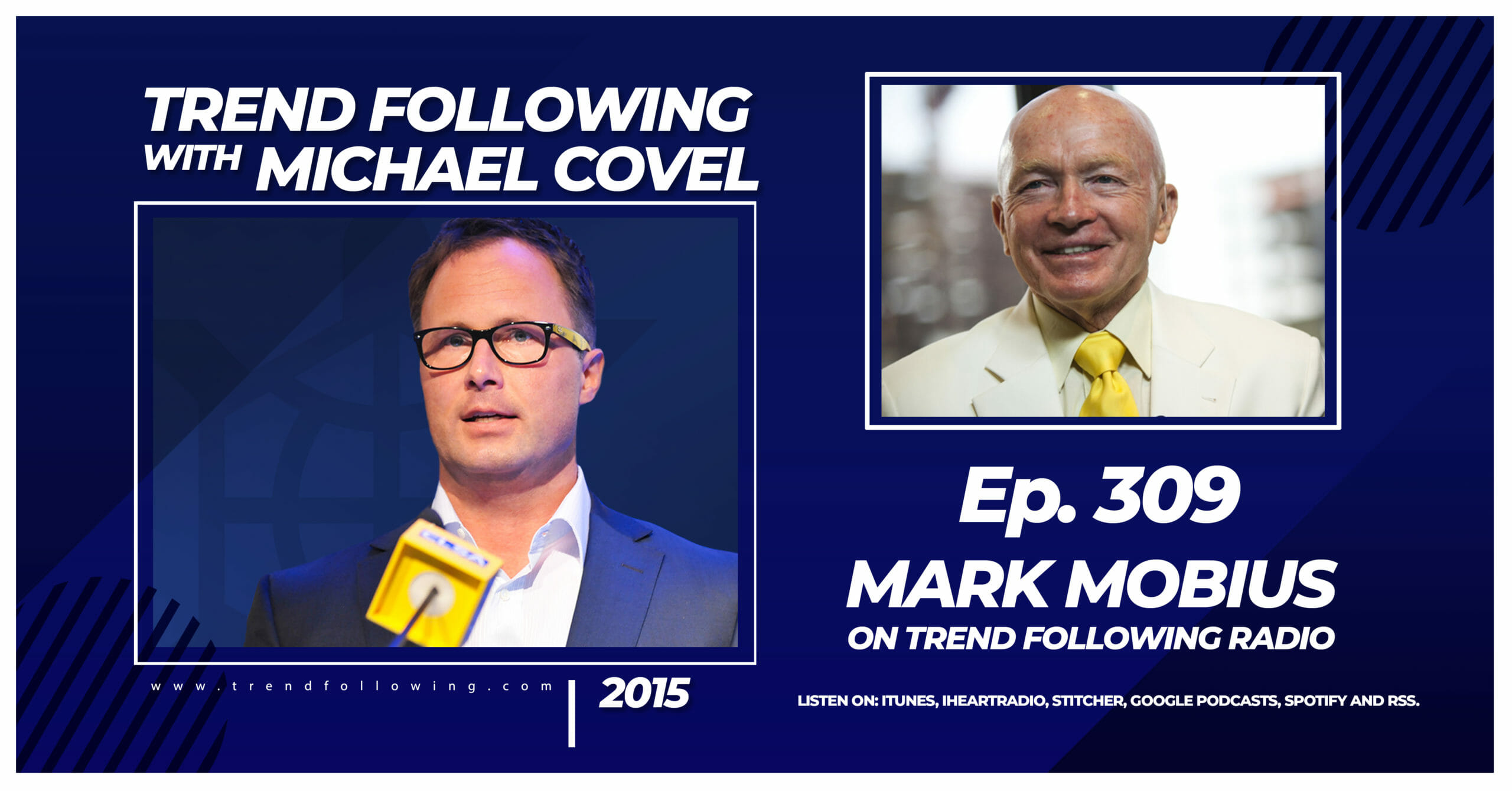
Ep. 309: Mark Mobius Interview with Michael Covel on Trend Following Radio

Mark Mobius
Mark Mobius

My guest today is Mark Mobius, Ph.D., executive chairman of Templeton Emerging Markets Group, joined Templeton in 1987. Currently, he directs the Templeton research team which is based in 18 global emerging markets offices, and manages emerging markets portfolios. Mobius oversees a team of more than 50 people managing some $45 billion.

The topic is economics.

In this episode of Trend Following Radio we discuss:

  • Key events that happened along Mobius’ development and moved him to find emerging markets as his passion
  • Growth across Asia
  • The importance of being on the ground to see what’s happening in China to have a true picture of what’s going on
  • Why what’s happening in China now is entirely different from the USSR in the early 1980’s
  • The two Koreas, and whether we’ll see one Korea eventually
  • The impact of both North and South Korea on their own
  • Mobius’ outlook on Myanmar
  • Singapore as an emerging market, and as it is compared to a city in the States
  • India, its growth, and how Mobius sees it moving forward
  • The importance of travel, and how it changes everybody that goes out there and experiences it

Listen to this episode:

Jump in!

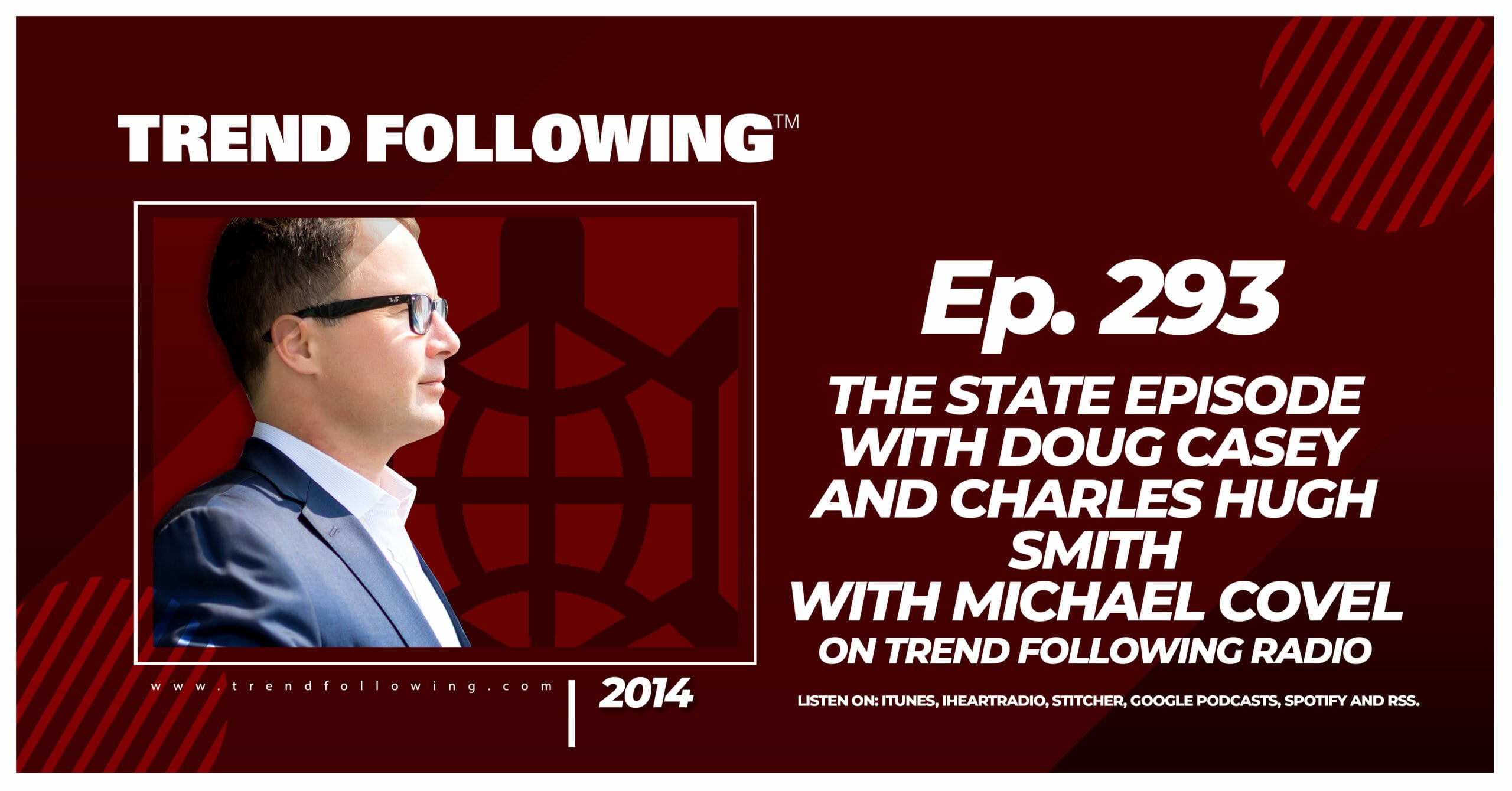
Ep. 293: The State Episode with Doug Casey and Charles Hugh Smith with Michael Covel on Trend Following Radio

The State Episode with Doug Casey and Charles Hugh Smith with Michael Covel on Trend Following Radio

My guests today are Doug Casey and Charles Hugh Smith.

Casey is the founder and chairman of Casey Research, a provider of paid subscription newsletter services espousing libertarian viewpoints as the justification for the purchase of highly speculative microcap stocks, precious metals, and other investments.

Smith is an American writer and blogger. He is the chief writer for the site “Of Two Minds”. Started in 2005, this site has been listed No. 7 in CNBC’s top alternative financial sites. Smith’s economic works stress the value and efficacy of decentralizing power and wealth, the individual’s power of self-determination and the value of community, which in his view has been diminished by the state.

The topics are state power and central planning.

In this episode of Trend Following Radio we discuss:

  • Casey and Covel discuss what it’s like having traveled to over 175 countries and where one can find social and economic liberty today in this world; the advantages of being a perpetual tourist; why Casey describes himself as an anarchist; if whether there is a purpose anymore to voting in the United States of America; loyalty to the country where you were born; those who rule out the possibility of a financial panic in the future; quantitative easing and currency debasement; and what was the trigger for Casey’s turn at life as a global traveler.
  • Smith and Covel discuss how winners and are being selected by the state as exemplified by the 2008 financial crisis; alliances between corporations and the state; why there might be an uproar if equity markets were not at all-time highs; what happens when the typical wage earner can no longer substitute debt for earned income; stagnant wages and tradable labor; building your life around non state controlled opportunities; the decentralization of power and wealth; and the reliance on secrecy in politics to avoid accountability.

Listen to this episode:

Want to learn more Trend Following? Watch my video here.

Mainstream Financial Media & Wrestling: Hip Tied

Great connections from Ben Hunt:

My point is not that mass-mediated financial advice is kinda like professional wrestling. My point is that mass-mediated financial advice is EXACTLY like professional wrestling. And I know that it must seem like I’m slamming Cramer and CNBC and the rest of the mass media financial guru-sphere by equating their efforts with professional wrestling, but I’m really not. I just want to call things by their proper names. I LOVE professional wrestling. Second only to professional politics, professional wrestling demonstrates Narrative creation and execution at an extremely high level of artistry, with hundreds of millions of dollars at stake. And it’s NOT a fake representation of wrestling in the way that an episode of “Marcus Welby, M.D.” is a fake representation of medical practice. Professional wrestling is scripted and choreographed, like a TV medical drama, but there are actual athletic feats executed here. It is “real wrestling” in that sense, where there is no “real medicine” being practiced in the filming of “House”. But no one in his right mind believes that professional wrestling is the same thing as Olympic wrestling or collegiate wrestling. Professional wrestling is its own thing – a marvelous and entertaining thing – and it deserves to be understood in that light. Well … mass-mediated financial advice is its own thing, too, where Narrative creation and execution is the only thing that matters, and everything you see or read is driven by the economic diktat of driving the Narrative du jour forward. No one in his right mind should believe that mass-mediated financial advice is the same thing as professional, individuated financial advice. And yet here we are, in a world where the notion of trust has become so warped that every day, thousands of investors question the trustworthiness of their flesh-and-blood financial advisors and tens of thousands more act on their own because they trusted a piece of Narrative-driven advice they heard on the TV or read in the newspaper. Why is it so important to distinguish between real people and mass media representations of people when it comes to matters of trust? Because in the wise words of J.K. Rowling, never trust anything that thinks for itself if you can’t see where it keeps its brain.

More.


How can you move forward immediately to Trend Following profits? My books and my Flagship Course and Systems are trusted options by clients in 70+ countries.

Also jump in:

Trend Following Podcast Guests
Frequently Asked Questions
Performance
Research
Markets to Trade
Crisis Times
Trading Technology
About Us

Trend Following is for beginners, students and pros in all countries. This is not day trading 5-minute bars, prediction or analyzing fundamentals–it’s Trend Following.

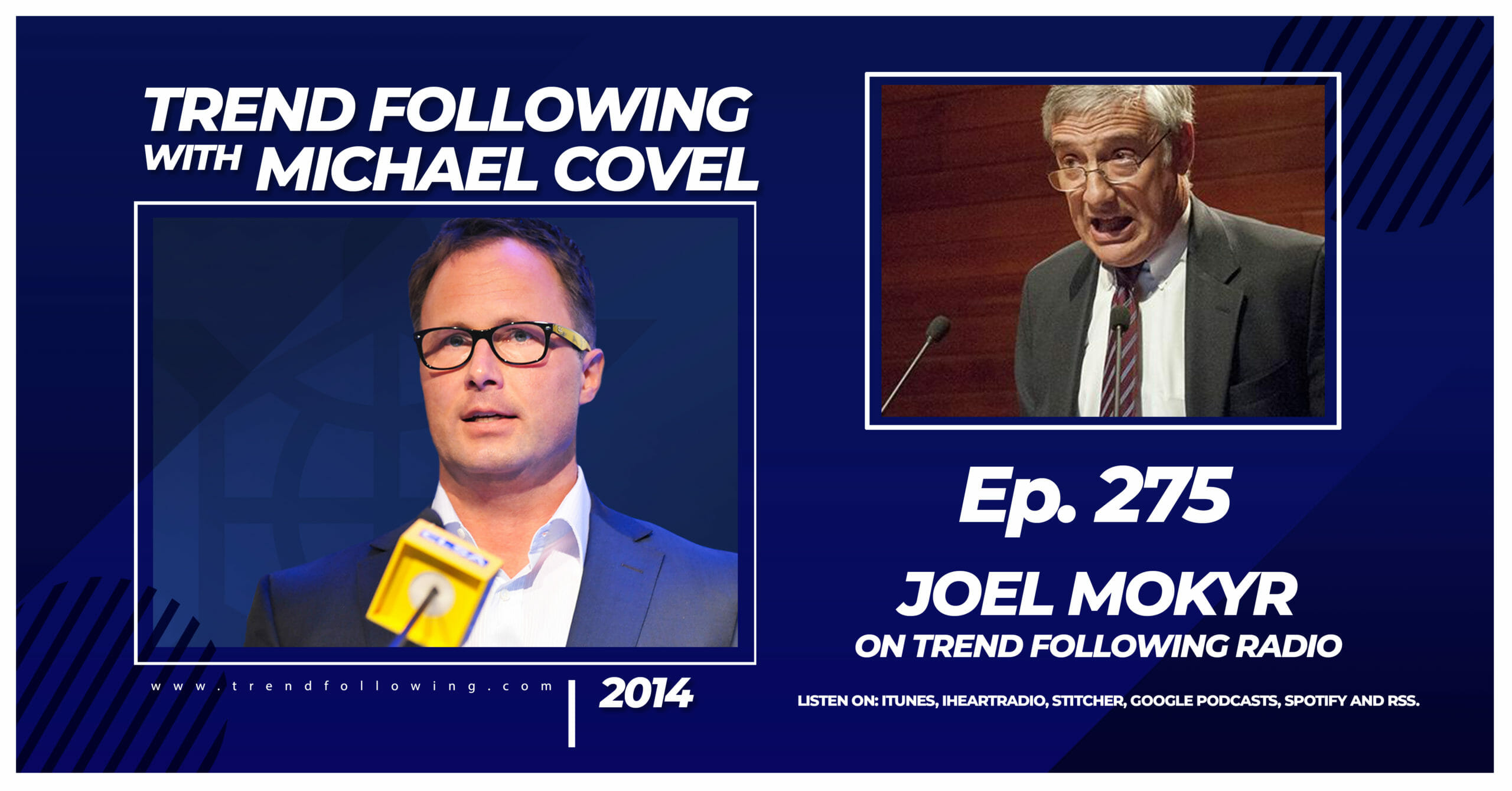
Ep. 275: Joel Mokyr Interview with Michael Covel on Trend Following Radio

Joel Mokyr
Joel Mokyr

My guest today is Joel Mokyr, an economic historian at Northwestern University. He focuses on technological progress, and how it affects growth. From Mokyr’s perspective, we haven’t seen anything yet. He’s not trying to predict what will happen next; he’s just confident and ready that big things will continue to happen.

The topic is technology.

In this episode of Trend Following Radio we discuss:

  • Define technology
  • The notion of playing God with technology
  • How technology and economic growth are intertwined
  • Why screwing up is part of technology
  • The acceleration of technology
  • New ways of measuring growth
  • Anesthesia and antibiotics as technologies and imagining new technologies as revolutionary as them
  • Moving from a wheat and steel economy into an information economy
  • The factory, the separation between firm and household, and the Industrial Revolution
  • The death of distance
  • Why technology is often not reflected in the GDP
  • Solving the language barrier through technology
  • Why the global acceptance of the English language is driven by technology
  • Why innovation isn’t natural to us
  • The declining respect of the writings of previous generations
  • Why the median age will continue to increase
  • Why we are moving into a mass-customization society
  • Changes in material science
  • The best way to think about the future

Listen to this episode:

Jump in!

Central Banks, What Have they Become? Ben Hunt’s View

A recent piece from Ben Hunt (see my Trend Following Radio Podcasts with Ben Hunt: ep 252, and ep. 447:

In every important respect, the Fed and the ECB and their brethren are no longer central banks at all. They are Ministries of Markets, no different from a Ministry of Industry or – even more eerily similar – the Ministry of Culture you would find in most European governments.

I spent the past week in Switzerland, meeting with old friends and making some new ones, and just like my recent travels in the US there was one overwhelming sentiment. No one doubts the omnipotence of central banks. No one doubts that market outcomes are fully determined by central bank policy. No one doubts that central banks are large and in charge. No one doubts that central banks can and will inflate financial asset prices. And everyone hates it.

Among those investors and allocators with the freedom to flee public markets, the interest in private market opportunities has never been greater. Among those investors and allocators trapped by mandate diktat in the Alice in Wonderland world of public markets, the resigned desperation has never been worse. It’s a quiet desperation in Zurich – a Teutonic stare at the floor and a wrinkling of the mouth – more obvious in Geneva with a Gallic shrug and a full-faced grimace. But’s it’s all the same emotional response to the Bizarro markets in this, the Golden Age of the Central Banker.

At this point the Narrative hegemony is complete. There’s no longer even a cursory bow to the idea that fundamentals matter. Earnings seasons come and go in the financial press with hardly a murmur. Over the past six months I can count on the fingers of one hand the financial press headlines that recapped the market day by saying that stocks went up or down “because” of company fundamentals. Six months ago I was writing in insurgent fashion about the “New Goldilocks Economy” constructed not on actual fundamental data but on how that data was interpreted through the lens of central bank policy. Today it’s a so-what-else-is-new article in the WSJ. A year ago I would meet with the occasional true believer in the power of central bank Narratives and the poverty of fundamental analysis in an environment of profound political uncertainty, but it was always against a dominant backdrop of “synchronized global growth” or “stock-picking is going to work again, just you wait and see”. Now everyone is a convert to the Narrative of Central Bank Omnipotence. Wherever I go, anywhere in the world, I am preaching to the choir when I deliver my sermon.

So I’m calling a top. Not a top in markets, because I honestly have no idea what’s going to happen next. But I’m calling a top in the Narrative of Central Bank Omnipotence because it has, in fact, reached its asymptotic limit of influence and belief.

It’s a top because the cracks are starting to show and widen. A Narrative architecture can sustain amazing structures, much like the flying buttress allows Gothic cathedrals to soar, but ultimately it can only bear so much weight. Draghi’s language last Thursday was sloppy. His pitch was uncharacteristically poor as he sang his lullaby to the Red King. I think he’s bitten off waaaay more than even he can chew, a point I’ll review at length next week. As for the US, the Central Bank Omnipotence Narrative is actually counterproductive for equity market price levels at this point. Because we are such well-trained monkeys, we act by reflex today to buy-buy-buy whenever a headline of Central Bank activism surfaces, but the training starts to work the other way when the tightening starts in earnest and the Fed reserves hang out there unresolved, like the mother of all lead balloons draped around the long end of the curve. Remember what an inverted yield curve looks like? Ain’t a pretty sight. But draining the reserves could look even worse. Damned if you do. Damned if you don’t. And the equity market caught in the middle.

It’s a top because – like a Ministry of Industry or a Ministry of Culture – a Ministry of Markets and its dirigiste control of the human animal’s social behavior ultimately fails. Maybe not a failure in the sense of apocalypse and ruin (although sometimes), but a failure in the sense that The Next Big Thing never comes out of a Ministry. They have their successes, sure, some grand program or triumphant announcement, but they’re only successes because we are TOLD they are successes. Since when has a Ministry of Culture sparked great art? Since when has a Ministry of Industry sparked great commercial advancement? Ministries are well-meaning. Ministries are the darlings of the professional intelligentsia that controls the organs of the State and Media. Ministries are wonderfully effective instruments of social control. But neither art nor commerce nor investment comes well from on high. It just doesn’t stick. The most powerful ideas in human history always come from below, not from above, and markets (and elections and revolutions) are the transmission mechanism of the idea engine. Watch out above!w

An inflection point in the market Narrative doesn’t alter market price levels directly. It alters the informational structure of markets (for a refresher course on what I mean, see “Through the Looking Glass”). It alters the market’s response pattern to future signals and events. That’s why I think it’s silly to predict end of year S&P 500 levels or engage in any such crystal ball gazing, because I have no idea what will happen next. But whatever pops out of the woods next (and somehow I doubt the global economy is walking down a primrose path), I think that using an Epsilon Theory perspective based on information theory and strategic behavior can help me react quickly and appropriately, which is what I mean by Adaptive Investing.

I don’t know what the catalyst for The Next Big Thing will be, although I have my suspicions. Maybe it’s a realignment election in Italy or the US. Maybe it’s China saying whatever the Mandarin equivalent of no mas might be. Maybe it’s a liquidity seizure in the repo market or some other unanticipated structural market failure. But whatever it is, we’re no longer at a point where additional State intervention can claim additional Narrative firepower. It’s like buying a stock that has no short interest and where all the sell-side analysts are rabidly positive. No thanks! Just as a short seller today is the marginal buyer of your stock tomorrow, so is the skeptic today the convert tomorrow. There are no more skeptics. To update Milton Friedman’s famous quote, we are all Bernankians now. Or rather, we all have to profess our Bernankian faith through our market behaviors even as we privately yearn for the Old Gods of greed and fear and the Old Languages of value and growth. And that’s the inflection point. From here on out I’m a seller of the Central Bank Narrative of Omnipotence and Control, and I’ll be writing about what that means for portfolio construction and risk management here at Epsilon Theory.

All the best,
Ben Hunt, Ph.D.
Chief Risk Officer

Nice. He is not a pure trend follower, but makes a great case for it.

Related Discussions: Embracing Failure, Calm Down, Technicals Matter, and Cullen Roche Podcast.


How can you move forward immediately to Trend Following profits? My books and my Flagship Course and Systems are trusted options by clients in 70+ countries.

Also jump in:

Trend Following Podcast Guests
Frequently Asked Questions
Performance
Research
Markets to Trade
Crisis Times
Trading Technology
About Us

Trend Following is for beginners, students and pros in all countries. This is not day trading 5-minute bars, prediction or analyzing fundamentals–it’s Trend Following.

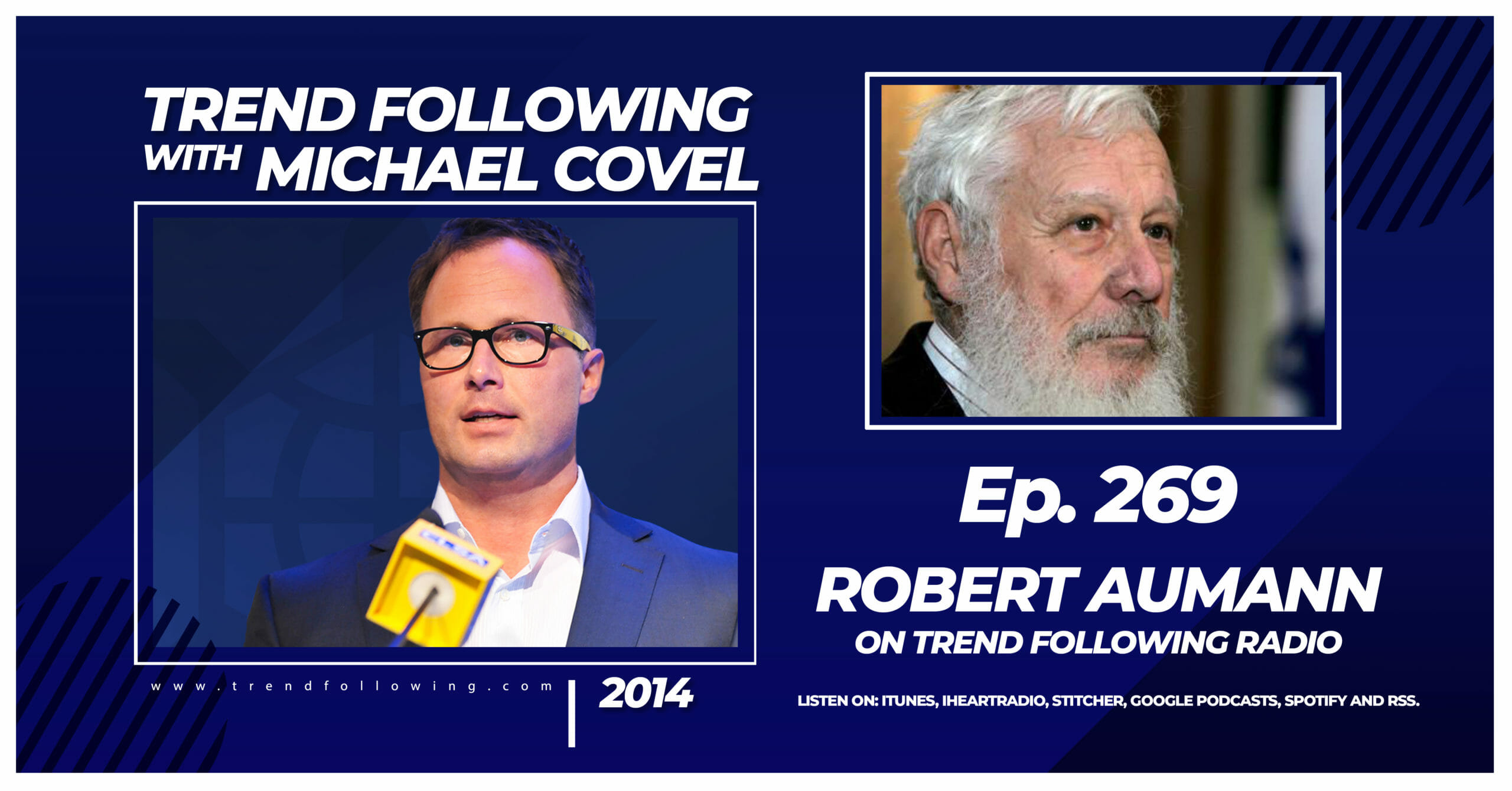
Ep. 269: Robert Aumann Interview with Michael Covel on Trend Following Radio

Robert Aumann
Robert Aumann

My guest today is Robert Aumann, the fourth Nobel Prize winner to appear on this podcast. Aumann is an Israeli-American mathematician, and a member of the United States National Academy of Sciences. He is a professor at the Center for the Study of Rationality in the Hebrew University of Jerusalem in Israel.

The topic is game theory.

In this episode of Trend Following Radio we discuss:

  • Conflict and cooperation through game theory analysis
  • World via his game theory perspective
  • Meeting John Nash and Aumann’s early background
  • What game theory is trying to accomplish
  • The economic definition of rationality
  • The idea of a strategy matrix
  • The world champions of peace and the best way to maintain peace
  • The 2008-09 bailouts from Aumann’s perspective and a game theory outlook
  • Behavioral economics
  • Game theory, diplomats, and the Cuban Missile Crisis
  • The existence of nuclear weapons and the Cold War

Listen to this episode:

Jump in!