
Subscribe now and watch my free trend following VIDEO.

“Since I already know what to expect, it’s easy stress free trading…”

Feedback in:

I enjoy reading your emails, although, we do have different trading styles. I appreciate the ideas and strategies of your emails. I remember when my system was still in it’s early development stages, 89-90, I entertained the idea of being a Commodities Trading Advisor. I worked with a gentleman who at the time had a brokerage firm in Miami Florida called [name] Trading. His first name was Richard. He was Reagan’s advisor in metals. At one time, and I was schooled on all types of trading (tricks), perks I will call them, but in time became valuable to me. Why I like day trading verses trend or (swing point) trading? I enter my position at or shortly after the open, make my target profit, then out, work day usually done by noon [disagree strongly] or shortly there after. Since I already know what to expect, it’s easy stress free trading. No waiting and having to go through the emotional roller coaster that comes with it, as you watch the markets up and down movements. I know you know what I am talking about. Anyway, soon as I can, I will start showing you. Happy Trading my friend.

Swing trading? Day trading? Not recommended.

Thanks for the note, but that path is anything but clear! A good start.


How can you move forward immediately to Trend Following profits? My books and my Flagship Course and Systems are trusted options by clients in 70+ countries.

Also jump in:

Trend Following Podcast Guests
Frequently Asked Questions
Performance
Research
Markets to Trade
Crisis Times
Trading Technology
About Us

Trend Following is for beginners, students and pros in all countries. This is not day trading 5-minute bars, prediction or analyzing fundamentals–it’s Trend Following.

“What I am missing mostly is unnecessary risk…”

Feedback in:

What I am missing mostly is unnecessary risk. Mostly the risk is something I like to see missing muster. I crush risk. Have no tolerance for unnecessary risk when possible. I’m arrogant about dismissing risk whenever possible.

I never do acrobatics without a parachute for example. Never fly acro below 1000 feet continuing with the aviation thought. I continue to fly like an eagle inverted or upright with managed or no risk. Expand the joy and push risk aside. If you are a being you are already so far ahead on the scoreboard nothing else will ever come close. Road following comes natural if y don’t over think it. I like to think of a trend like a road that is going where I want to go. In flying or driving its IFR (I Follow Roads) or I follow my headlights to get where I want to go. Sometimes I find a short cut and take the drama filled longer scenic route.

Sometimes the cost of operation is thought of as risk. It’s not. Every business has a cost of the production of outcome. If you are without cost of production it’s likely you are sitting in your vault counting past revenue. You won’t know the cost or benefit of vault time until you come out. It’s called buy and hold. Often an excellent strategy because humans tend to like producing over failing. Long is usually more popular than short because it’s so natural.

Mike thanks for all your great input.

Don B.

Thanks Don, but you are causing me to think too much! More on the psych side of it here.


How can you move forward immediately to Trend Following profits? My books and my Flagship Course and Systems are trusted options by clients in 70+ countries.

Also jump in:

Trend Following Podcast Guests
Frequently Asked Questions
Performance
Research
Markets to Trade
Crisis Times
Trading Technology
About Us

Trend Following is for beginners, students and pros in all countries. This is not day trading 5-minute bars, prediction or analyzing fundamentals–it’s Trend Following.
Ep. 791: Nick Radge Interview with Michael Covel on Trend Following Radio

Nick Radge
Nick Radge

Subscribe to Trend Following Radio on iTunes

My guest today is Nick Radge. He began trading in 1985. During a stint working for an investment bank in Singapore Nick dedicated his evenings testing trading strategies; 2 hours a day for 18 months, a total of at least 750 hours. Nick’s first book, Every-Day Traders, was written to identify the traits of successful traders. What do successful traders do that is different to other traders? In Adaptive Analysis for Australian Stocks, Nick shows his readers how to use price action to make the most of their winning trades and, often more importantly, to quickly recognize a losing trade and exit their position. In Unholy Grails–A New Road to Wealth, Radge outlines simple strategies to make money during uptrends and how to defend capital when the markets turn down. Nick is a Director at The Chartist, a stock market advisory service based in Queensland, Australia.

The topic is trading.

In this episode of Trend Following Radio we discuss:

  • High quality share market trading signals, charts, commentary, insights and education.

Mentions & Resources:

Listen to this episode:

Jump in!

“The biggest challenge in my trading has been protecting the money that I have made in my product….”

Feedback in:

The biggest challenge in my trading has been protecting the money that I have made in my product. I’m a fifth generation cattle rancher (we buy and sell cattle with the theory of buying what’s discounted and adding value to are product) my family has been blessed over the years and we have done well in the cattle business, but with doing well that means TRYING to protect what we have. I’m surrounded by uncertainty. Weather, volatile markets, animals, regulations and so on. I’ve read three of your books and I really can correlate with what your saying about quantitative decision making and let price dictate decisions. In the cattle business if it doesn’t add up mathematically then we don’t take the risk of pursuing that trade, so why do I look at risk protection differently? I always felt deep down there was a better way to manage risk. Trying to protect what we have made (with the cattle) to only pay huge margin calls and miss out on big trends. I’m not the greatest with computers and right now and that feels also like a huge challenge, but I’m confident that can be learned. I’m reading and absorbing like crazy through your podcast. Longhand I have been using moving averages to find volatility in the feeder and fat cattle markets, another big mental challenge right now is the computer side. I’m not a computer guy, but I love the idea of checking my computer before or after trading that day and having my system tell me what to do, not some talking head that is prolly being paid to say what he or she is saying. So to wrap up. My biggest challenges are protecting large sums of money with risk protection and using tech to make better quantified decisions.

[Name] Land & Cattle

I can help. A good start.


How can you move forward immediately to Trend Following profits? My books and my Flagship Course and Systems are trusted options by clients in 70+ countries.

Also jump in:

Trend Following Podcast Guests
Frequently Asked Questions
Performance
Research
Markets to Trade
Crisis Times
Trading Technology
About Us

Trend Following is for beginners, students and pros in all countries. This is not day trading 5-minute bars, prediction or analyzing fundamentals–it’s Trend Following.

Ep. 790: Stop Looking for Efficiency with Michael Covel on Trend Following Radio

Stop Looking for Efficiency with Michael Covel

Subscribe to Trend Following Radio on iTunes

Please enjoy my monologue Stop Looking for Efficiency with Michael Covel on Trend Following Radio. This episode may also include great outside guests from my archive.

Listen to this episode:

Want to learn more Trend Following? Watch my video here.

“This question is based on the premise that most markets only trend 1/3 of the time…”

Feedback in:

Dear Michael,

This is a question with regards to different timing of funds/allocation coming into a trend following trading account. For example you are running a moving average cross over system and is already in a LONG position due to the favourable cross over condition that indicates an uptrend.

i.e. Strategy: BUY when EMA 20 crosses EMA 50 towards the upside and SELL when it crosses back down.

The question here is what do you do when you receive extra allocation/funds to the trading account in between the signals generated? Do you immediately add on the extra allocation on the current trade or new funds will only be allocated when the next signal is given?

This question is based on the premise that most markets only trend 1/3 of the time and if we always wait till the next signal before allocating the new funds, the opportunity cost seems pretty high. Do advise what does a trend following fund manager do in this case? (trying to remove discretionary decision to the maximum and hence the question)

Much appreciated.

Yours sincerely,
Royal (student of your trend following theories)

You have all of my Flagship content in front of you? Or you are in one of my books? I have a very precise way of teaching a system. I don’t teach by correcting without first starting with a solid foundation.


How can you move forward immediately to Trend Following profits? My books and my Flagship Course and Systems are trusted options by clients in 70+ countries.

Also jump in:

Trend Following Podcast Guests
Frequently Asked Questions
Performance
Research
Markets to Trade
Crisis Times
Trading Technology
About Us

Trend Following is for beginners, students and pros in all countries. This is not day trading 5-minute bars, prediction or analyzing fundamentals–it’s Trend Following.

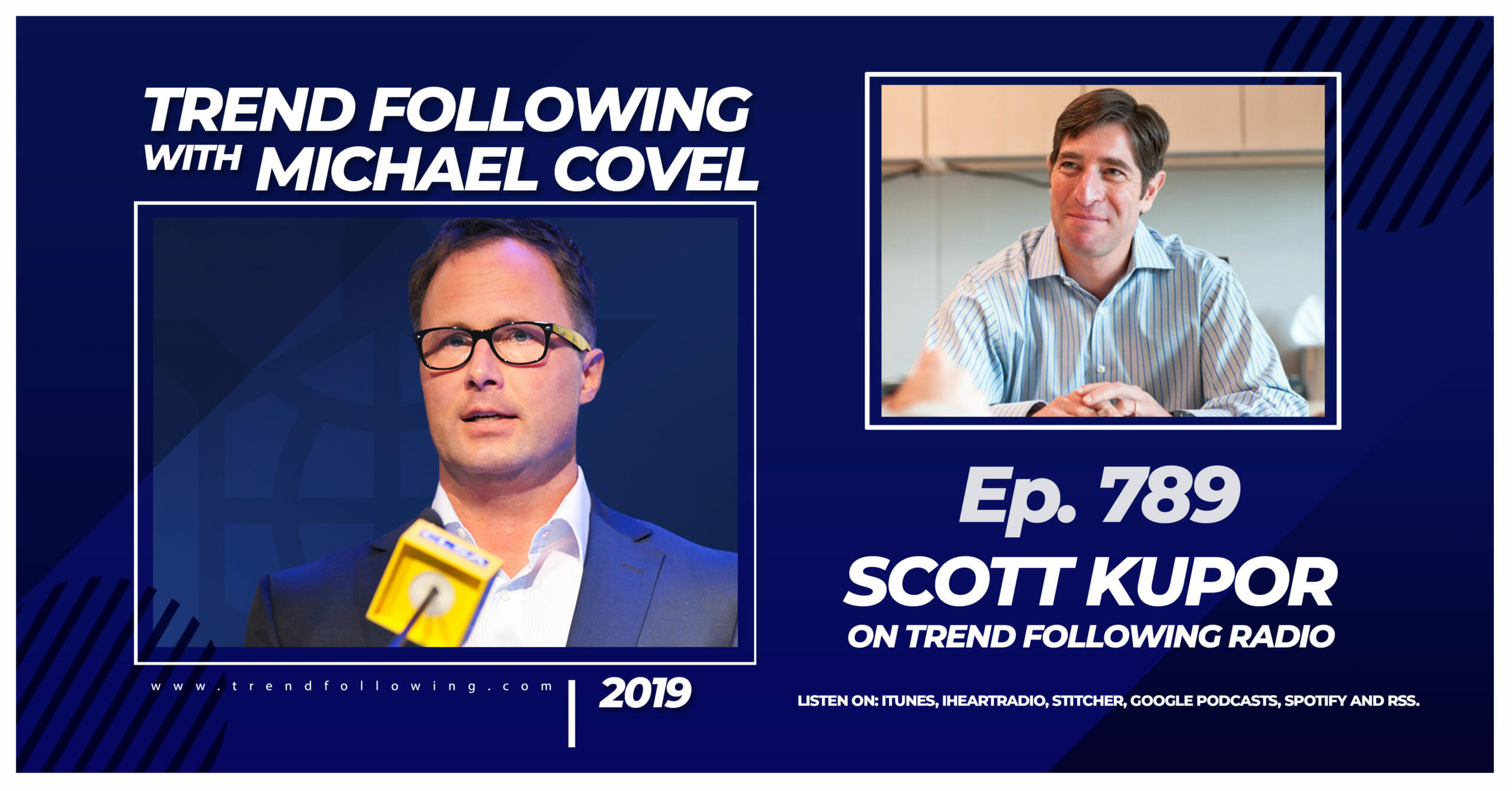
Ep. 789: Scott Kupor Interview with Michael Covel on Trend Following Radio

Scott Kupor
Scott Kupor

Subscribe to Trend Following Radio on iTunes

My guest today is Scott Kupor, the managing partner of Andreessen Horowitz. He has overseen the firm’s rapid growth to one hundred fifty employees and more than $7 billion in assets under management.

The topic is his book Secrets of Sand Hill Road: Venture Capital and How to Get It.

In this episode of Trend Following Radio we discuss:

  • What are venture capitalists saying about your startup behind closed doors? And what can you do to influence that conversation?
  • Why most VCs typically invest in only one startup in a given business category?
  • Why the skill you need most when raising venture capital is the ability to tell a compelling story?
  • How to handle a “down round,” when startups have to raise funds at a lower valuation than in the previous round?
  • What to do when VCs get too entangled in the day-to-day operations of the business?
  • Why you need to build relationships with potential acquirers long before you decide to sell?

Mentions & Resources:

Listen to this episode:

Jump in!