Subscribe now and watch my free trend following VIDEO.

Sunrise Capital: Lessons In Trend Following Persistence

Gary Davis was just about to turn 34 as he started trading with a trend following program he had learned from author J. Welles Wilder, Jr. He lost on his first 17 trades, but once he made one tweak, which he believed is the only reason he is still trading now, he was back in the game.

Davis [then] came to the conclusion, after a period of rigorous and profitable testing with his own money, that there was significant potential in scaling the size of his trading strat­egies. He sought the help of friends and family for capital to seed a larger pool of money.

Davis founded and launched what would come to be known as Sunrise Capital Partners (known as Sunrise Commodities at the time of inception) in 1980—with the gentle prodding of Ken Tropin (who then was with Dean Witter brokerage, but who today runs one of the most successful trend following firms in the world).

Davis was not super high tech at the time. He pre­ferred handwritten charts and price quotes from the print version of the Wall Street Journal. That should be an inspi­ration for those of you who want to make excuses for not having the perfect this or that. Just do it, right?

Note: Excerpt from The Little Book of Trading.


How can you move forward immediately to Trend Following profits? My books and my Flagship Course and Systems are trusted options by clients in 70+ countries.

Also jump in:

Trend Following Podcast Guests
Frequently Asked Questions
Performance
Research
Markets to Trade
Crisis Times
Trading Technology
About Us

Trend Following is for beginners, students and pros in all countries. This is not day trading 5-minute bars, prediction or analyzing fundamentals–it’s Trend Following.

The TurtleTraders Had 5 Questions for Their Trading

The Turtles’ core axioms were the same ones practiced by the great speculators from one hundred years earlier:

“Do not let emotions fluctuate with the up and down of your capital.”
“Be consistent and even-tempered.”
“Judge yourself not by the outcome, but by your process.”
“Know what you are going to do when the market does what it is going to do.”
“Every now and then the impossible can and will happen.”
“Know each day what your plan and your contingencies are for the next day.”
“What can I win and what can I lose? What are probabilities of either happening?”

However, there was precision behind the familiar-sounding euphemisms. From the first day of training, William Eckhardt outlined five questions that were relevant to what he called an optimal trade. The Turtles had to be able to answer these questions at all times:

1. What is the state of the market?
2. What is the volatility of the market?
3. What is the equity being traded?
4. What is the system or the trading orientation?
5. What is the risk aversion of the trader or client?

There was no messing around in Eckhardt’s tone, as he suggested that these were the only things that had any importance.

What is it the state of the market? The state of the market simply means. “What is the price that the market is trading at?” If Microsoft is trading at 40 a share today, then that is the state of that market.

What is the volatility of the market? Eckhardt taught the Turtles that they had to know on a daily basis how much any market goes up and down. If Microsoft on an average trades at 50, but typically bounces up and down on any given day between 48 and 52, then Turtles were taught that the volatility of that market was four. They had their own jargon to describe daily volatilities. They would say that Microsoft had an “N” of four. More volatile markets generally carried more risk.

What is the equity being traded? The Turtles had to know how much money they had at all times, because every rule they would learn adapted to their given account size at that moment.

What is the system or the trading orientation? Eckhardt instructed the Turtles that in advance of the market opening, they had to have their battle plan set for buying and selling. They couldn’t say, “Okay, I’ve got $100,000; I’m going to randomly decide to trade $5,000 of it.” Eckhardt did not want them to wake up and say, “Do I buy if Google hits 500 or do I sell if Google hits 500?” They were taught precise rules that would tell them when to buy or sell any market at any time based on the movement of the price. The Turtles had two systems: System One (S1) and System Two (S2). These systems governed their entries and exits. S1 essentially said you would buy or sell short a market if it made a new twenty-day high or low.

What is the risk aversion of the trader or client? Risk management was not a concept that the Turtles grasped immediately. For example, if they had $10,000 in their account, should they bet all $10,000 on Google stock? No. If Google all of a sudden dropped, they could lose all $10,000 fast. They had to bet a small amount of the $10,000, because they didn’t know whether or not a trade was going to go in their favor. Small betting (for example, 2 percent of $10,000 on initial bets) kept them in the game to play another day, all the while waiting for a big trend.

Note: Excerpt from The Complete TurtleTrder.


How can you move forward immediately to Trend Following profits? My books and my Flagship Course and Systems are trusted options by clients in 70+ countries.

Also jump in:

Trend Following Podcast Guests
Frequently Asked Questions
Performance
Research
Markets to Trade
Crisis Times
Trading Technology
About Us

Trend Following is for beginners, students and pros in all countries. This is not day trading 5-minute bars, prediction or analyzing fundamentals–it’s Trend Following.
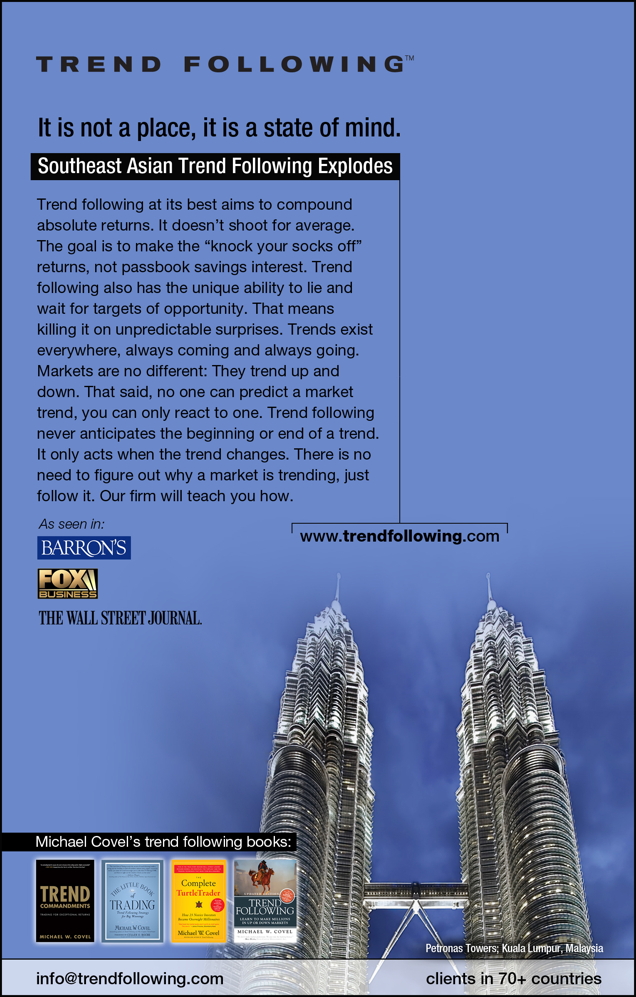
Trend Following in Singapore, Malaysia and Indonesia

More ads:

1
2
3
4
5
6
7


How can you move forward immediately to Trend Following profits? My books and my Flagship Course and Systems are trusted options by clients in 70+ countries.

Also jump in:

Trend Following Podcast Guests
Frequently Asked Questions
Performance
Research
Markets to Trade
Crisis Times
Trading Technology
About Us

Trend Following is for beginners, students and pros in all countries. This is not day trading 5-minute bars, prediction or analyzing fundamentals–it’s Trend Following.

Mark Rosenberg of SSARIS: ‘Deal with It’ Wisdom

Back in the mid-nineties I met Mark Rosenberg for the first time in his office in Stamford, CT. Rosenberg was/is a trend following trader. Recently, I caught this line from him describing John W. Henry:

“In 1980, Henry told me, ‘I’m going buy the St. Louis Cardinals.’ I told him, ‘You don’t have any money,’ but he always believed he would.”

Such a good piece of wisdom. Well, Henry did not end up with the Cardinals, but the Boston Red Sox were a nice consolation prize!

Fun story about Rosenberg? When I first met him he shared a great trading/entrepreneurial ‘way’ that always stuck with me. Sitting in his private office, and I still remember the book Future Shock prominently displayed, Rosenberg talked about the ups and downs of trading along with the mental outlook needed to excel. He told me that when the down times came, those losing money times, he would always come home and tell his wife that it was back to “franks and beans”. Meaning, he adjusted. He was pragmatic. He always cut back until trends came back.


How can you move forward immediately to Trend Following profits? My books and my Flagship Course and Systems are trusted options by clients in 70+ countries.

Also jump in:

Trend Following Podcast Guests
Frequently Asked Questions
Performance
Research
Markets to Trade
Crisis Times
Trading Technology
About Us

Trend Following is for beginners, students and pros in all countries. This is not day trading 5-minute bars, prediction or analyzing fundamentals–it’s Trend Following.
Efficient Markets: Killing Off the Monster

From the Economist:

Having lived through the financial crisis of 2007-08, the man in the street might find the idea that markets are “efficient” incredible. But the efficient-market hypothesis, like a Hollywood monster, has proved very hard to kill off. From the truism that the average investor could not beat the market after costs, academics developed the insight that obvious market-beating opportunities would quickly be arbitraged away.

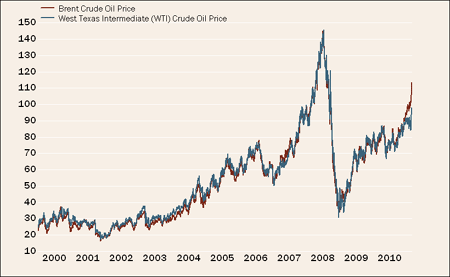
Here is a great example of efficient markets — not:

That chart could only have been effectively traded as a trend following trader. You used fundamentals to trade that? You are full of it or you were flipping coins and hit heads.


How can you move forward immediately to Trend Following profits? My books and my Flagship Course and Systems are trusted options by clients in 70+ countries.

Also jump in:

Trend Following Podcast Guests
Frequently Asked Questions
Performance
Research
Markets to Trade
Crisis Times
Trading Technology
About Us

Trend Following is for beginners, students and pros in all countries. This is not day trading 5-minute bars, prediction or analyzing fundamentals–it’s Trend Following.

Transtrend: Netherlands Based Trend Following Trader

Transtrend has had great trend following performance since 1995: (PDF).

More.


How can you move forward immediately to Trend Following profits? My books and my Flagship Course and Systems are trusted options by clients in 70+ countries.

Also jump in:

Trend Following Podcast Guests
Frequently Asked Questions
Performance
Research
Markets to Trade
Crisis Times
Trading Technology
About Us

Trend Following is for beginners, students and pros in all countries. This is not day trading 5-minute bars, prediction or analyzing fundamentals–it’s Trend Following.
Could You Be on a Desert Island and Make Money Trading?

There are people (read: intellectual twits) who don’t understand the value in this article because the date is “2005”. They think, “It’s 2010, no good now!” The people who think like that are the same people who trust their money to the buy and hold insanity of Fidelity. Everyone gets what they want, right? Off my soapbox and onto a a great excerpt from that article:

“I [Harding] went to Sabre [first firm] because I didn’t want to sit in an investment bank and make money. I wanted to know if you could do it from outside the markets looking in. “Could you be on a desert island and make money trading?” was the question I was asking myself.” Partly this was Harding the scientist exerting an influence, as the efficient market hypothesis was a hot topic amongst academics that studied markets…”With the EMH under consideration I was very interested to know whether the very antithesis of that, technical analysis, had any truth in it. So I went to Sabre very much in the spirit of intellectual curiosity.” According to Harding the prevailing thinking at places like Wood Mackenzie was that there was no intellectual respect for technical analysis. There were a hundred analysts there, consisting of various types of serious people, and the technical analyst was isolated at the end of a row in an out-of-the-way part of the office. His craft was considered intellectually light-weight by his peers and the press. ” I remember being visited by the FT’s Barry Riley in 1988. Within a week there was a side-swipe in print along the lines of “that’s more than the whizzkids with computers can manage,” ” recalls a somewhat wearisome Harding. “But the thing is he and all the other serious investment professionals nodding sagely in agreement were wrong. No amount of looking knowledgeable and smug will make you right if you are wrong in the first place.” This attitude was something that Harding was to get used to over his career. “For eighteen of my 25 years in markets I have received intellectual scorn and derision from everyone – business school professors, senior investment professionals to experienced journalists. But thankfully now it’s different: the battle is won. The enemy is routed. All we are doing now is mopping up the stragglers.” David Harding spent two years at Sabre Fund Management, each day drawing hundreds of charts by hand, like a true craftsman. Every chart was bound into big leather folders, and in turn each chart pattern was copied into other folders. He likens it to an old-fashioned publishing house. Harding noted without irony that the company was run by accountants, and that “there certainly was method in what was done there.” He continues “I certainly regard my time there as the foundation stone of my credentials as an empiricist. There is nothing like drawing thousands of charts by hand to fix them in your mind. In fact I regard this phase of exhausting taxonomy of technical analysis as being like the relationship used to be between biology and taxonomy in the life sciences. Until something like 1830 you had gentlemen scientists collecting leaves and putting them into folders, and it wasn’t until Darwin that he and others started putting some order on it. Only by arranging data and putting it in order can you get any pattern out of it. What AHL and others have done is go beyond the taxonomy and turn trading into a real science.”

Continuing:

“Our sort of approach to markets is a science. It is an unpublished science, but it is a real one. You could get the thick leather bound volumes of papers on it if there was a willingness to “open the kimono”, as the horrible modern expression has it.” “The process of trading our system is like repeatedly drawing different coloured balls from the statisticians apocryphal bag. As we draw out a ball it becomes part of the track record, and we put it back in the bag, but there is no guarantee that the balls will come out in the same order in future.”


How can you move forward immediately to Trend Following profits? My books and my Flagship Course and Systems are trusted options by clients in 70+ countries.

Also jump in:

Trend Following Podcast Guests
Frequently Asked Questions
Performance
Research
Markets to Trade
Crisis Times
Trading Technology
About Us

Trend Following is for beginners, students and pros in all countries. This is not day trading 5-minute bars, prediction or analyzing fundamentals–it’s Trend Following.