In “The Complete TurtleTrader” one of the two female Turtles elected not to be interviewed. Maybe that interview is closer to reality today as I just noticed that Liz Cheval is paying ad dollars to Google for the term “Michael Covel.” That is a nice endorsement of “The Complete TurtleTrader!”
Category: Trend Following
Michael Carr: Dungeons & Dragons Writer Becomes TurtleTrader
Michael Carr was an original Turtle. Before being hired as a Turtle by Richard Dennis he was a writer and game designer known for writing Fight in the Skies and Don’t Give Up the Ship! (I am not familiar with these, but clearly there is a following!). Carr later joined Dungeons & Dragons and wrote In Search of the Unknown. Today, Carr writes for American Snowmobiler Magazine while residing in Wisconsin. This reinforces the diversity of Turtles selected.
Richard Dennis Back in the Day
Feedback in tonight:
Hello Michael, I’ve just finished reading The Complete TurtleTrader with great pleasure. I traded on the floor of the Mid-Am from the last few months it was located at the Fisher Building until 1976, when (having made my entire, if modest, living with about $2,000 of capital for a few years) I finally got too worried about possible out-trades (only one of which could have wiped me out) and sold my seat. I was, and remain today, an extremely conservative but fairly consistently profitable trader, by commodities standards. Of course Rich Dennis was something of a legend even back at the old Fisher Building location by the time I’d arrived. It was generally known that he engaged in inter-market spread trading, mostly in grains in those days, since he could then get reduced margins. Then, when Dennis started trading what seemed to be really bizarre inter-market spreads, such as wheat and silver, the old-timers scoffed mightily. But his strategy of buying the stronger of two trending markets had obviously worked – that was clear to anyone who’d been watching his career at that point. Soon after MACE moved to Jackson Blvd,, of course, Dennis moved across the street to the BOT, though he kept his MACE seat for quite some time after that. I well remember the MACE secretary accosting Dennis, who’d come on the floor from the BOT one afternoon after closing, loudly complaining that Dennis never deposited his daily clearing house checks. A few of us gathered around as a slightly chastened Dennis went to his trading desk, pulled open an unlocked drawer, and retrieved something like $50,000 in undeposited checks. He just didn’t seem to pay much attention to his MACE business by that time. At any rate, your book was both informative and entertaining. Thanks! [Name withheld]
Nice piece of insight. Thanks!
C & D Commodities Broker Ticket
One of the Turtles Lucy Wyatt Mattinen sent me an original C & D Commodities broker ticket. Here is a scan. C & D was Richard Dennis’ firm.
Questions Used to Choose the Turtles
The following true/false questions were sent out to the second group of Turtles. These questions were used to help decide who was picked and who was not:
1. One should favor being long or being short whichever one is comfortable with.
2. On initiation one should know precisely at what price to liquidate if a profit occurs.
3. One should trade the same number of contracts in all markets.
4. If one has $100,000 to risk, one ought to risk $25,000 on every trade.
5. On initiation one should know precisely where to liquidate if a loss occurs.
6. You can never go broke taking profits.
7. It helps to have the fundamentals in your favor before you initiate.
8. A gap up is a good place to initiate if an uptrend has started.
9. If you anticipate buy stops in the market, wait until they are finished and buy a little higher than that.
10. Of 3 types of orders (market, stop, and resting), market orders cost the least skid.
11. The more bullish news you hear and the more people are going long the less likely the
uptrend is to continue after a substantial uptrend.
12. The majority of traders are always wrong.
13. Trading bigger is an overall handicap to one’s trading performance.
14. Larger traders can “muscle” markets to their advantage.
15. Vacations are important for traders to keep the proper perspective.
16. Undertrading is almost never a problem.
17. Ideally, average profits should be about 3 or 4 times average losses.
18. A trader should be willing to let profits turn into losses.
19. A very high percentage of trades should be profits.
20. A trader should like to take losses.
21. It is especially relevant when the market is higher than it’s been in 4 and 13 weeks.
22. Needing and wanting money are good motivators to good trading.
23. One’s natural inclinations are good guides to decision making in trading.
24. Luck is an ingredient in successful trading over the long run.
25. When you’re long, “limit up” is a good place to take a profit.
26. It takes money to make money.
27. It’s good to follow hunches in trading.
28. There are players in each market one should not trade against.
29. All speculators die broke
30. The market can be understood better through social psychology than through economics.
31. Taking a loss should be a difficult decision for traders.
32. After a big profit, the next trend-following trade is more likely to be a loss.
33. Trends are not likely to persist.
34. Almost all information about a commodity is at least a little useful in helping make decisions.
35. It’s better to be an expert in 1-2 markets rather than try to trade 10 or more markets.
36. In a winning streak, total risk should rise dramatically.
37. Trading stocks is similar to trading commodities.
38. It’s a good idea to know how much you are ahead or behind during a trading session.
39. A losing month is an indication of doing something wrong.
40. A losing week is an indication of doing something wrong.
41. The big money in trading is made when one can get long at lows after a big downtrend.
42. It’s good to average down when buying.
43. After a long trend, the market requires more consolidation before another trend starts.
44. It’s important to know what to do if trading in commodities doesn’t succeed.
45. It is not helpful to watch every quote in the markets one trades.
46. It is a good idea to put on or take off a position all at once.
47. Diversification in commodities is better than always being in 1 or 2 markets.
48. If a day’s profit or loss makes a significant difference to your net worth, you’re overtrading.
49. A trader learns more from his losses than his profits.
50. Except for commission and brokerage fees, execution “costs” for entering orders are minimal over the course of a year.
51. It’s easier to trade well than to trade poorly.
52. It’s important to know what success in trading will do for you later in life.
53. Uptrends end when everyone gets bearish.
54. The more bullish news you hear the less likely a market is to break out on the upside.
55. For an off-floor trader, a long-term trade ought to last 3 or 4 weeks or less.
56. Other’s opinions of the market are good to follow.
57. Volume and open interest are as important as price action.
58. Daily strength and weakness is a good guide for liquidating long-term positions with big profits.
59. Off-floor traders should spread different markets of different market groups.
60. The more people are going long the less likely an uptrend is to continue in the beginning of a trend.
61. Off-floor traders should not spread different delivery months of the same commodity.
62. Buying dips and selling rallies is a good strategy.
63. It’s important to take a profit most of the time.
Short Answer Questions
On the back of the true/false answer sheet, please answer these questions with one sentence each.
1. What were your standard test results on college entrance exams?
2. Name a book or movie you like and why.
3. Name a historical figure you like and why.
4. Why would you like to succeed at this job?
5. Name a risky thing you have done and why.
6. Explain a decision you have made under pressure and why that was your decision.
7. Hope, fear and greed are said to be enemies of good traders. Explain a decision you may have made under one of these influences and how you view that decision now.
8. What are some good qualities you have that might help in trading?
9. What are some bad qualities you have that might hurt in trading?
10. In trading would you rather be good or lucky? Why?
11. Is there anything else you’d like to add?
If you enjoy this then be sure to check out The Complete Turtle Trader.
How can you move forward immediately to Trend Following profits? My books and my Flagship Course and Systems are trusted options by clients in 70+ countries.
Also jump in:
• Trend Following Podcast Guests
• Frequently Asked Questions
• Performance
• Research
• Markets to Trade
• Crisis Times
• Trading Technology
• About Us
Trend Following is for beginners, students and pros in all countries. This is not day trading 5-minute bars, prediction or analyzing fundamentals–it’s Trend Following.
The Two Female Turtles: Liz Cheval and Lucy Wyatt
As I mention in my book there were two female Turtles. This was news to many as the lone female Turtle for all these years had been positioned as Liz Cheval, but my research showed that to be incorrect. Lucy Wyatt Mattinen was a Turtle as well. And it was other Turtles who were the source of confirming Wyatt Mattinen’s Turtle existence. But like everything with the Turtles there was a more detailed back story!
I state in my book that Cheval elected to not speak for “The Complete TurtleTrader”. She did, however, email me during my book writing process:
Michael,
Thanks for the email and voicemail. I appreciate you contacting me. Could you clarify a couple of things for me? Are you the original founder of the TurtleTrader website? I know it’s changed quite a bit over the years. I think it’s a great resource. Just wasn’t sure if you were the original founder and if so, and do you have any contact information for Russell Sands and other turtles. Rich asked me to put together a list for him and I think you have more up-to-date information than I do. I would appreciate a list of email addresses or other contact information on as many turtles as you have.
Thanks.
Liz
Worse than Cheval saying “no” was not even being able to find Lucy Wyatt Mattinen to ask her for an interview during my book writing process. However, once the book was published I quickly heard from Wyatt Mattinen. She was incensed that she was described as “doing her nails” by another Turtle. In no uncertain terms she educated me about her long time involvement with Rich Dennis and Bill Eckhardt. She laid out her trading successes. Clearly, Wyatt Mattinen, while not an active fund manager today, has lived an interesting life. While she did not agree with the “nails” comment she did state in no uncertain terms that my book was bullseye accurate
However, little did I know I had stirred the pot by declaring that there were two female Turtles. In fact, my article in Trader Monthly revealed the unexpected. Trader Monthly, in verifying my article details with Cheval, was told by Cheval that she was the only female Turtle. Trader Monthly stood by the notion of two female Turtles and referred to “women” in the article.
Why all of the detail? There are quite a few who are interested in the Turtle back story. For example, once my book galleys, the drafts, started making the rounds, feedback from one person in particular struck a chord. Bob Pardo is a seasoned trader. He is also a skeptic, the kind of person you want to read your book in order to understand the weaknesses. Pardo does not believe in praise as much as constant improvement. And, although his bluntness probably rattles many, his honesty was welcomed.
Pardo confronted me with a number of questions postulating why some Turtles were averse to talking and he wondered if there weren’t further lessons to be drawn from Dennis’ managed money efforts. He also saw the apparent paranoia from some Turtles as interesting and worthy of further exploration. So in many ways the back stories I have posted are in response to the likes of Pardo and many others who have asked questions since my book’s release.
More to come.
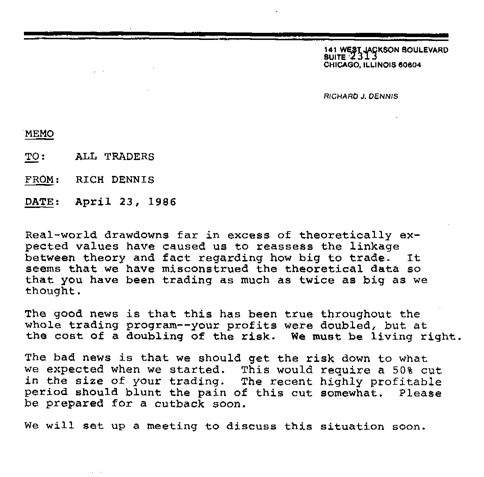
The Turtle Memo to “Cut Back”
One of the interesting aspects of the Turtle program was the research completed by four Turtles during the program. They figured out that the rules given to them were too “hot”. Here (PDF) is the memo telling them to cut back.