Subscribe now and watch my free trend following VIDEO.

The Origins of Trend Following

Here is one view about the origins of trend following. This has been posted before, but time for a repost. An excerpt:

“Although trend following has been a popular trading philosophy for many years, surprisingly little has been written about its origins and history. This is partly due, no doubt, to the scarcity of available information prior to the early 20th century, and because until about 50 years ago trend following as a philosophy had not been completely articulated. To be sure, by the early 1950s many trend following methodologies were in common use – and may have been for centuries – but the underlying concept had not been fully defined, or even given a name. One reason for this paucity of early information is suggested by the “following” part of the term “trend following.” The implication is one of passivity, of reaction, rather than of bold, assertive action — and human nature shows a distinct preference for the latter. Also, trend following appears to be too simple an idea to be taken seriously. Indeed, simple ideas can take a very long time to be accepted – think of the concept of a negative number, or of zero: simple to us, but problematic to our ancestors.”

Quoting from a 1954 work by William Dunnigan. Dunnigan states:

“We think that “forecasting” should be thought of in the light of measuring the direction of today’s trend and then turning to the Law of Inertia (momentum) for assurance that probabilities favor the continuation of that trend for an unknown period of time into the future. This is trend following, and it does not require us to don the garment of the mystic and look into the crystal balls of the future. Let us believe that it is possible to profit through economic changes by following today’s trend, as it is revealed statistically day-by-day, week-by-week, or month-by-month. In doing this we should entertain no preconceived notions as to whether business is going to boom or bust, or whether the Dow-Jones Industrial Average is going to 500 or 50. We will merely chart our course and steer our ship in the direction of the prevailing wind. When the economic weather changes, we will change our course with it and will not try to forecast the future time or place at which the wind will change.”

The world changes and trend following stays the same by always adjusting to the current situation.


How can you move forward immediately to Trend Following profits? My books and my Flagship Course and Systems are trusted options by clients in 70+ countries.

Also jump in:

• Trend Following Podcast Guests
• Frequently Asked Questions
• Performance
• Research
• Markets to Trade
• Crisis Times
• Trading Technology
• About Us

Trend Following is for beginners, students and pros in all countries. This is not day trading 5-minute bars, prediction or analyzing fundamentals–it’s Trend Following.

Dornbusch’s Law: A Reason Trend Following Works

John Hussman sources a ‘law’:

Dornbusch’s law: “The theorem is that financial crises take much, much longer to come than you think and then they happen much faster than you would have thought. So you have a chance to be wrong twice.”

Hussman himself adds:

“…we’re not quite to the point where we would conclude that a fresh economic downturn is “off the table.” Financial strains tend to come on abruptly. Until we observe debt restructuring and transparent accounting rules (especially some modified version of mark-to-market), it will be dangerous to think of economic risks as being “off the table,” when they are probably just hidden under a napkin.”

I like Hussman. Very bright fundamental guy. However, the theorem he cites, and his own words about the unpredictability of markets, sure makes trend following the prettiest girl available.

Making the Trend Your Friend; Trend Following and Michael Covel in Barrons

michael covel in barrons

Mike Hogan penned an article titled ‘Making the Trend Your Friend‘ in today’s Barrons. An excerpt:

BUY-AND-HOLD INVESTING is a loser, says Michael Covel, founder of Trend Following, one of several Websites devoted to the trading strategy of the same name.

“How many more decades can you go with negative returns?” he asks, referring to the disappointing aughts (www.trendfollowing.com). The unofficial chronicler of the 25-year-old active investing strategy, Covel claims that leading practitioners of trend following, like Boston Red Sox owner John William Henry, have collectively logged a 17.56% average annual return since 1984 compared with 7.37% for the Standard & Poor’s 500.

Trend following is grounded in the notion that a stock or sector in motion tends to stay in motion—until it stops. “Markets that break out are more likely to continue than to reverse direction,” maintains Covel. It’s equally applicable to short and long trades and to any class of asset—stocks, futures, currencies—with typical holding periods of a few weeks.

Trend following is similar to momentum investing, except that devotees studiously avoid using company fundamentals like revenue growth or positive earnings surprises as trade signals. The focus is entirely on price movement—although trend followers aren’t that enamored of charting or technical analysis, either. When a trend starts, most technical indicators turn in the same direction, says Covel.

THE KEY DIFFERENCE between trend following and most investment strategies is the lack of crystal-ball gazing. Trend followers make no attempt to forecast a trend’s duration, magnitude or key inflection points. Entry and exit triggers are decided at entry, and trend followers often arrive late to the party.

Its “buy high, sell higher” orientation smacks of the bigger-foolism that has tripped up so many investors, large and small. But trend followers don’t blindly chase bubbles. Their systems try to take the emotion out of investing through rules-based decisions, back-testing of trade theses and strict risk management.

A portfolio is usually spread across a dozen or more (hopefully) noncorrelated assets with tight trailing stops, which can be 2% or less below entry price. That means a high percentage of holdings can get stopped out in the search for a few home runs. Investors need a pre-defined fund allocation strategy that can withstand a losing streak.

“As many as 60% of initial bets will be wrong,” says Covel, “The biggest impediment to success is fear of failure.”

Covel operates several sites that explain the strategy, including trendfollowing.com and TurtleTrader. They are supported by the sale of books, CD-ROMs and seminars, but also offer considerable free content (www.trendfollowing.com/resources.html).


How can you move forward immediately to Trend Following profits? My books and my Flagship Course and Systems are trusted options by clients in 70+ countries.

Also jump in:

• Trend Following Podcast Guests
• Frequently Asked Questions
• Performance
• Research
• Markets to Trade
• Crisis Times
• Trading Technology
• About Us

Trend Following is for beginners, students and pros in all countries. This is not day trading 5-minute bars, prediction or analyzing fundamentals–it’s Trend Following.

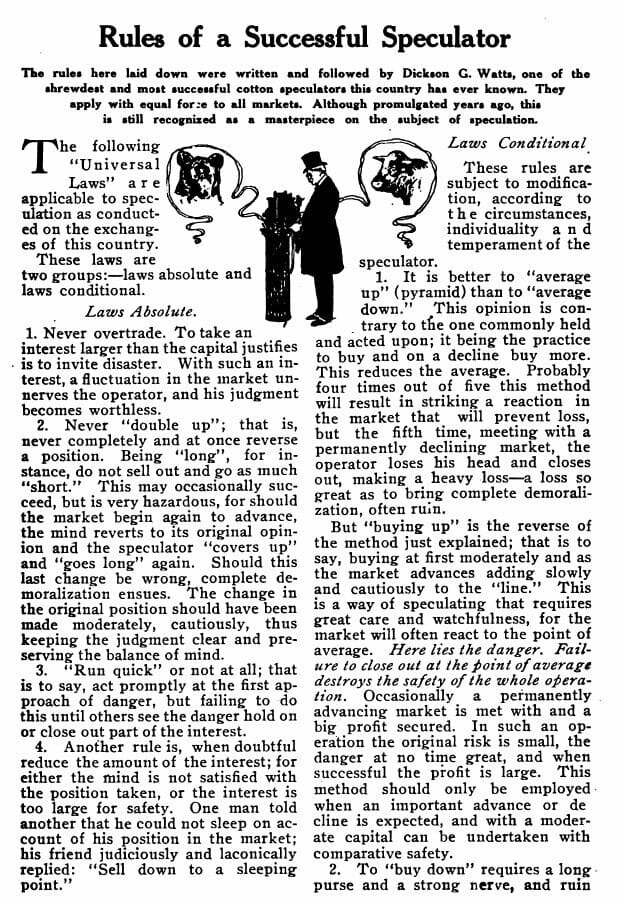
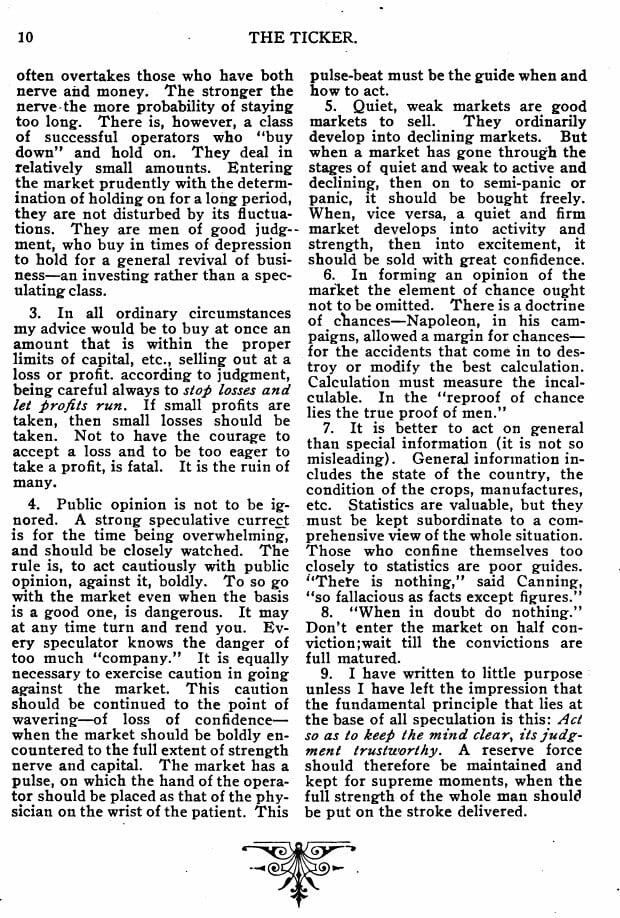
Speculation as a Fine Art: Dickson Watts

A great little read (PDF) from Dickson Watts.

Watts list of ‘Essential Qualities of the Speculator’ show the timeless value of his insight:

1. Self-Reliance. A man must think for himself, must follow his own convictions. George MacDonald says: “A man cannot have another man’s ideas any more than he can another man’s soul or another man’s body.” Self-trust is the foundation of successful effort.

2. Judgment. That equipoise, that nice adjustment of the faculties one to the other, which is called good judgment, is an essential to the speculator.

3. Courage. That is, confidence to act on the decisions of the mind. In speculation there is value in Mirabeau’s dictum: “Be bold, still be bold; always be bold.”

4. Prudence. The power of measuring the danger, together with a certain alertness and watchfulness, is very important. There should be a balance of these two, Prudence and Courage; Prudence in contemplation, Courage in execution. Lord Bacon says: “In meditation all dangers should be seen; in execution one, unless very formidable.” Connected with these qualities, properly an outgrowth of them, is a third, viz: promptness. The mind convinced, the act should follow. In the words of Macbeth; “Henceforth the very firstlings of my heart shall be the firstlings of my hand.” Think, act, promptly.

5. Pliability. The ability to change an opinion, the power of revision. “He who observes,” says Emerson, “and observes again, is always formidable.”

The qualifications named are necessary to the makeup of a speculator, but they must be in well-balanced combination. A deficiency or an overplus of one quality will destroy the effectiveness of all. The possession of such faculties, in a proper adjustment is, of course, uncommon. In speculation, as in life, few succeed, many fail.

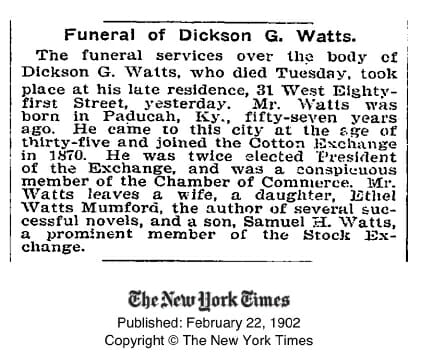
It’s hard to find much on Watts, but I added more here.

Speculation as a Fine Art: Dickson Watts
Dickson Watts Trading Laws
Speculation as a Fine Art: Dickson Watts

How can you move forward immediately to Trend Following profits? My books and my Flagship Course and Systems are trusted options by clients in 70+ countries.

Also jump in:

• Trend Following Podcast Guests
• Frequently Asked Questions
• Performance
• Research
• Markets to Trade
• Crisis Times
• Trading Technology
• About Us

Trend Following is for beginners, students and pros in all countries. This is not day trading 5-minute bars, prediction or analyzing fundamentals–it’s Trend Following.
The Winton Papers: Speculation, Wise

While I have not seen it, apparently Gordon Gekko opines in the new ‘Wall Street’ that:

“The Mother of all evil is speculation.”

Let’s hope Oliver Stone doesn’t actually believe that (if he does, fantastic moron). The counter? An excerpt from the publication ‘The Winton Papers’:

“Speculari, the Latin root of the verb to speculate has the literal meaning ‘to observe’, and a study of speculation will show that most successful speculators can be well described as ‘observers’. To be successful this observation must of necessity be detached and unemotive and thus where great social and moral issues are at stake, it is perhaps not surprising that this view point should arouse some distrust and hostility among the general population (particularly when the speculator profits at a time of general discontent). Yet this detached observation is clearly in the spirit of the natural scientist and the act of speculating for money is in the spirit of the empirical scientist’s restless yearning to add to empirical knowledge and put theories to the test. Thus making money from mathematical models [systematic trend following] is in one sense less about the corruption of intellectual endeavor than about the appropriate statistical test of the utility of such models for the development of scientific theory.”

Note: ‘The Winton Papers’ were published by Winton Capital.


How can you move forward immediately to Trend Following profits? My books and my Flagship Course and Systems are trusted options by clients in 70+ countries.

Also jump in:

• Trend Following Podcast Guests
• Frequently Asked Questions
• Performance
• Research
• Markets to Trade
• Crisis Times
• Trading Technology
• About Us

Trend Following is for beginners, students and pros in all countries. This is not day trading 5-minute bars, prediction or analyzing fundamentals–it’s Trend Following.
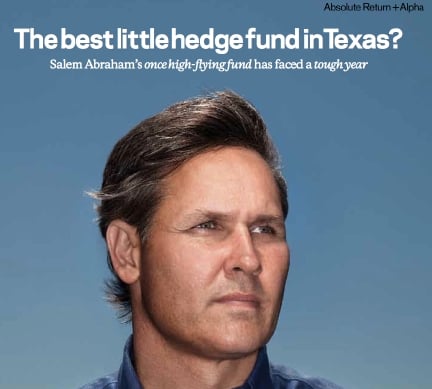
Salem Abraham: The Best Little Hedge Fund in Texas?

An article (PDF) about Salem Abraham and Abraham Trading Company (with a nice mention of my book ‘The Complete TurtleTrader‘).

salem abraham of abraham trading


How can you move forward immediately to Trend Following profits? My books and my Flagship Course and Systems are trusted options by clients in 70+ countries.

Also jump in:

• Trend Following Podcast Guests
• Frequently Asked Questions
• Performance
• Research
• Markets to Trade
• Crisis Times
• Trading Technology
• About Us

Trend Following is for beginners, students and pros in all countries. This is not day trading 5-minute bars, prediction or analyzing fundamentals–it’s Trend Following.
Could You Be on a Desert Island and Make Money Trading?

There are people (read: intellectual twits) who don’t understand the value in this article because the date is “2005”. They think, “It’s 2010, no good now!” The people who think like that are the same people who trust their money to the buy and hold insanity of Fidelity. Everyone gets what they want, right? Off my soapbox and onto a a great excerpt from that article:

“I [Harding] went to Sabre [first firm] because I didn’t want to sit in an investment bank and make money. I wanted to know if you could do it from outside the markets looking in. “Could you be on a desert island and make money trading?” was the question I was asking myself.” Partly this was Harding the scientist exerting an influence, as the efficient market hypothesis was a hot topic amongst academics that studied markets…”With the EMH under consideration I was very interested to know whether the very antithesis of that, technical analysis, had any truth in it. So I went to Sabre very much in the spirit of intellectual curiosity.” According to Harding the prevailing thinking at places like Wood Mackenzie was that there was no intellectual respect for technical analysis. There were a hundred analysts there, consisting of various types of serious people, and the technical analyst was isolated at the end of a row in an out-of-the-way part of the office. His craft was considered intellectually light-weight by his peers and the press. ” I remember being visited by the FT’s Barry Riley in 1988. Within a week there was a side-swipe in print along the lines of “that’s more than the whizzkids with computers can manage,” ” recalls a somewhat wearisome Harding. “But the thing is he and all the other serious investment professionals nodding sagely in agreement were wrong. No amount of looking knowledgeable and smug will make you right if you are wrong in the first place.” This attitude was something that Harding was to get used to over his career. “For eighteen of my 25 years in markets I have received intellectual scorn and derision from everyone – business school professors, senior investment professionals to experienced journalists. But thankfully now it’s different: the battle is won. The enemy is routed. All we are doing now is mopping up the stragglers.” David Harding spent two years at Sabre Fund Management, each day drawing hundreds of charts by hand, like a true craftsman. Every chart was bound into big leather folders, and in turn each chart pattern was copied into other folders. He likens it to an old-fashioned publishing house. Harding noted without irony that the company was run by accountants, and that “there certainly was method in what was done there.” He continues “I certainly regard my time there as the foundation stone of my credentials as an empiricist. There is nothing like drawing thousands of charts by hand to fix them in your mind. In fact I regard this phase of exhausting taxonomy of technical analysis as being like the relationship used to be between biology and taxonomy in the life sciences. Until something like 1830 you had gentlemen scientists collecting leaves and putting them into folders, and it wasn’t until Darwin that he and others started putting some order on it. Only by arranging data and putting it in order can you get any pattern out of it. What AHL and others have done is go beyond the taxonomy and turn trading into a real science.”

Continuing:

“Our sort of approach to markets is a science. It is an unpublished science, but it is a real one. You could get the thick leather bound volumes of papers on it if there was a willingness to “open the kimono”, as the horrible modern expression has it.” “The process of trading our system is like repeatedly drawing different coloured balls from the statisticians apocryphal bag. As we draw out a ball it becomes part of the track record, and we put it back in the bag, but there is no guarantee that the balls will come out in the same order in future.”


How can you move forward immediately to Trend Following profits? My books and my Flagship Course and Systems are trusted options by clients in 70+ countries.

Also jump in:

• Trend Following Podcast Guests
• Frequently Asked Questions
• Performance
• Research
• Markets to Trade
• Crisis Times
• Trading Technology
• About Us

Trend Following is for beginners, students and pros in all countries. This is not day trading 5-minute bars, prediction or analyzing fundamentals–it’s Trend Following.