My guest today is Darren Kottle, the Chief Investment Officer of Caddo Capital Management LLC, and sub-advisor to an alternative/hedged strategy at Catalyst Funds.
The topic is hedge fund.
In this episode of Trend Following Radio we discuss:
Kottle’s early experiences in the market, starting off in a discount stock brokerage
His experiences working with a Nobel laureate Kenneth Arrow at Stanford
The sources of trend following profit
George Soros’ concept of reflexivity
The importance and believing in your system to the core
Thoughts on investment banks
The pivot point for Kottle to fully embrace a trend following system
What the Turtle story did for him when he first heard it
Uncertainty vs. being wrong
The percentage of people that truly understand that “it’s all reflected in the price”
Listen to this episode:
Listen to this podcast on iTunes. (Please leave a rating!)
Your First Loss is Your Best Loss with Michael Covel on Trend Following Radio
Please enjoy my monologue Your First Loss Is Your Best Loss with Michael Covel on Trend Following Radio. This episode may also include great outside guests from my archive.
Listen to this episode:
Listen to this podcast on iTunes. (Please leave a rating!)
Persistence, Patton and Reincarnation with Michael Covel on Trend Following Radio
Please enjoy my monologue Persistence, Patton and Reincarnation with Michael Covel on Trend Following Radio. This episode may also include great outside guests from my archive.
Listen to this episode:
Listen to this podcast on iTunes. (Please leave a rating!)
Why Tactical Macro Investing Still Makes Sense — Further Revisiting Kat’s “Managed Futures and Hedge Funds: A Match Made in Heaven” (PDF):
In November 2002, Cass Business School Professor Harry M. Kat, Ph.D. began to circulate a Working Paper entitled Managed Futures and Hedge Funds: A Match Made in Heaven. The Journal of Investment Management subsequently published the paper in the First Quarter of 2004. In the paper, Kat noted that while adding hedge fund exposure to traditional portfolios of stocks and bonds increased returns and reduced volatility, it also produced an undesired side effect — increased tail risk (lower skew and higher kurtosis). He went on to analyze the effects of adding a macro investment approach known as “managed futures” to the traditional portfolios, and then of combining hedge funds and managed futures, and finally the effect of adding both hedge funds and managed futures to the traditional portfolios. He found that managed futures were better diversifiers than hedge funds; that they reduced the portfolio’s volatility to a greater degree and more quickly than did hedge funds, and without the undesirable side effects. He concluded that the most desirable results were obtained by combining both managed futures and hedge funds with the traditional portfolios. Kat’s original period of study was June 1994–May 2001. In this paper, we revisit and update Kat’s original work. Using similar data for the period Jan 2001–December 2015, we find that his observations generally hold true about 15 years later. During the subsequent 141⁄2 years, a highly volatile period that included separate stock market drawdowns of 36% and 56%, managed futures have continued to provide more effective and more valuable diversification for portfolios of stocks and bonds than have hedge funds.
Don’t Let Them Fuck You Around with Michael Covel on Trend Following Radio
Please enjoy my monologue Don’t Let Them F*** You Around with Michael Covel on Trend Following Radio. This episode may also include great outside guests from my archive.
Listen to this episode:
Listen to this podcast on iTunes. (Please leave a rating!)
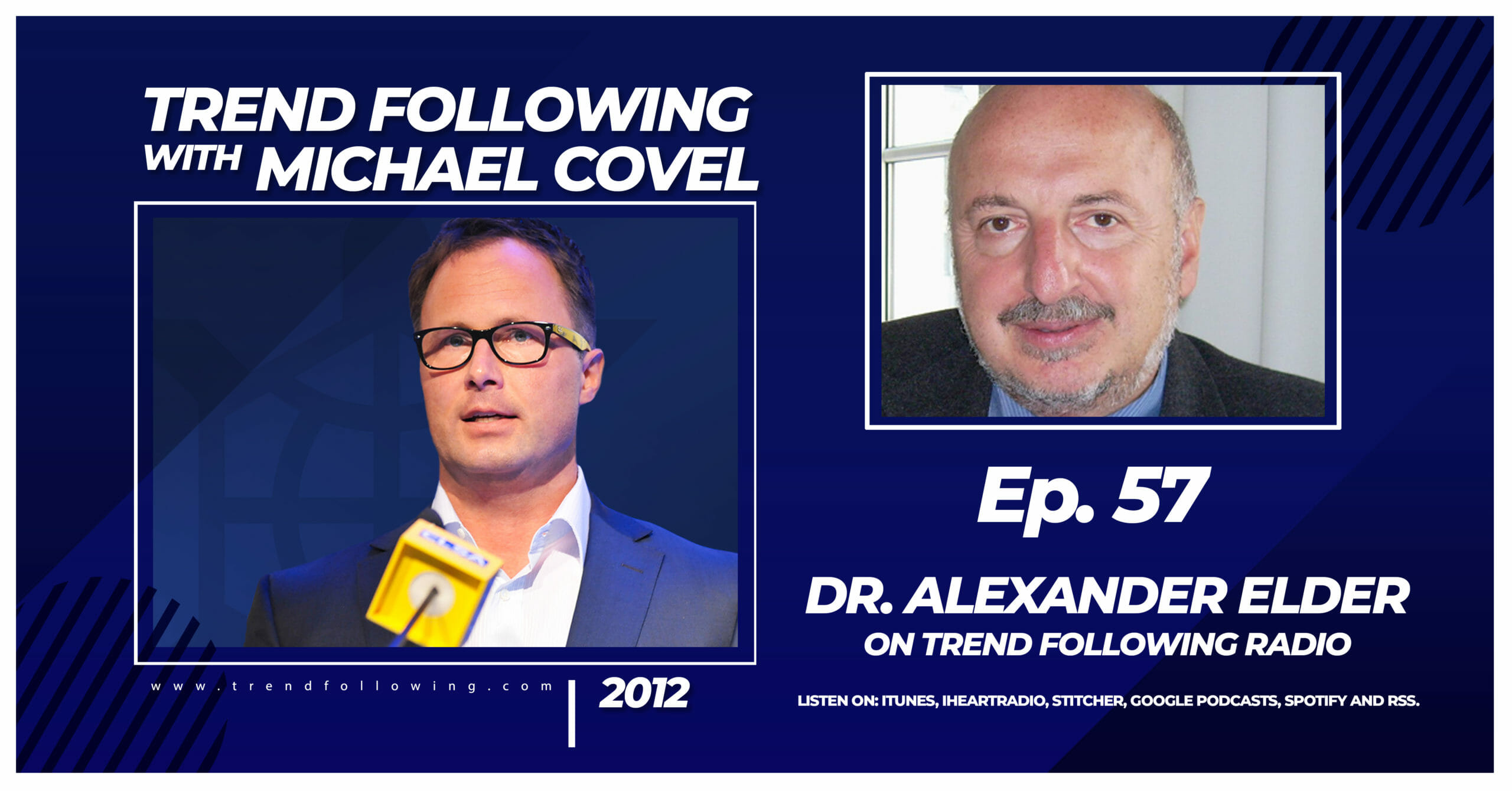
My guest today is Dr. Alexander Elder, a trader, educator and author. Dr. Elder’s unique and inspiring story starts with his dissatisfaction with the system in his home country of Estonia. At 23, while working as a ship’s doctor, he jumped a Soviet Union ship in Africa and received political asylum in the United States; he also ended up on the KGB’s wanted list. Dr. Elder worked as a psychiatrist in New York City and taught at Columbia University.
The topic is his book Trading for a Living: Psychology, Trading Tactics, Money Management.
In this episode of Trend Following Radio we discuss:
Experience as a psychiatrist provided him with a unique insight into trading
Psychology of trading
How a high degree of education can sometimes be a hindrance
The most dangerous personality traits to have as a trader
The stages of trader development
The importance of money management
The importance of keeping records and diaries of your trades
The notion of exiting long positions and shorting weakness
The similarities and differences between traders in different geographic locations
How financial markets can be like manic depressive patients
Listen to this episode:
Listen to this podcast on iTunes. (Please leave a rating!)