Abstract: The extraordinary growth of short volatility strategies creates risks that may trigger the next serious market crash. A low yield, low volatility environment has drawn various market participants into essentially similar short volatility-contingent strategies with a common non-linear risk factor. We discuss these strategies, their commonalities, and the generally unrecognized risks that they would pose if everyone unwinds simultaneously. Volatility selling investors essentially provide “shadow financial insurance.” Market participants and regulators would benefit from preparing for large, self-reinforcing technical unwinds that may occur when central banks change policy or when macro or political events affect investor confidence.
I have been trading commodity futures since 1996 on and off and credit you as the source of the vast majority of my market knowledge over the years. Thank you for all your work. (I can’t decide whether I love your books or the podcasts more.)
I have attached an article on the craziness of market predictions that appeared in “The Australian” newspaper only today [Wall Street got its 2017 market predictions wrong; Nov. 24, 2017], just in case you haven’t seen it. How can almost an entire industry be built on the idea that human beings can predict the future?
My guest today is Michael Gervais, a high performance psychologist. He works with top performers to train and implement skills necessary to pursuing and revealing one’s maximum potential. His clients include world record holders, Olympians, internationally acclaimed artists and musicians, MVPs from every major sport and Fortune 100 CEOs. He is also co-founder of Compete to Create. Part of Michael’s training is helping clients realize there are things we are in control of and things we are not in control of – therefore focus on what you can control. We can train our bodies, our craft and mind. Michael teaches clients through science based research that refining all three of these areas are essential to becoming successful.
The topic is psychology.
In this episode of Trend Following Radio we discuss:
Living in the present moment
Mindfulness
High performance training
Grit
“The natural state of our mind is like a drunk monkey.” – Michael Gervais
I didn’t realize I was trend following (since I haven’t finished your book I am not 100% sure yet, but it looks like it). I didn’t even realize trend following was a thing. It was quite a nice surprise, when by accident, I came across your book on the shelves. I have avoided all books and web pages (other than scanners) on investing and trading. My theory has been that the industry was a quagmire of bullshit (based on my background of Scientific communications and hence the need for proof and explanations). However, I had been stopping in at bookstores randomly, in the hopes that my theory was wrong. So far, with your book, there may be some hope.
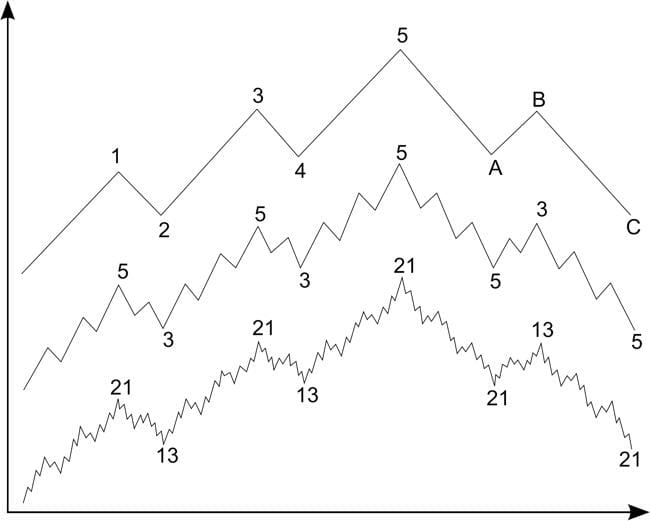
The Elliott Wave Principle posits that collective investor psychology, or crowd psychology, moves between optimism and pessimism in natural sequences. These mood swings create patterns evidenced in the price movements of markets at every degree of trend or time scale. In Elliott’s model, market prices alternate between an impulsive, or motive phase, and a corrective phase on all time scales of trend, as the illustration shows. Impulses are always subdivided into a set of 5 lower-degree waves, alternating again between motive and corrective character, so that waves 1, 3, and 5 are impulses, and waves 2 and 4 are smaller retraces of waves 1 and 3. Corrective waves subdivide into 3 smaller-degree waves starting with a five-wave counter-trend impulse, a retrace, and another impulse. In a bear market the dominant trend is downward, so the pattern is reversed—five waves down and three up. Motive waves always move with the trend, while corrective waves move against it. The patterns link to form five and three-wave structures which themselves underlie self-similar wave structures of increasing size or higher degree. Note the lowermost of the three idealized cycles. In the first small five-wave sequence, waves 1, 3 and 5 are motive, while waves 2 and 4 are corrective. This signals that the movement of the wave one degree higher is upward. It also signals the start of the first small three-wave corrective sequence. After the initial five waves up and three waves down, the sequence begins again and the self-similar fractal geometry begins to unfold according to the five and three-wave structure which it underlies one degree higher. The completed motive pattern includes 89 waves, followed by a completed corrective pattern of 55 waves. Each degree of a pattern in a financial market has a name. Practitioners use symbols for each wave to indicate both function and degree—numbers for motive waves, letters for corrective waves (shown in the highest of the three idealized series of wave structures or degrees). Degrees are relative; they are defined by form, not by absolute size or duration. Waves of the same degree may be of very different size and/or duration. The classification of a wave at any particular degree can vary, though practitioners generally agree on the standard order of degrees (approximate durations given):
-Grand supercycle: multi-century
-Supercycle: multi-decade (about 40–70 years)
-Cycle: one year to several years (or even several decades under an Elliott Extension)
-Primary: a few months to a couple of years
-Intermediate: weeks to months
-Minor: weeks
-Minute: days
-Minuette: hours
-Subminuette: minutes
Amazing.
Elliott Wave prose is almost as good as Scientology: Definitely No PhD Required.