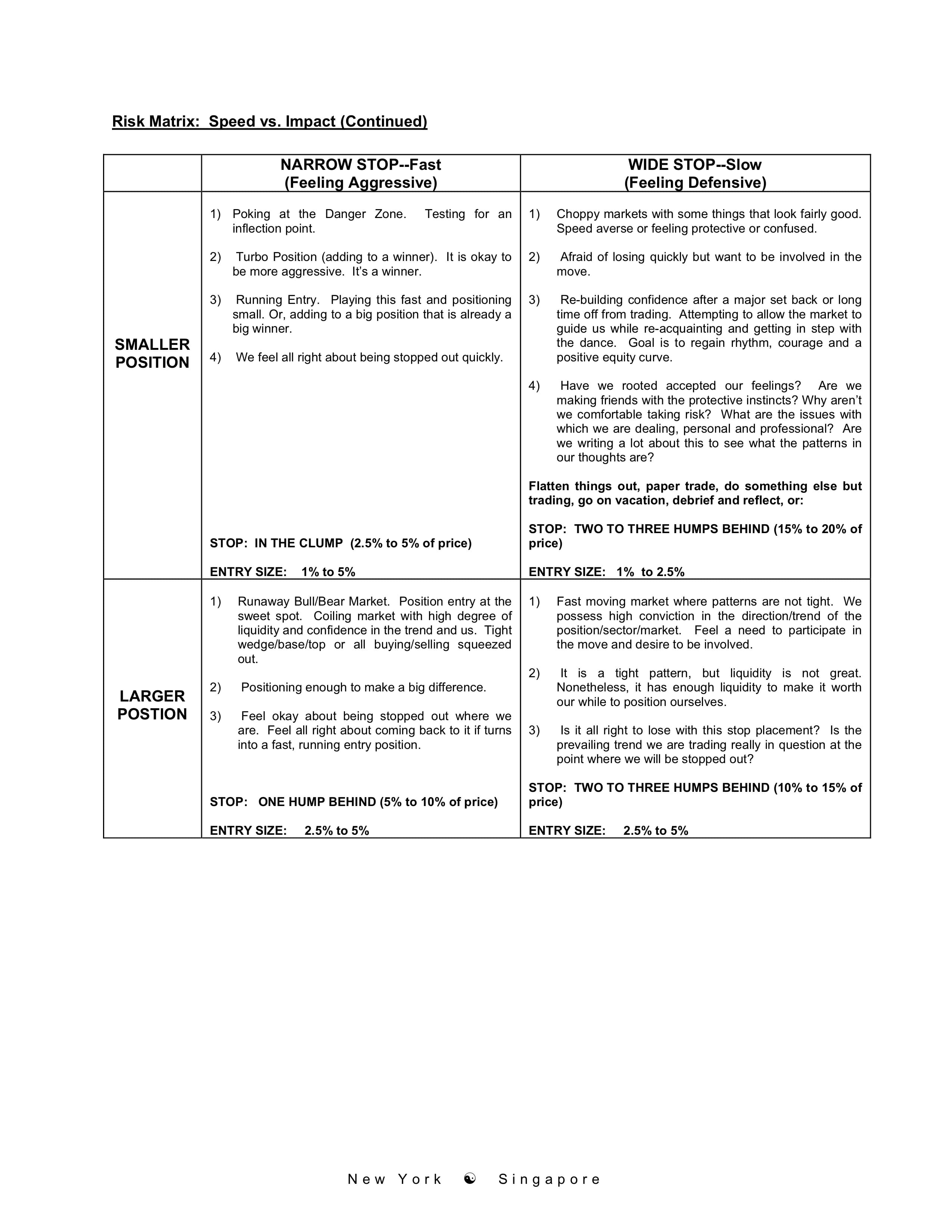
The Risk Matrix: Speed v. Impact (PDF).

More.


From the Washington Post today comes a story about the “bunt debate” in baseball:
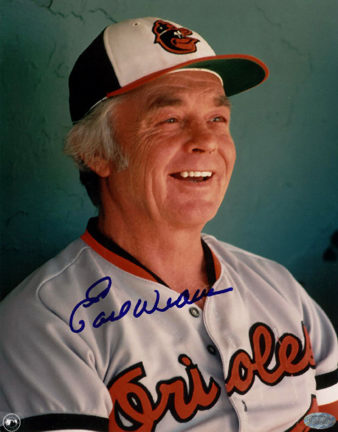
Earl Weaver
“As a future Hall of Fame outfielder in Baltimore, Robinson played for four seasons under Manager Earl Weaver (himself a Hall of Famer), who is widely considered the father of the anti-bunt movement. In his book, “Weaver On Strategy,” the legendary skipper lists his “laws” of managing, the fourth of which is, “Your most precious possessions on offense are your 27 outs.” Weaver’s Fifth Law is a corollary: “If you play for one run, that’s all you’ll get.” “I hated playing for one run,” Weaver said recently. “But I didn’t always take my own advice. I never bunted with Frank Robinson or Boog Powell or Eddie Murray at the plate, of course. But I did it with [Mark] Belanger and [Paul] Blair, two real good players. I think I bunted them too much.”
Isn’t that a great line? Play for one run and that’s all you will get. There it is in black and white the “secret” to baseball or trading success. I also used a great line about Earl Weaver in my book Trend Following:
“Earl Weaver designed his offenses to maximize the chance of a three-run homer. He didn’t bunt, and he had a special taste for guys who got on base and guys who hit home runs.”
Trend following is always about the home runs. Think there is more safety in hitting singles (or short-term trading’s small gains), think again.
Suggestions for trading from the old pro and founder of Commodities Corporation Amos Hostetter:
1. Experience must teach. Follow it invariably.
2. Observation gives the best tips of all. Observe market behavior and experience shows how to profit.
3. Buying on a rising market is the comfortable way. The point is not so much to buy as cheap as possible or go short at the top prices, but to buy as & sell at the right time.
4. Remember a market is never too high for you to begin buying or too low to begin selling. Let your tape reading show you when to begin. After the initial transaction don’t make a second unless the first shows a profit.
5. There is a great deal in starting right in every enterprise.
6. When something happens on which you did not count when your plans were made, it behooves you to utilize the opportunity.
7. In a bear a market it is always wise to cover if complete demoralization develops suddenly.
8. Stick to facts only and govern your actions accordingly.
9. What is abnormal is seldom a desirable factor in a traders calculations. If a market doesn’t act right, don’t touch it.
Commodities Corporation was the original trading mentor long before Richard Dennis and the Turtles. Commodities Corporation, as noted in my book, taught or funded many of the great market wizard trading pros.
More wisdom and thoughts from old Pro Traders, can be found here.
Always understand the risk/reward of the trade as it now stands, not as it existed when you put the position on. Some people say, “I was only playing with the market’s money.” That’s the most ridiculous thing I ever heard.
-Bill Lipschutz
Continue reading “Wisdom Found in the New Market Wizards Book”
Michael Mauboussin of Legg Mason authored an interesting perspective on the “lead steer”. Read PDF report.
I caught a brief story today about ‘exits’. The following excerpt is right from the trend following play book:
“It’s a common enough saying that people use in various situations in everyday life. But when you’re a stock investor, the phrase “cut your losses” takes on a special meaning. Investors are tempted to hang onto a stock that’s begun to tank. It’s easy to think, “Well, this stock can’t go any lower,” or “It’s a good company; the stock will come back.” But you don’t get ahead in the market by hoping and wishing and guessing. A better plan is to apply a strong set of rules that have worked. While your stock-buying rules are your offense, your sell rules are your defense. It’s inevitable that you’ll make mistakes or you’ll buy a stock at exactly the right point, but the breakout fizzles. You want a Plan B ready for those situations. Here’s what that Plan B looks like: Say you bought a stock at the proper entry point. But the breakout goes awry, and the stock moves lower. Keep an eye on it. If it falls 7% to 8% below your buy point, sell it.”
Investor’s Business Daily
Katharine Stalter
Can a great trader have great skill and no opportunity to make money? Can a bad trader have no skill and tons of opportunity to make money? The answer is yes to both questions. Luck is at play in the short-term for most traders. There will always be “some guy” with a great one year return. The sustained edge appears only over time.
What’s the point? What happens when the bad trader with no skill finally finds himself with no opportunity? Think about it.
Jon Sundt of Altegris is to be thanked for the root of this analogy. He made it at a recent symposium I attended.