
Subscribe now and watch my free trend following VIDEO.

Blog

When the Whole World Is Trending

Look at this list.

US 10-year yield: highest since 2007.
Japan 10-year: highest since 1996.
France 10-year: highest since 2008.
UK 10-year: highest since 2007.
Germany 10-year: highest since 2009.
South Korea 10-year: highest since 2011.
Australia 10-year: highest since 2011.
Netherlands 10-year: highest since 2011.
Portugal 10-year: highest since 2017.

Nine sovereign bond markets. Nine multi-decade highs. All at the same time.

The financial press will spend months explaining why. Deficits. Inflation. AI debt. Federal Reserve policy. The Bank of Japan finally abandoning thirty years of yield curve control. They will disagree with each other, produce thousands of words of analysis, and be confident about it all. Some of them will be right about some of it.

Here is what will help you as a trader. That list is a trend. Nine of them, actually. And they all pointed the same direction.

Bond prices move opposite to yields. When yields rise to multi-decade highs, bond prices fall, and in some cases to levels not seen in a generation. The US 30-year Treasury touched its highest yield since 2007. Japan’s 10-year government bond reached its highest yield since 1996, unwinding thirty years of near-zero rates. These are not routine moves. These are the kinds of moves that define a decade.

There was no shortage of people holding the opposing story. For fifteen years the consensus was that rates were going nowhere. Every time yields ticked up, someone explained why they would come back down. The story was convincing, told by serious people with serious credentials. It was wrong, and it cost the people who believed it.

The trend follower was not trading the story. He was watching price. When yields broke higher and held, he followed. Not because he forecast what the Bank of Japan would do, but because price was moving and he followed it. The explanation arrived later, in the newspapers. The position was already on.

Now look at that list again with a different question. Not why is this happening, but what does it mean for every other market?

Rising yields are not isolated. They are the price of money becoming more expensive everywhere, simultaneously. Equities re-rate. Currencies shift. Companies that borrowed cheaply for years face refinancing at rates they never modeled. Governments that issued debt at near-zero yields now carry interest payments that in many G7 countries exceed defense spending. The ripple from nine sovereign bond markets all moving in the same direction does not stay in the bond market.

This is what a global macro trend looks like. It does not announce itself at a conference. It does not wait for consensus. It shows up in price, across markets, and it rewards the trader who follows where price leads.

You do not need to know why. You need to know which direction, and whether you are on the right side of it. Nine sovereign bond markets trending together is one of the clearest directional signals a systematic trader can ask for. The profit comes from being positioned before the explanation arrives.

Read the market. When it trends, follow it. When nine of them trend together, pay close attention.

P.S. This is exactly what I track in the Bull, Bear & Black Swan Report: major trends across stocks, bonds, currencies, and commodities, without trying to predict what comes next. If you’d like a purchase link for the Report, just email us at [email protected]. If you want the full methodology behind that approach, I teach it in ​Trend Following Mastery​.

Sources: Multi-decade yield highs per country as reported across financial media. US 30-year Treasury, German 10-year Bund, and Japan 10-year JGB levels as of August 2026 per FRED, Bundesbank, and Japan Ministry of Finance. G7 debt and interest payment figures per IMF and Reuters.


How can you move forward immediately to Trend Following profits? My books and my Flagship Course and Systems are trusted options by clients in 76+ countries.

Also jump in:

• Trend Following Radio Guests
• Frequently Asked Questions
• Performance
• Research
• Markets to Trade
• Crisis Times
• Trading Technology
• About Us

Trend Following is for beginners, students and pros in all countries. This is not day trading 5-minute bars, prediction or analyzing fundamentals–it’s Trend Following.

Nike’s stock has dropped exactly 80.00% from its all-time high.

The stock reached its all-time closing high of $177.51 on November 5, 2021, but market struggles have driven the price down to a 12-year low of $35.51. This multi-year retreat has erased a decade of market gains and led to the company’s impending removal from the prestigious S&P 100 index.

Why?

Nike went woke.

The primary marketing campaigns, product decisions, and financial commitments reflecting this shift since 2018 include:

High-Profile Marketing Campaigns:

Colin Kaepernick Partnership (2018): Nike launched its “Dream Crazy” campaign featuring the former NFL quarterback, known for kneeling during the national anthem to protest racial injustice. The campaign tagline read: “Believe in something, even if it means sacrificing everything.”

Pride Month & Transgender Visibility (2018): The brand released commercials celebrating transgender ballroom dancer Leiomy Maldonado as part of its Pride Month initiatives.

“Dream Crazier” Campaign (2019): Narrated by Serena Williams, this Super Bowl commercial directly challenged traditional gender stereotypes and male-dominated culture in professional sports.

Dylan Mulvaney Promotion (2023): Nike partnered with transgender influencer Dylan Mulvaney for a paid Instagram campaign to promote women’s sports bras and leggings, drawing intense scrutiny from conservative commentators.

Product and Financial Moves:

Betsy Ross Flag Sneaker Cancellation (2019): Nike pulled a planned Air Max 1 USA sneaker featuring the early American flag after Colin Kaepernick raised concerns about its historical associations.

Black Community Financial Commitment (2020): Following widespread racial justice protests, Nike launched a “Don’t Do It” video campaign and committed $40 million over four years to support organizations serving Black communities in the U.S.

Youth Sports Funding: Nike funded research and community programs centered around supporting transgender and non-binary youth athletes.

Conclusion: go woke, go broke.

Now here is where it gets interesting.

I couldn’t have predicted Nike would drop because of being woke. It could have gone up or down.

The bottom-line conclusion? Feel free to dislike woke as much as I do, but don’t let your personal analysis govern your trading decisions.

Use trend following instead.

P.S. Building the discipline to evaluate your execution and not just your results is one of the hardest things in trading. The Trend Following Mastery course is built on that foundation, and the Bull, Bear & Black Swan Report reinforces that thinking every month. If you’d like a purchase link for the Report, just email us at [email protected].


How can you move forward immediately to Trend Following profits? My books and my Flagship Course and Systems are trusted options by clients in 76+ countries.

Also jump in:

• Trend Following Radio Guests
• Frequently Asked Questions
• Performance
• Research
• Markets to Trade
• Crisis Times
• Trading Technology
• About Us

Trend Following is for beginners, students and pros in all countries. This is not day trading 5-minute bars, prediction or analyzing fundamentals–it’s Trend Following.
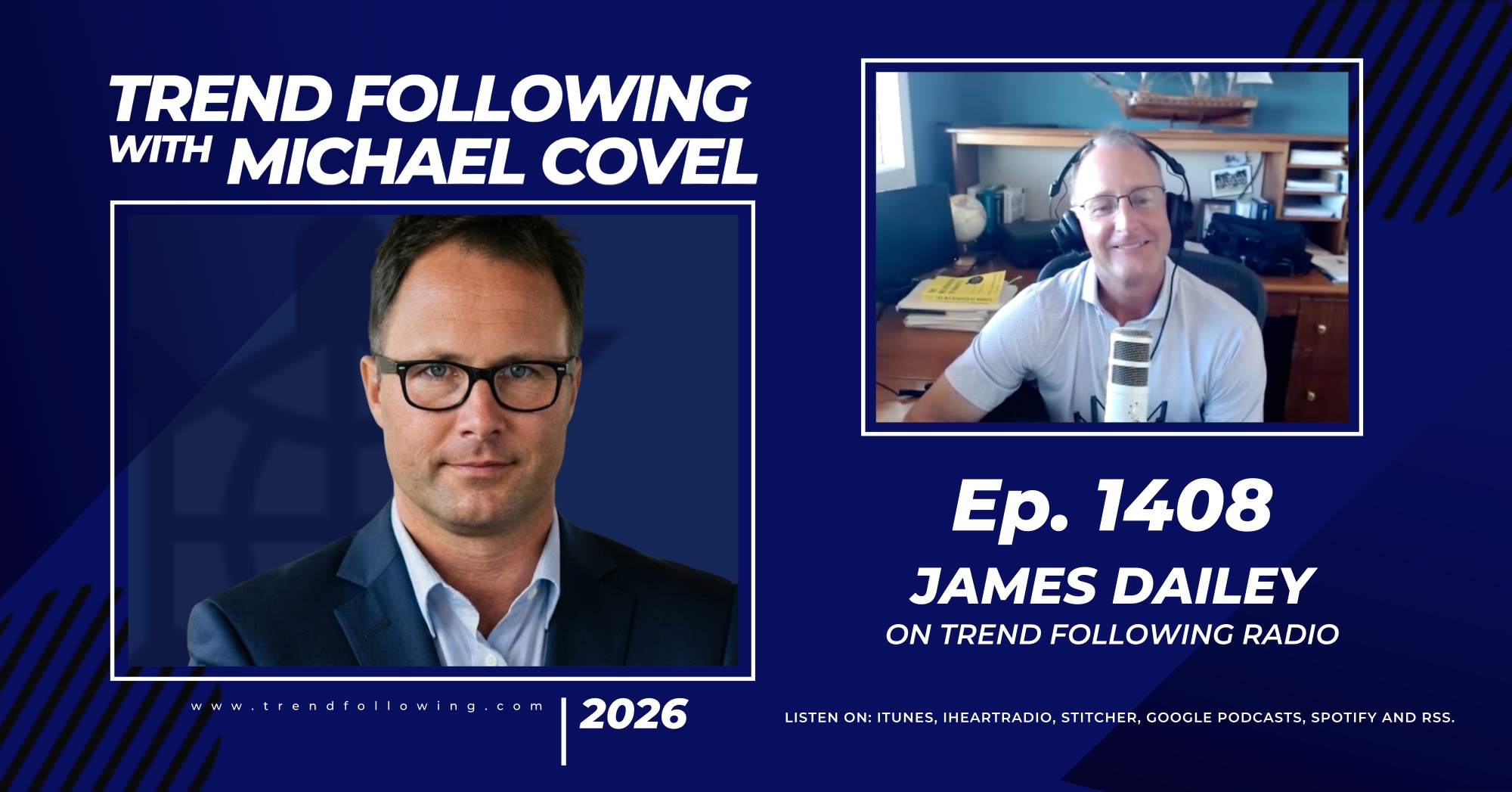
Ep. 1408: James Dailey Interview with Michael Covel on Trend Following Radio

James Dailey
James Dailey

Subscribe to Trend Following Radio on iTunes

My guest today is James Dailey. He is Chief Executive Officer of DUNN and has responsibilities in the areas of strategic planning, business and product development, client relations and financial reporting.

The topic is Dunn Capital’s white paper High Vol Trend Following: Most Valuable Alternative Investment. 

In this episode of Trend Following Radio we discuss:

  • Trend following as a true alternative investment
  • Portfolio diversification and non-correlated returns
  • Crisis alpha and equity market dislocations
  • High-volatility trend following and positive skew
  • AI, clean data, and systematic investment research

Mentions & Resources:

Listen to this episode:

Jump in!

“I’ve been a trend follower investor for more than twenty-five years…”

Feedback in:

Good morning Michael,

Thanks for your willingness to actually read my response. You are one of my teachers and partly responsible for my success as an investor. Many years ago, I read “Trend Following,” which was recommended to me by Ed Seykota. Much later I bought Trend Commandments.

The hold back from greatness now is the fear of a partial “Blowup” at my age. World affairs seem so chaotic that I fear waking up to the first trades of the day showing the Dow off 20% and the Nasdaq even worse. I sidestepped all the big ones, Oct. 1987, 2000-2003 Dot Bomb, 2020 Covid decline and the 2007 financial crisis.

Reducing or exiting equities completely was more of a reaction to losing my own money than pure trend following. My growth efforts now are a combination of William O’Neil’s CANSLIM and your trend following principles. Trend Commandments reestablishes confidence in the superiority of trend following. I tried using Optimal F, but didn’t stay long. It felt like I was plunging more than investing. But, I loved the math.

I’ve read and studied dozens of books from, “Where Are The Customer’s Yachts”, “Extraordinary Popular Delusions and the Madness of Crowds”, to your two informative books. As well as many other investment books on Risk, Black Swans, etc. When I met Ed, he breathed life into the concept of trend following. Prior to Ed, I’d heard of trend following, but thought it sounded too simple and poo-pooed the idea. I didn’t really know what trend following meant at that time.

I live in [location]. I met Ed at [location]. When Ed introduced himself, I said, “You’ve got to be kidding, I just finished reading a book about you last night.” That was the start of our friendship. At that time, our interest was about how aircraft actually manage to fly. We did all sorts of experiments to show that the Bernoulli Principle was nowhere to be found on an airplane wing. That’s another story for another time, but only if you ask. Ed was reluctant to share all of his methods out of fear that I would not fully understand and might misinterpret his words and make costly mistakes. When I would ask him something directly, he would offer his experience.

Back to your question about what’s holding me back:

I’m currently rereading your book, “Trend Commandments” for the 3rd time. I needed the refresher because recently, I wandered off into an investment style that I’m not very good at – “dividend investing”. Because of age and other considerations, I moved about half my portfolios out of trend following (growth) to dividend investing. So far, so good. As money flows out of tech, it goes into the world-dominator – dividend stocks for safety. But, I’m not comfortable or able to sit on my hands while one or more of my dividend stocks starts to crater. I never get the long-term benefit ala Buffett.

Rereading Trend Commandments brought renewed confidence in trend following that I lived by for the past few decades.
Because of my age and the age of my friends and family whose accounts I manage, I rarely have more than 40% to 50% invested in equities. And still, I’m able to nearly match and often exceed the returns of the S&P500. Less risk, same result as a passive index ETF. Plus, it’s fun.

So, in a nutshell, I’ve been a trend follower investor for more than 25 years but have never achieved the kind of success that you wizards have. My background is that I was born & raised in a relatively sub-middle income home, joined the USAF in 1964 and retired after 22 years – so no real investment or business experience. I received a scholarship from the Air Force and graduated with an Electrical Engineering degree from the University of [location]. A few years later, a Masters in Business and that’s when I realized there was this stuff called money that seemed more profitable than electronics.

Thank you very much for your clear, hard hitting message in Trend Commandments. I’ll reread your Trend Following book soon. I tried to use the Turtle Traders techniques that I found online, but didn’t find it compatible with my personality. Probably due to the big drawdowns.

Comments welcomed,

Best Regards,
[name]

Thanks a million for the thoughtful feedback!


How can you move forward immediately to Trend Following profits? My books and my Flagship Course and Systems are trusted options by clients in 70+ countries.

Also jump in:

• Trend Following Podcast Guests
• Frequently Asked Questions
• Performance
• Research
• Markets to Trade
• Crisis Times
• Trading Technology
• About Us

Trend Following is for beginners, students and pros in all countries. This is not day trading 5-minute bars, prediction or analyzing fundamentals–it’s Trend Following.

AI Hits Pause. Here’s the Only Chart That Matters.

Something is shifting in AI-land.

In the last few weeks, a handful of AI lab leaders have started talking openly about slowing down, pausing frontier releases, or at least dialing back the hype they spent the last three years building. Some closely watched IPOs have been quietly pushed to “next year.” And the same people who told us AI would remake the global economy are now the ones telling us to be careful.

Two stories are floating around to explain it.

Story one: take it at face value. Some of the smartest, best-funded people on the planet are genuinely worried about what they’ve built, and they’re trying to get ahead of it.

Story two: it’s cover. Pausing, delaying, and warning is exactly what precedes a bubble deflating — a way to manage the narrative before “we sold you a story” becomes the headline.

Here’s the trend-following answer to that debate: it doesn’t matter which one is true.

Not because it isn’t interesting — it is. But because you will never get a phone call telling you which story wins before the market moves. You’ll get a chart. That’s the whole discipline in one sentence: see the price, follow the price, trade the price. Not the earnings call, not the op-ed, not the postponed IPO. The price.

Lab leaders hedging in public. IPOs slipping. A noticeably more cautious tone from people who were maximally bullish a year ago — any one of those is a headline. None of them is a trade. A trade shows up when price confirms something: a market that’s been trending starts printing lower highs, or a name that looked unstoppable finally breaks its own trendline. Until then, it’s just noise dressed up as insight.

That is exactly why trend followers have survived every bubble and panic for decades without ever needing to diagnose the story correctly in real time. 1999–2000 didn’t require knowing whether the internet was a real revolution or a mania. 2008 didn’t require understanding a CDO. It required a system that got you out when the trend broke and back in when a new one started — regardless of which narrative turned out to be true.

So hold the “AI pause” story loosely. It might be real caution. It might be a soft landing ahead of a correction. It might be nothing at all. Whatever it is, it will show up in price before it shows up in a headline you can trust. Watch the trend, not the narrative.

P.S. Building the discipline to evaluate your execution and not just your results is one of the hardest things in trading. The Trend Following Mastery course is built on that foundation, and the Bull, Bear & Black Swan Report reinforces that thinking every month. If you’d like a purchase link for the Report, just email us at [email protected].


How can you move forward immediately to Trend Following profits? My books and my Flagship Course and Systems are trusted options by clients in 76+ countries.

Also jump in:

• Trend Following Radio Guests
• Frequently Asked Questions
• Performance
• Research
• Markets to Trade
• Crisis Times
• Trading Technology
• About Us

Trend Following is for beginners, students and pros in all countries. This is not day trading 5-minute bars, prediction or analyzing fundamentals–it’s Trend Following.

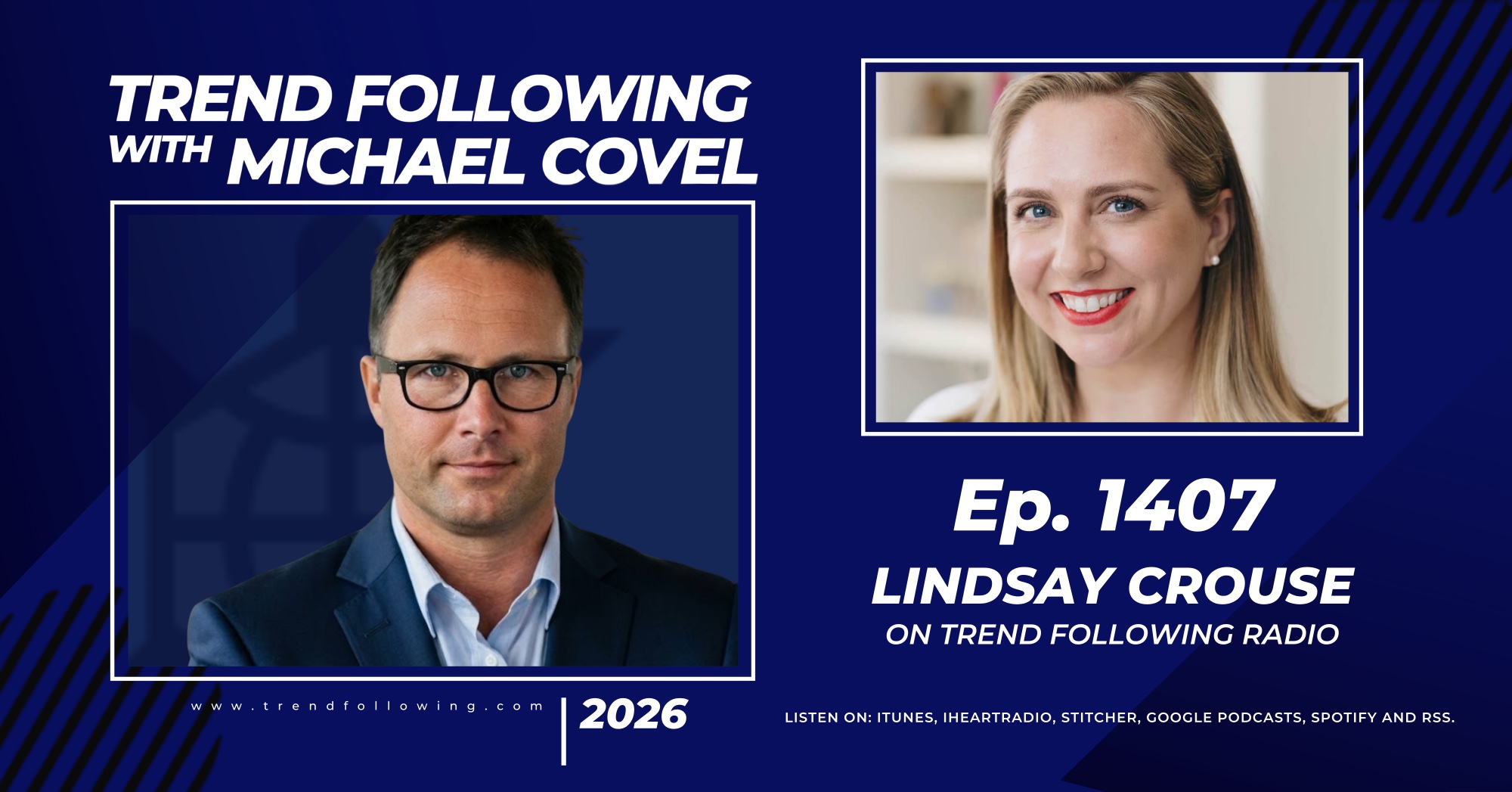
Ep. 1407: Lindsay Crouse Interview with Michael Covel on Trend Following Radio

Lindsay Crouse
Lindsay Crouse

Subscribe to Trend Following Radio on iTunes

My guest today is Lindsay Crouse. Lindsay is a writer, journalist, and former New York Times editor whose work explores ambition, endurance, sports, and knowing when to walk away.

The topic is her book The Case for Quitting: The Surprising Benefits of Opting Out.

In this episode of Trend Following Radio we discuss:

  • Quitting as a strategic decision rather than failure
  • Perseverance, rest, burnout, and knowing when to stop
  • Sunk costs, opportunity costs, risk, and taking losses
  • Relationships, commitment, and the choice to stay or leave
  • Career transitions, legacy, and personal reinvention

Mentions & Resources:

Listen to this episode:

Jump in!