Subscribe now and watch my free trend following VIDEO.

Efficient Market Bullshit

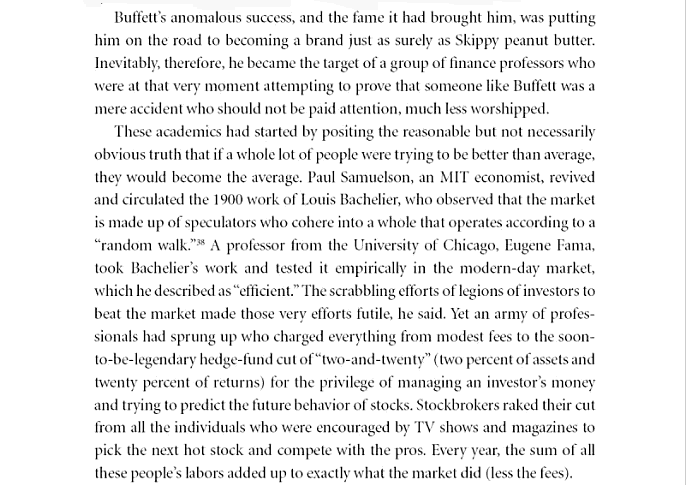
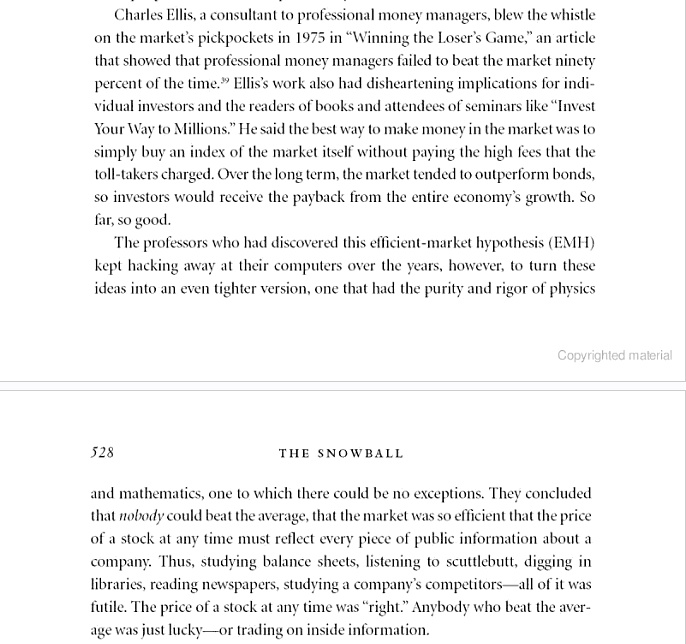
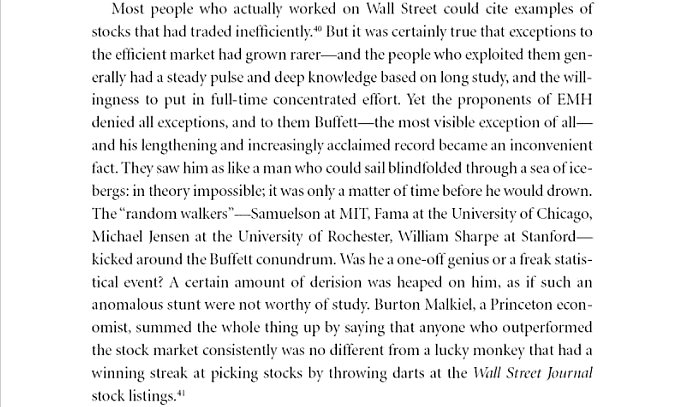
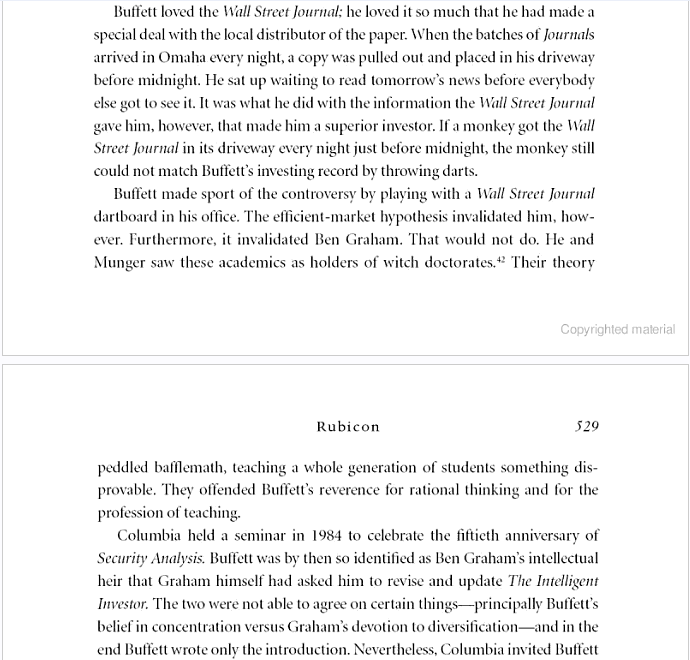
I love it when people tell me the trend following ‘winners’ are the lucky survivors. In my humble opinion people who think like that are either ignorant in the short-term willing to learn/be corrected or, and I say this bluntly, losers in life unable to accept reality. If trend following winners are the lucky monkeys hitting the keyboards, than the king of the monkeys must be Warren Buffett. Buffett himself makes the case for why this is bullshit (there is no other word) in an excerpt from Snowball:

Part 1
Part 2
Part 3
Part 4
Part 5
Part 6

Book excerpt idea courtesy of BreakoutStocks.

Paul Tudor Jones Commencement: You Will Fail

Nice read (PDF):

FAILURE. Failure that is so mortifying and so devastating that it makes you try to become invisible. It makes you want to hide your face, your soul, your being from everyone else because of the shame. Trust me, boys—if you haven’t already tasted that, you will. I am sure most of you here already have. AND IT IS HARD. I know this firsthand, but I also know that failure was a key element to my life’s journey.

More.


How can you move forward immediately to Trend Following profits? My books and my Flagship Course and Systems are trusted options by clients in 70+ countries.

Also jump in:

Trend Following Podcast Guests
Frequently Asked Questions
Performance
Research
Markets to Trade
Crisis Times
Trading Technology
About Us

Trend Following is for beginners, students and pros in all countries. This is not day trading 5-minute bars, prediction or analyzing fundamentals–it’s Trend Following.

Ed Seykota Words of Wisdom

Here is a recent Ed Seykota thought from his blog that is always ignored by the politicians:

Part of the effective way to fix things is to stop trying to fix things…

Simple wisdom ignored by every politician with a pulse. Why do they ignore it? Because, and let’s be perfectly frank here among friends, most people who vote for politicians actually think they can control the economy, change the business cycle or stop market crashes. The day is coming, and probably sooner than later, when President Obama will be responsible for the economy, fairly or unfairly. And when he does own it, and if it doesn’t improve, his current loyal army will be clamoring for someone else to fix things. That might be the only prediction worth betting on.

Richard Dennis: Prince of the Pit

The father of the Turtles Richard Dennis was very wise even back in the day. From an article circa 1976 wholly relevant to today.


How can you move forward immediately to Trend Following profits? My books and my Flagship Course and Systems are trusted options by clients in 70+ countries.

Also jump in:

Trend Following Podcast Guests
Frequently Asked Questions
Performance
Research
Markets to Trade
Crisis Times
Trading Technology
About Us

Trend Following is for beginners, students and pros in all countries. This is not day trading 5-minute bars, prediction or analyzing fundamentals–it’s Trend Following.

Nobel Laureate Daniel Kahneman Explains Intuition

A reminder that never goes out of style:

The lone word “VOMIT” appeared on the screen as Nobel Prize-winning psychologist Daniel Kahneman described how audience members would involuntarily react to the stimulus, including raised hairs on the back of the neck, increased sweat gland activity, and heightened sensitivity to other unsettling words.

Kahneman, who is a professor emeritus at Princeton’s Woodrow Wilson School of Public and International Affairs, specializes in the psychological underpinnings of economic decision-making.

The exercise in priming was part of Kahneman’s talk on judgment and intuition yesterday in Yenching Auditorium.

Despite being a psychologist—and never having studied economics—Kahneman received the 2002 Nobel Prize in Economics for his work’s impact on the field. Tuesday’s presentation was the first of three talks to be given by Kahneman this week as part of the Mind/Brain/Behavior Interfaculty Initiative’s 2008 Distinguished Lecture Series.

Kahneman opened the evening by presenting a series of examples of persistent flaws in intuition. In his “Linda” scenario, for example, Kahneman revealed the tendency for people to misjudge probabilities.

Respondents frequently estimate that the likelihood of a woman named Linda being both a bank teller and active in the feminist movement was greater than the probability of her just being a bankteller, simply because of the way Linda is described. But base-rate probabilities make it impossible for this to be true.

In a later slide, Kahneman displayed two identical multiplication problems on the screen in reverse order and showed that a person’s estimate of the answer depends on whether the numbers are arranged in ascending or descending order, with higher estimates predicted when larger numbers come first.

Kahneman explained that much of the success of his work has come from its narrow focus. “We did not try to make a general model of what we found because much of its meaning would have been lost,” he said.

Although the work may be narrow in its focus, it has proved widely applicable, he said, especially in the fields of social psychology and economics.

“We did not anticipate a response to our work and certainly did not expect to be talking about it 35 years later,” Kahneman said, in reference to his work on rapid judgments based on available and salient information, which he began in 1969.

Economics professor David I. Laibson ’88 provided post-lecture commentary, describing the major impact of Kahneman and other psychologists on the field of economics. To prove his point, Laibson presented a 2006 issue of The Economist with a cover story on “Happiness” and a 10-page report about the brain.

“We’re losing on every dimension,” Laibson joked, referring to psychology’s gaining influence on economics. In a more serious tone, Laibson described Kahneman as unique even among other Nobel Laureates in the field of economics.

Instead of exporting ideas from economics to other fields like many of his fellow laureates, he exported ideas into economics, Laibson said.

Psychological concepts that Kahneman has applied to economics include prospect theory, heuristics and biases, hedonics, and the two-system theory of intuition and reasoning.

After the presentation, Laibson described Kahneman as “among the handful of most influential economic contributors in the 20th century.”

For the two remaining lectures, Kahneman will speak on decision-making and rationality this evening and on evolving notions of well-being tomorrow.

More on Daniel Kahneman.


How can you move forward immediately to Trend Following profits? My books and my Flagship Course and Systems are trusted options by clients in 70+ countries.

Also jump in:

Trend Following Podcast Guests
Frequently Asked Questions
Performance
Research
Markets to Trade
Crisis Times
Trading Technology
About Us

Trend Following is for beginners, students and pros in all countries. This is not day trading 5-minute bars, prediction or analyzing fundamentals–it’s Trend Following.

“So You Think that Money is the Root of All Evil?”

The other day I was forwarded a rant that included this excerpt:

“I drove a Porsche 911 Cabriolet, flew a Beechcraft Baron 58P, lived in a house on the lake in Tahoe that recently was listed for $10 million, had two boats on the lake and a 50 foot yacht in the Caribbean when I was 23 years old. Money, my friends, means nothing.”

I could not disagree more with that last desperate sentence. A speech (read) that backs my contention more eloquently than I could ever state myself. The best excerpt from that speech?

“Let me give you a tip on a clue to men’s characters: the man who damns money has obtained it dishonorably; the man who respects it has earned it. “Run for your life from any man who tells you that money is evil. That sentence is the leper’s bell of an approaching looter. So long as men live together on earth and need means to deal with one another–their only substitute, if they abandon money, is the muzzle of a gun.