

For those who still want to argue that the success of Richard Dennis and the success of some Turtles was “nature” over “nurture” you may want to take a read of “Talent Is Overrated: What Really Separates World-Class Performers from Everybody Else.” The book’s conclusion is the exact same conclusion I wrote about in my last chapter of “The Complete TurtleTrader”: the dividing line for greatness is deliberate practice, not talent. The Turtles were absolutely an example of nurture trumping nature. And for the ones who have endured their long term success is all about their hard work.
Category: Trend Following
Why Do Some Run from Trend Following?
Below is feedback in today from a reader about the continued debate of what to call “trend following”. The regulators and exchanges use terms like managed futures and commodity trading advisers (CTAs), but these describe an instrument not the strategy (David Harding makes the point here too). On to the feedback:
Hi Michael, I recall somewhere where you initiated a discussion in an attempt to find a better name for managed futures. You may have seen this discussion on managed futures – from the perspective of a former public pension fund director – (ex-Virginia retirement system investment head) who has been involved in the alternative investment industry for nearly twenty years. One of the very best overviews on managed futures that I have seen (Worth a view despite its length).
https://admin.na3.acrobat.com/_a777821181/p89835260
At around the 53 minute mark he touches upon the need for a better descriptor for the industry and he suggests Global Micro and Long short futures and FX. He argues that global macro is similar and well known but trades are more discretionary and more thematic around certain markets. Managed futures tend to incorporate the same markets but are more systematic and more diversified and tend not to take the large macro bets, instead smaller bets across a number of markets. Also long short equity is the largest and well known hedge fund strategy, more often than not CTA’s are long and short across many market. Not perfect descriptors by any means, but I thought they were better than others that I have heard.
Oh gosh, those names are terrible! Ug. Just as bad. They should call it trend following since the vast majority of CTAs are trend followers. Why do they all run from ‘trend following’? Commodity is a misnomer. Futures is a misnomer. Those things describe an instrument! Why do they not call it by the strategy? My associate writes back:
So mean reversion, econometric, spread, pattern recognition, etc., those programs would fall under ‘trend following’? That wouldn’t make sense. Most are trend based, but [you] can’t describe an entire industry [that way].
I disagree that managed futures exists beyond trend following. The ‘other’ strategies are tiny by comparison. Why should the average person be burdened with mean reversion, econometric, spread, and pattern recognition strategies when the strategy with all the assets and success is trend following? To me that makes no sense! Bottom line, much of this insistence to have a title with the word ‘future’ in it must lay at the feet of the CME. I get it. I know that ‘futures’ and ‘commodities’ are their core business, but for people in 2009 to continue to believe the strategy of trend following only exists in the ‘commodities’ world is asinine. And trust me, very smart people continue to say things like, “Don’t trend followers just trade commodities?” Every time I hear that I cringe.
Success with Trend Following
From a reader today:
I have made $15 million investing in CTAs [regulatory term for trend followers] over the last 20 years, starting with Bill Dunn. I have read many books on Technical Trend Following and bought Trade Station and played with it. I read the three ‘Market Wizards’ interview books, and ‘Managed Trading, Myths…’ Having said all that, I am looking forward to learning from the interesting chapters in your book.
Thanks!
Michael Covel and Trend Following in Opalesque


An Odd Review
A recent 4 star review of my new edition of “Trend Following” that appeared at Amazon:
The Trend is Your Friend so says this author. But wait, a lot of smart people say trend following doesn’t work. Look, if this were easy we’d all be rich. When I picked this up the first thing I saw was a quote by Eric Hoffer ! Who ? He wrote The True Believer and other philosophical books. If you trade these markets I guess you better be philosophical. Anyway this is mostly about trend following in commodity and currency markets but most people trade stocks. In Appendix A I found “Trend Following For Stocks”. A test was run buying stocks that made an all time high using a loose stop loss method over several years that worked. Of course we know that running back tests really might not mean a whole lot when it comes to the future. Predicting that future is tough. Folks like Victor Niederhoffer (The Education of a Speculator and others) believe that things that worked in the past often don’t work in the future because of changing cycles. I learned that at the race track. Here’s the beef, when the cover states “Learn How To Make Millions In Up or Down Markets” a lot of credibility is lost. It makes a serious book sound like another get rich quick scheme.
My response? I am confused. You say: “…a lot of smart people say trend following doesn’t work…” Who exactly says this? Victor Niederhoffer? Did you read the section in the book about Niederhoffer? Did you see the performance data for trend followers in the book? Thanks for the taking time to read the book, I sincerely appreciate the time, but don’t be surprised when this author (me) calls out incorrect information. The biggest thing I have learned about the subject of trend following over the last decade is that so many people simply either can’t or won’t wrap their arms around it. I can understand that. For 25 years Wall Street has plowed millions upon millions of investors into buy and hold/mutual fund nonsense, and when that bubble burst, fear, confusion and debate are not surprising.
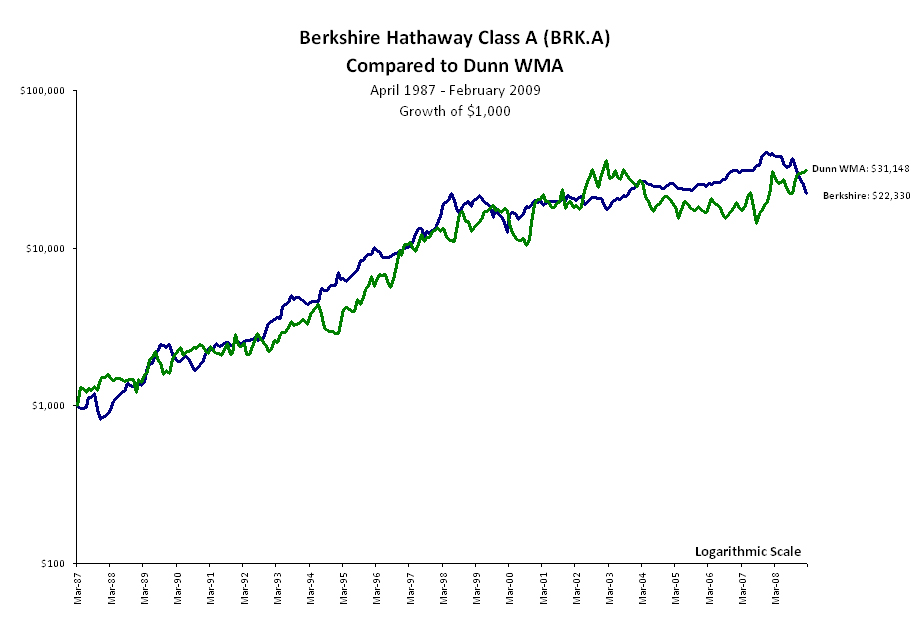
Warren Buffett v. Bill Dunn
This chart is an interesting comparison of trend following trader Bill Dunn v. legendary trader Warren Buffett.
Lucky Survivors!
A critic has been on here recently with the argument, and I paraphrase, “trend followers are lucky survivors who were flipping coins with terrible Sharpe ratios who will soon blowup.”
His last post:
I’ve said it once and I’ll say it again. Risk is beta. Risk is the chance that you won’t meet your investment goals. The only way to quantify that in a portfolio is to use the long term variability in returns. You say Sharpe is bullshit because it penalizes good volatility, but the Sortino ratio fixes that. The Sortinos of trend followers are terrible. What else do I need to say?
This has been beat into the ground, but readers are free to comment. You too Geetesh Bhardwaj.
Note: one more post came in again after seeing above:
Let me guess Covel you had to look up Sortino ratio which is why you linked to it, right? My favorite part is that you won’t post what I write because you know it is entirely fact based and proves your trend following beliefs 100% wrong.
I do love it when the crazies think they have invalidated trend following technique and performance data. I saw these exact same accusations 15 years ago.