Learn how one man made his trend following fortune and became a legend: Get the free DVD delivered.

The Turtle Trading Story

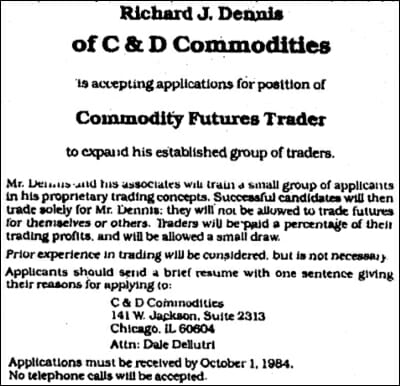
Imagine seeing this want ad buried in the back of Barron's classifieds. Why does an ad a generation ago matter today? It matters more than ever. One individual who answered that ad is a billionaire trend following trader today.

The story of how a group of ragtag students, many with no Wall Street experience, were trained to be millionaire traders can't be ignored. Think of Donald Trump's show The Apprentice, played out in the real world with real money and real hiring and firing. However, these apprentices were thrown into the fire and challenged to make money almost immediately, with millions at stake. They weren't trying to sell ice cream on the streets of New York City. They were trading stocks, bonds, currencies, oil, and dozens of other markets to make millions.

This story blows the roof off the conventional Wall Street success image so carefully crafted in popular culture: prestige, connections, and no place at the table for the little guy to beat the market (and beating the market is no small task). Legendary investor Benjamin Graham always said that analysts and fund managers as a whole could not beat the market because in a significant sense they were the market. On top of that, the academic community has argued for decades about efficient markets, once again implying there is no way to beat market averages.

Yet making big money, beating the market, is doable if you don't follow the herd, if you think outside the box. People do have a chance to win in the market game, but he or she needs the right rules and attitude to play by. And those right rules and attitude collide head-on with basic human nature.

This real-life apprentice story would still be buried had I not randomly picked up the July 1994 issue of Financial World magazine, featuring the article "Wall Street's Top Players." On the cover was famed money manager George Soros playing chess. Soros had made $1.1 billion for the year. The article listed the top one hundred paid players on Wall Street for 1993, where they lived, how much they made, and in general how they made it. Soros was first. Julian Robert- son was second, at $500 million. Bruce Kovner was fifth, at $200 million. Henry Kravis of KKR was eleventh at $56 million. Famed traders Louis Bacon and Monroe Trout were on the list, too.

The rankings (and earnings) provided a crystal-clear landscape of who was making "Master of the Universe" money. Here were, without a doubt, the top players in the "game." Unexpectedly, one of them just happened to be living and working outside Richmond, Virginia, two hours from my home.

Twenty-fifth on the list was R. Jerry Parker, Jr., of Chesapeake Capital and he had just made $35 million. Parker was not yet forty years old. His brief biography described him as a former pupil of Richard Dennis (who?) and noted that he was trained to be a "Turtle" (what?). Parker was described as a then twenty-five-year-old accountant who had attended Dennis's school in 1983 to learn his "trend-tracking system." The article also said he was a disciple of Martin Zweig (who?), who just happened to be thirty-third on the highest-paid list that year. At that moment the name "Dennis" was neither more nor less important than "Zweig," but the implication was that these two men had made Parker extremely rich.

The common wisdom that the only way you could find success was by working in eighty-story steel-and-glass towers in New York, London, Hong Kong, or Dubai was clearly dead wrong. Jerry Parker's office was absolutely in the middle of nowhere, thirty miles outside Richmond in Manakin-Sabot, Virginia. Soon after reading the magazine, I drove down to see his office, noting its lack of pretense, and sat in the parking lot thinking, "You have got to be kidding me. This is where he makes all that money?"

Malcolm Gladwell famously said, "There can be as much value in the blink of an eye as in months of rational analysis." Seeing Parker's country office was an electrical impulse for me, permanently dispelling the importance of location. But I knew nothing else at the time about Jerry Parker other than what was in that 1994 issue of Financial World. Were there more of these students? How did they become students? What were they taught? And who was this man Dennis who had taught Parker and others?

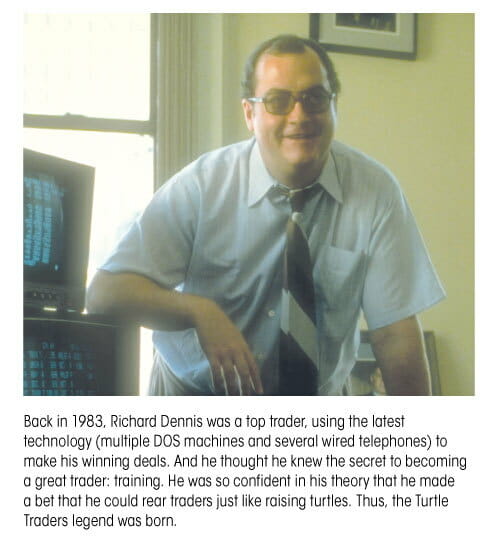
Richard Dennis was an iconoclast, a wildcatting Chicago trader not affiliated with a major investment bank or Fortune 500 firm. As the "locals" were fond of saying on Chicago trading floors, Dennis "bet his left nut." He mastered that uncanny knack by his early twenties. Unlike the general public wedded to their "feelings" to make decisions Dennis used mathematical tools to calculate risk and used it to his advantage. What he learned and what he taught students never resembled Jim Cramer barking stock tips. More important, Dennis proved that his ability to make money in the markets was not luck. His stu- dents, mostly novices, made millions for him and themselves.

In 1983, by the time he was thirty-seven, he'd made hundreds of millions of dollars out of an initial grubstake of a few hundred. Dennis had done it on his own terms in less than fifteen years, with no formal training or guidance from anyone. He took calculated risks leveraging up huge amounts of money. If he liked a trade, he took all of it he could get. He lived the markets as a "betting" business.

Dennis figured out how to profit in the real world from an under- standing of behavioral finance decades before Nobel prizes were handed out to professors preaching theory. His competitors could never get a handle on his consistent ability to exploit irrational market behavior throughout all types of markets. His understanding of probabilities and payoffs was freakish.

Dennis simply marched to a different drum. He eschewed publicity about his net worth even though the press speculated about it extensively. "I find that kind of gauche," said Dennis. Perhaps he was reticent to focus on his wealth because what he really wanted to prove was that his earning skills were nothing special. He felt anyone could learn how to trade if taught properly.

His partner, William Eckhardt, disagreed, and their debate resulted in an experiment with a group of would-be apprentice traders recruited during 1983 and 1984 for two trading "classes." That "Turtle" name? It was simply the nickname Dennis used for his students. He had been on a trip to Singapore and visited a turtle-breeding farm. A huge vat of squirming turtles inspired him to say, "We are going to grow traders just like they grow turtles in Singapore."

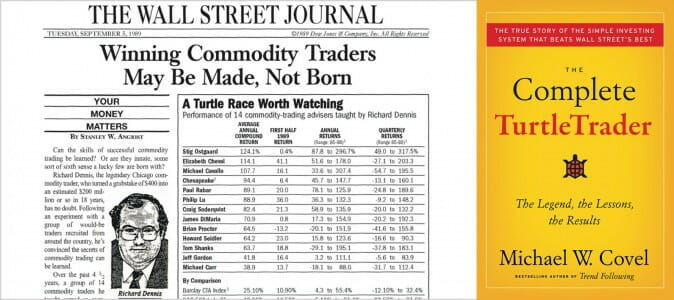
After Dennis and Eckhardt taught novices like Jerry Parker how to make millions and the "school" closed, the experiment morphed into word-of-mouth legend over the years supported by few hard facts. The National Enquirer version of the story was captured in 1989 by a Wall Street Journal headline, "Can the skills of successful trading be learned? Or are they innate, some sort of sixth sense a lucky few are born with?"

Since the 1980s are long past, many might wonder if the Turtles' story still has relevance. It has more relevance than ever. The philosophy and rules Dennis taught his students, for example, are similar to the trading strategy employed by numerous billion-dollar-plus hedge funds. True, the typical stock-tip chaser glued daily to CNBC has not heard this story, but the players on Wall Street, the ones who make the real money, know.

The inside story has not been told to a wider audience until now because Richard Dennis is not a household name today, and because so much has happened on Wall Street since 1983. After the experiment ended, the characters, both teachers and Turtles, went their separate ways and an important human experiment fell through the cracks, even though what took place is as significant today as then.

What was the real story, and how did the Turtles learn their craft? What trading rules were they taught, and how can an average trader or investor use those insights today in his portfolio? What happened to them after the experiment, in the ensuing years? Finding the answers to those questions, with and without Dennis and his students' cooperation, has kept me passionately curious.

Note: Michael Covel's The Complete TurtleTrader is available on Amazon.

Training: New Turtles

What questions were used to select the original Turtle students? Read the true-false questions. However, as you consider the Turtle story keep in mind that Turtle 'hype' over the years has grown. Dennis and the Turtles were always trend followers, not gut traders. No matter how secretive some have acted, they were just great trend followers. Interestingly, while some Turtles are still great successes, some are failures (and some of the failures pretend to be successes). If you want to know the real story, so you can potentially make Turtle sized profits, you can learn.

The Complete TurtleTrader

What Are People Saying?

"Most beat-the-market books aren't worth my shelf space. This one is."
Bloomberg
James Pressley

"If you want to beat the market, you have to do something different from what everyone else is doing, and you have to be right. In this fascinating and instructive book, Michael Covel tells how a group of novice traders used a system that generated trades that were both different and right, and which made them a lot of money. If you want to understand the real world of trading, read this book."
Bill Miller
Chairman and Chief Investment Officer
Legg Mason Capital Management

"Because Covel so clearly lays out these ingredients of success, his book is relevant not just to trend traders, but to anyone who aspires to greatness in the markets. The message is clear: to win, the odds must be in your favor, and you must have the fortitude to keep playing, remain consistent, and compound your edge. That's a formula for success in any field of endeavor, which may be why the Turtle story finds universal appeal."
Brett Steenbarger

"I did enjoy the book...I hope it's doing well for you."
Tom Shanks
Original Turtle

"The book was wonderful..."
Michael Shannon
Original Turtle

"Liked it. Congratulations on a job well done."
Jeff Gordon
Original Turtle

"Book is very good...thank you for going for the truth and objectivity."
Lucy Wyatt
Original Turtle

"All in all, not bad. I wish it had never been done and I wish I were not in it, but I know that you were definitely going to do it, so I figured I would try to get the truth out as much as possible. By and large, it worked that way."
Jim DiMaria
Original Turtle

"I can say that after hearing the turtle story many times from many of the people that are part of the story and after reading many articles about such story, this is by far the most entertaining, inspiring, extensive, and honest story of the turtles I have ever read."
Francisco Vaca
Second Generation Turtle
Associate with original Turtle Paul Rabar

The Complete TurtleTrader Afterword--Read It Now.


More:

Proven Automated Trading Systems for Up & Down Markets. Solutions for Stocks, Futures, Currencies, ETFs, LEAPs & Commodities